
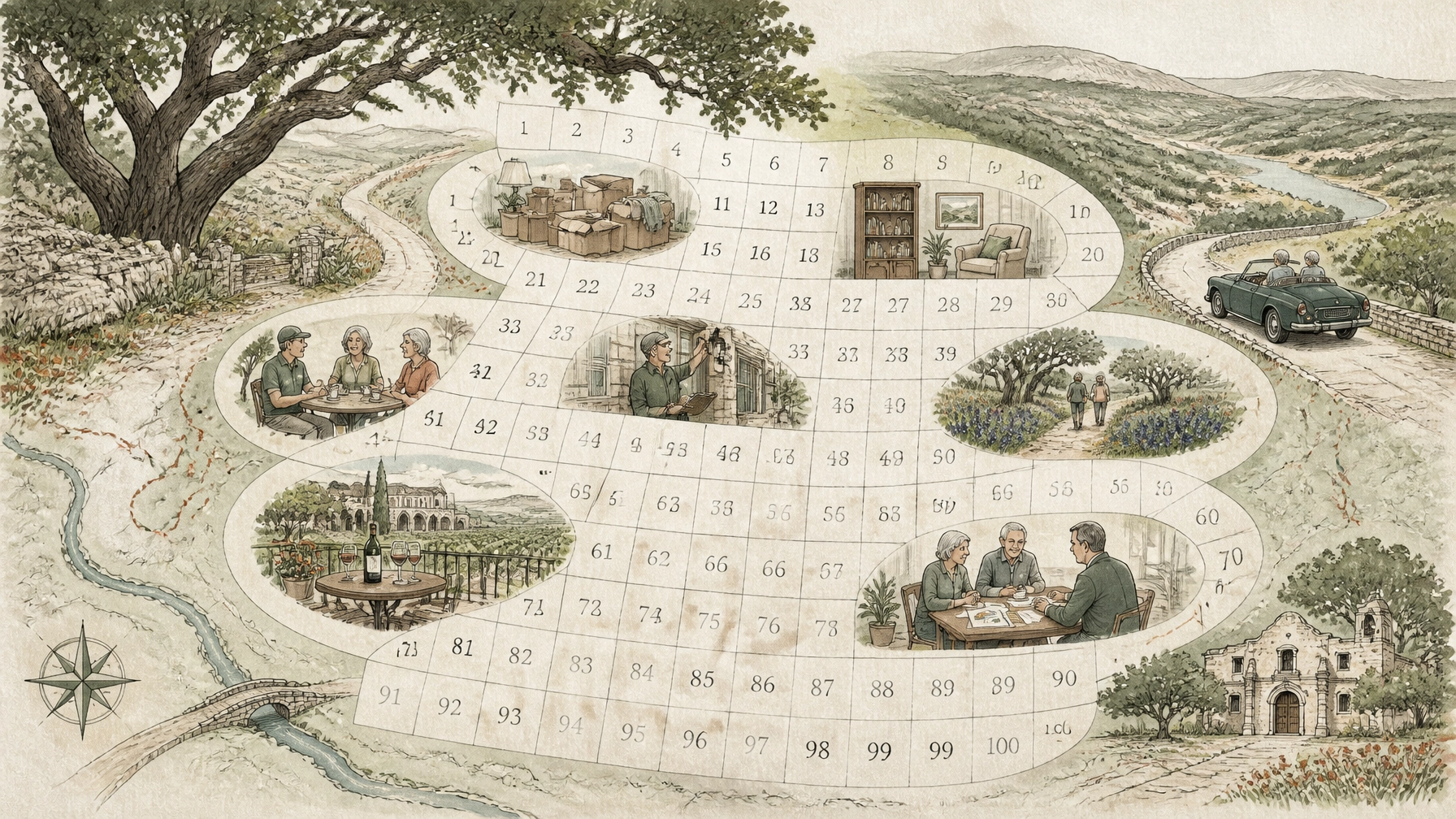
Moving to the Texas Hill Country is not finished when the boxes are empty. The real transition begins when you start learning how your new home, routes, relationships, services, and routines fit together.
For affluent retirees, the first 100 days are an opportunity to turn a beautiful relocation into a comfortable, sustainable lifestyle. Instead of trying to master everything at once, use the period as a gradual orientation: stabilize the essentials, learn the geography, meet the people who make the community work, and then review how the move has affected your broader financial picture.
This is not another residency checklist or downsizing plan. It is a practical rhythm for settling into daily life.
Days 1–10: Make the House Feel Operational
The first phase is about more than unpacking. It is about making the home function reliably.
Start with the systems you depend on every day:
- Electricity and water
- Internet and mobile service
- Trash and recycling
- Propane or natural gas, if applicable
- Security systems and smart-home controls
- Irrigation, pool, gate, and landscaping services
- Mail delivery and package access
If you are moving into a ranch-style property or a larger luxury home, create a simple household reference file. Include utility contacts, shutoff locations, appliance information, gate codes, service agreements, warranties, and emergency contacts. A digital copy is useful, but keep a printed version in a known location for guests or household help.
This is also the time to notice how the home behaves. Which rooms become warm in the afternoon? Where does runoff collect after rain? Is the driveway comfortable at night? Do you have enough exterior lighting? These observations are more valuable after living in the home for several days than they were during a showing.
If your property includes acreage, wells, septic systems, extensive landscaping, or private roads, ask the previous owner, property manager, or local service providers about maintenance patterns. The goal is not to fix everything immediately. It is to understand the cadence of your new property.

Put Important Deadlines on the Calendar
Some post-move administrative deadlines are easy to overlook while you are focused on furniture and contractors. The Texas Department of Motor Vehicles says new residents generally have 30 days to register a vehicle in Texas. The Texas Department of Public Safety provides guidance for obtaining a Texas driver license within 90 days.
Treat those dates as calendar reminders rather than last-minute errands. Gather the documents you may need, schedule appointments early, and allow time for county-office availability.
Days 11–30: Learn Your Routes Before You Need Them
The Hill Country is scenic, but its roads are part of the lifestyle equation. A restaurant, physician, golf club, airport, or family gathering may be close in miles but feel very different depending on the road, time of day, weather, and destination.
During this phase, drive your most important routes several times:
- Your primary grocery store and pharmacy
- Your doctor, dentist, and preferred urgent-care location
- The nearest hospital or emergency department
- Your bank, post office, and regular shopping areas
- Your preferred church, club, gym, or community center
- The route visiting family will use to reach your home
- Your most frequent Austin or San Antonio connection, if applicable
Try these routes in the morning, mid-afternoon, and after sunset. You will begin to notice which roads are comfortable, where traffic builds, how long errands really take, and whether a particular route is difficult to navigate at night.
A route notebook: digital or handwritten: can be surprisingly useful. Note alternate roads, construction zones, fuel stops, scenic overlooks, and places where you would prefer not to drive after dark.
Weather deserves special attention. The Texas Department of Transportation warns drivers not to enter flooded roads or low-water crossings. Its familiar advice is simple: “Turn Around, Don’t Drown.” Add local emergency alerts and DriveTexas to your phone so you can check road conditions before leaving.
You are not trying to become a local expert in 20 days. You are building confidence and options.

Days 31–50: Begin Building Local Relationships
A satisfying retirement is shaped by repeated contact, not just beautiful surroundings. During the first month, begin identifying the people and places that will become part of your normal week.
Start close to home. Introduce yourself to neighbors, property managers, homeowners’ association representatives, nearby ranch owners, or community staff. Ask practical questions:
- Which service providers do residents trust?
- What happens when severe weather affects the area?
- Where do people go for casual dinners?
- Which local events are worth attending?
- What should a new resident know about the roads or neighborhood?
You do not have to join every club or accept every invitation. Look for natural points of connection: a morning coffee, a walking group, a wine-tasting event, a lecture, a gallery opening, a golf event, or a community volunteer opportunity.
The Hill Country’s social life often reveals itself through repetition. The same faces appear at the farmers market, the bakery, the trailhead, the club, or the small-town festival. Becoming familiar with those rhythms can make the area feel like home faster than a formal orientation ever could.
Give yourself permission to be selective. Affluent retirement is not about filling every blank space on the calendar. It is about finding a few relationships and activities that genuinely improve the quality of your days.
Days 51–70: Organize the People Who Maintain Your Lifestyle
By the middle of the 100 days, you should have a clearer sense of what your home requires. Now organize the service relationships that will keep it running.
Depending on your property and preferences, this may include:
- Landscaping and native-plant maintenance
- Pool care
- HVAC servicing
- Plumbing and electrical support
- Pest and wildlife management
- Housekeeping
- Technology and home-automation assistance
- Gate, generator, irrigation, or well maintenance
- Transportation or household support
Rather than collecting a long list of names, build a short, dependable network. Confirm who responds to routine requests, who handles urgent issues, and whether providers serve your area consistently.
For a larger property, ask whether service providers offer seasonal inspections. A proactive visit before the hottest part of summer or before severe-weather season may reveal small issues before they become expensive disruptions.
Keep invoices and service agreements in one location. This makes household management easier and gives you a clearer picture of recurring costs. It also helps distinguish between occasional improvements and ongoing lifestyle expenses.

Days 71–85: Discover the Routine You Actually Want
The first several weeks often include too many errands, appointments, visitors, and decisions. By days 71 through 85, begin asking a more important question: What does an ordinary, enjoyable week look like here?
Create a sample week that includes:
- One or two outdoor activities
- Time for exercise or wellness
- A regular social connection
- A cultural or food-related outing
- Quiet time at home
- A practical errand day
- Flexibility for travel and family visits
Test the routine rather than imagining it. Walk the trail in the morning. Visit the winery on a weekday. Try the restaurant when it is busy. Attend a community event without knowing anyone. Spend a full afternoon at home and notice whether the property feels peaceful or demanding.
This is also a good time to consider the balance between privacy and connection. A secluded ranch may offer extraordinary calm but require more planning for errands and services. A golf or lifestyle community may simplify maintenance and create more social opportunities but offer less solitude. Neither is automatically better. Your first 100 days can help you determine whether your setting supports the pace you want.
If healthcare access is part of your relocation decision, revisit the routes and providers you identified earlier. Our guide to Hill Country healthcare access can provide additional context, but your own travel time and provider experience should guide your personal decisions.
Days 86–100: Review the Financial Transition
The final phase is not about making hurried investment decisions. It is about understanding how the move has changed your financial landscape.
Begin with a simple comparison between your expectations and your first three months of real spending. Review:
- Housing and property-related expenses
- Utilities and household services
- Travel time and fuel
- Dining, memberships, and recreation
- Healthcare-related costs
- Home improvements and furnishings
- Gifts, entertaining, and family visits
- One-time moving expenses versus ongoing costs
Separate permanent lifestyle changes from temporary relocation expenses. New furniture, contractors, and technology upgrades may make the first 100 days unusually expensive. At the same time, new recurring costs: such as acreage maintenance, club dues, concierge services, or frequent travel to a major city: may become part of your long-term plan.
Update your financial institutions, insurance providers, retirement accounts, and other important records with your new address. Keep a consolidated record of the home purchase, major improvements, insurance policies, and household obligations. For general educational questions related to state-specific residency, filing, or tax matters, consult a qualified tax professional and legal professional for individualized guidance. Texas Hill Country Retirement is a lifestyle resource, not a tax or legal advisory firm.
For investment management and retirement income planning, Mau Sanchez Capital focuses on client-specific portfolio design using transparent, liquid, publicly traded markets, including stocks and traditional fixed income. A general post-move review can help you assess whether your cash-flow plan, asset allocation, liquidity needs, and housing commitments still align with your broader goals.
The Mid-Year Retirement Checkup offers a useful framework for reviewing spending, liquidity, and portfolio alignment. The difference here is that your first 100-day review should focus specifically on what the relocation taught you.

Your 100-Day Finish Line
By day 100, you do not need to know every road, restaurant, neighbor, or service provider. You should, however, have a clearer answer to these questions:
- Does my home support the way I want to live?
- Which routes feel easy, and which require more planning?
- Who can I call when the house or property needs attention?
- Where do I feel naturally connected?
- What routines give my week structure?
- Which relocation costs were temporary, and which are now recurring?
- Does my financial plan reflect the life I am actually living?
A successful move is not measured by how quickly you complete a checklist. It is measured by how steadily your new life begins to feel familiar.
The Texas Hill Country offers room to slow down, explore, entertain, and create a more intentional retirement. Give yourself 100 days to learn its patterns: and to let the place reveal which version of retirement fits you best.
Schedule a private meeting with a fiduciary financial advisor today by calling (512) 593-8380 or by visiting: https://calendly.com/portafoliocapital/15min
Portafolio Capital Management dba Mau Sanchez Capital is a Registered Investment Adviser. This content is for informational purposes only and does not constitute investment advice or a solicitation to buy or sell any security. Advisory services are provided only pursuant to a written advisory agreement.
This article may include stories, scenarios, and perspectives created or assisted by artificial intelligence. Although the individuals and circumstances described may be fictional, the topics are intended to reflect real financial, personal, and lifestyle issues that retirees and individuals commonly face.
The content is provided to encourage readers to consider different perspectives that may affect their retirement, regardless of whether they are currently planning, approaching retirement, or already retired. It is intended for general educational and informational purposes only and should not be interpreted as personalized investment, financial, tax, legal, medical, or retirement-planning advice.
Individual circumstances vary. Readers should independently verify any information presented and consult appropriately qualified professionals before making financial or personal decisions. No advisory, professional, or client relationship is created through the use of this website.
Leave a Reply