
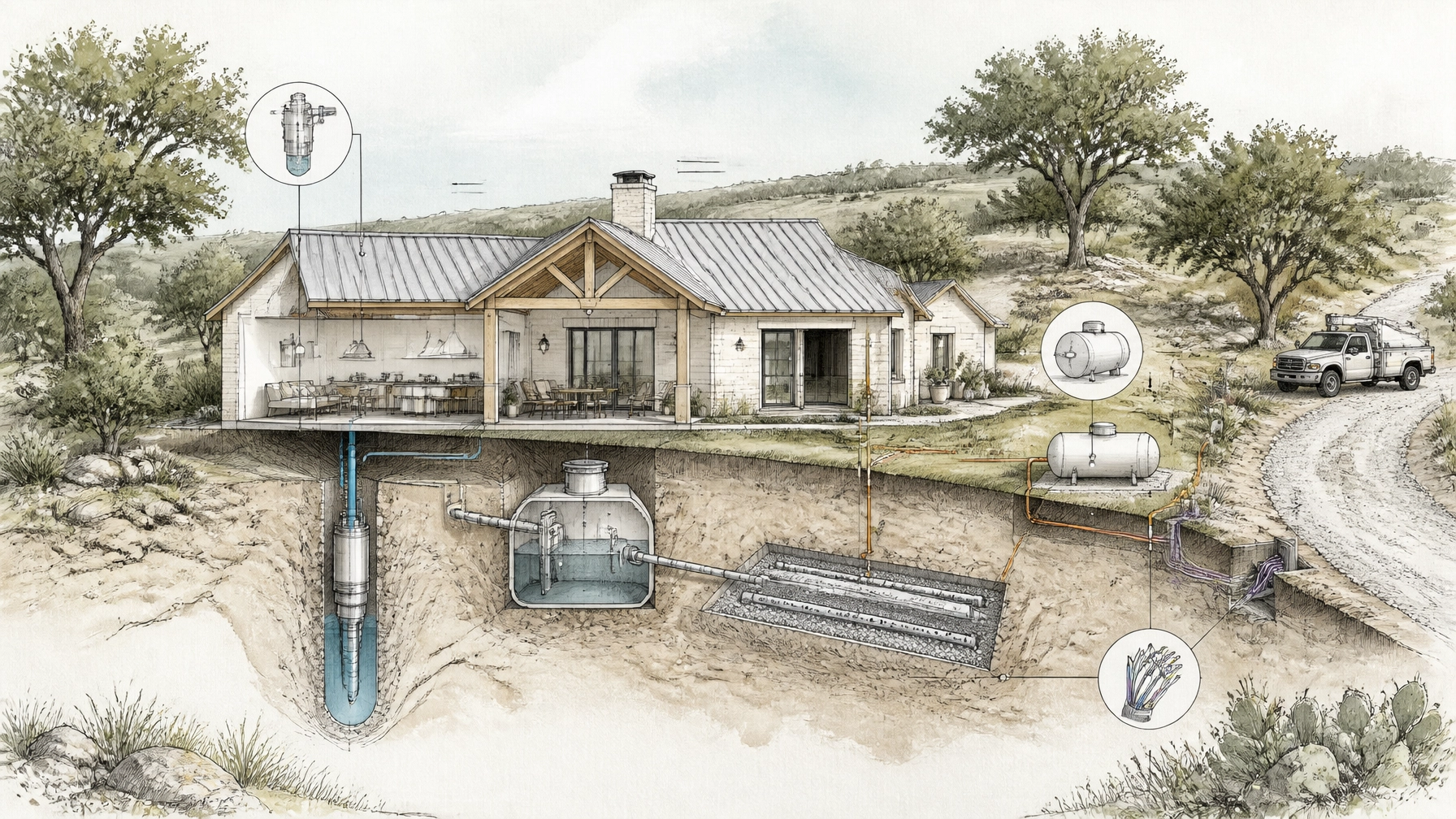
The appeal of a rural or semi-rural Hill Country home is easy to understand: more privacy, expansive views, space for guests, and the freedom to shape your days around nature rather than traffic.
But country living also means becoming the operator of a small private infrastructure system.
Instead of relying entirely on municipal utilities and city services, your home may depend on a private well, septic system, propane tank, rural internet connection, and shared or privately maintained roads. None of these automatically disqualifies a property. In fact, well-managed systems can support a comfortable and highly enjoyable retirement.
The key is knowing what you are buying, and what it will require after closing.
Start with the utility map, not the view
A beautiful homesite can distract buyers from the practical details that make daily life work. Before becoming attached to a particular property, ask for a complete utility map showing:
- The water source and well location
- The septic tank, treatment equipment, and drainfield
- Propane tank and buried gas lines
- Electric service and backup power equipment
- Internet connection point or antenna
- Driveway, gates, culverts, and access easements
- Areas reserved for future repairs or replacements
Request this information before inspections are complete, not after. A well or septic system that functions today may still be poorly documented, difficult to access, or inadequate for future improvements.
A current survey and title commitment are especially important for rural property. They can help identify easements, shared driveways, utility corridors, access rights, and restrictions affecting improvements.
For a broader relocation checklist, see the Ultimate Residency Checklist for Becoming a Legal Texan.
Private wells: confirm both quality and capacity
A private well is more than a faucet connected to the ground. It is a system involving the well casing, pump, pressure tank, electrical controls, water treatment equipment, storage capacity, and the aquifer below the property.
The Texas Groundwater Protection Committee explains:
“Private wells do not serve public water supply systems and are largely unregulated.”
That means responsibility for testing and maintaining a domestic well generally rests with the homeowner. The committee’s private well resources point homeowners toward testing, maintenance, and disinfection guidance.
During due diligence, request:
- The original drilling report or well log
- Well depth and static water level
- Pump age, horsepower, and replacement history
- Recent flow or yield testing
- Water-quality reports
- Records of pump, pressure tank, or filtration repairs
- Information about shared-well agreements, if applicable
Do not rely only on the seller’s statement that “the well has never been a problem.” A professional well inspection can evaluate visible components, pressure behavior, storage, and evidence of deferred maintenance. A qualified technician may also recommend a pump test to assess whether the system can support the household’s intended use.
Water quality should be tested through an appropriate laboratory. At a minimum, buyers commonly ask about bacteria and nitrates, with additional testing based on local geology, nearby land uses, and the home’s treatment equipment. The Texas Groundwater Protection Committee’s testing resources link to TCEQ sampling guidance and accredited laboratory information.
Also identify the groundwater conservation district with jurisdiction over the property. Rules regarding well registration, drilling, spacing, and pumping can vary by location. The fact that a neighboring property has a well does not guarantee that a new well can be drilled on a different tract. For questions about how property-related rules, costs, or deductions may apply to your own tax situation, consult a qualified tax professional.

Septic systems: learn how the household’s wastewater is managed
A septic system is a private wastewater treatment facility. It may include a tank, pumps, electrical controls, aeration equipment, spray heads, drip lines, or a conventional drainfield.
Texas calls these systems On-Site Sewage Facilities, or OSSFs. The Texas Commission on Environmental Quality’s homeowner guidance explains permitting, professional licensing, maintenance, and system selection.
Ask for:
- The original septic permit
- Installation date
- System type and design capacity
- Tank size
- Site evaluation or soil information
- A diagram showing the tank and drainfield
- Pumping and inspection records
- Maintenance contracts for aerobic or advanced systems
- Any notices, repairs, complaints, or compliance issues
A professional septic inspection should be part of the purchase process, particularly when records are missing or the home is older. The inspection may include locating the tank, evaluating sludge levels, checking pumps and alarms, examining distribution equipment, and reviewing the drainfield for signs of saturation or failure.
Think beyond the current bedroom count. If you plan to add a guest suite, casita, workshop apartment, or frequent family gatherings, ask whether the existing system is designed for that level of use. An attractive property may not have enough approved capacity for the lifestyle you envision.
Maintenance also varies by system. Conventional systems generally require periodic inspection and pumping based on household use and tank conditions. Aerobic systems may require a recurring service contract and more frequent inspections. The TCEQ maintenance resources can help you understand the obligations associated with different systems.
Protect the drainfield after moving in. Avoid driving, parking, building, or planting deep-rooted trees over it. Repair plumbing leaks promptly, use water thoughtfully, and avoid flushing materials that do not belong in a septic system.
Propane: clarify ownership, access, and emergency service
Propane is common in rural Hill Country homes, particularly where natural gas service is unavailable. It may fuel ranges, fireplaces, water heaters, pool equipment, standby generators, or the entire heating system.
The first question is simple but important: Who owns the tank?
A tank may be:
- Owned by the homeowner
- Leased from a propane supplier
- Located under a service agreement
- Shared under a community arrangement
Ownership affects who may fill the tank, who handles inspections, and what happens when the property is sold. Request the complete service agreement and confirm whether it transfers to a buyer.
The Railroad Commission of Texas regulates the safe storage, transportation, and use of LP-gas in Texas. Ask a qualified professional to inspect the tank, regulators, lines, appliance connections, and any underground installation.
Your supplier agreement should clearly explain:
- Delivery method: automatic or will-call
- Minimum delivery amount
- Pricing structure and fees
- Tank rental charges
- Emergency response availability
- Responsibility for regulators and repairs
- Road and gate access requirements
- Transfer, cancellation, or early termination charges
For a retirement household, convenience matters. A keep-full arrangement or tank monitor may be worth considering if the home depends on propane for heating, cooking, or backup power. Make sure delivery trucks can safely reach the tank without damaging landscaping, gates, or private roads.
Internet: test the address, not the marketing claim
Internet service can be a lifestyle issue, not merely a technical one. Many retirees want reliable access for telehealth, family video calls, streaming, travel planning, smart-home devices, and managing household affairs.
Do not assume that a provider serving the nearby town serves the property. Check the exact address through the FCC National Broadband Map, then contact each provider directly.
Ask:
- Is service available at this exact homesite?
- What technology is used: fiber, cable, fixed wireless, cellular, or satellite?
- What speeds are realistic during peak hours?
- Are there data caps or installation charges?
- Does fixed wireless require line-of-sight?
- How long is the installation wait?
- What happens during power outages?
If the home is already occupied, run speed tests at different times of day. Speak with nearby residents about outages, reliability, and customer support. A provider’s advertised “coverage” is not the same as an installed connection that performs well at your address.
If dependable connectivity is essential, consider making it part of your purchase decision and documenting what the provider confirms in writing.

Roads and service access: legal access is only the beginning
A property can have legal access and still be inconvenient to maintain.
Determine whether the road is:
- County-maintained
- Maintained by a property owners association
- Managed by a road association
- Shared informally by neighboring owners
- Covered by a recorded private easement
Review the title commitment, survey, recorded easements, road agreements, and applicable restrictions. Ask who pays for grading, gravel, drainage improvements, culvert replacement, tree removal, and storm-related repairs.
Also consider practical access. Can a propane truck, septic pumper, well technician, internet installer, ambulance, or moving truck reach the home? Are there locked gates, steep grades, narrow bridges, or low-water crossings?
A written road maintenance agreement is preferable to a handshake arrangement. It should explain cost-sharing, repair decisions, access rights, and the process for handling disagreements. For complex easements, a Texas real estate attorney can help interpret the documents.

Build a household operations file
Once you close, create a practical home operations file, digital, printed, or both. Include:
- Well reports and water tests
- Septic permits, diagrams, and service records
- Propane contracts and emergency numbers
- Internet provider details
- Electric service information
- Generator and HVAC records
- Gate codes and road contacts
- Preferred plumbers, electricians, pump technicians, and landscapers
- Annual inspection and maintenance dates
A rural home is easier to enjoy when its systems are visible, documented, and scheduled. Consider a seasonal review each spring and fall, including water testing, septic maintenance, HVAC servicing, tree and roof checks, generator testing, and road-access planning.

The goal is confidence, not complexity
Rural Hill Country living can offer the privacy, beauty, and slower rhythm many retirees want. The experience is most rewarding when the property’s practical systems match your preferences for convenience, travel, entertaining, and long-term upkeep.
Before making an offer, treat wells, septic, propane, internet, roads, and service contracts as part of the home: not as afterthoughts. Ask for records, use qualified professionals, confirm responsibilities in writing, and budget for ongoing care.
Texas Hill Country Retirement is a lifestyle and relocation resource for people exploring the region. For personalized retirement income planning and investment management guidance, learn more about Portafolio Capital Management dba Mau Sanchez Capital.
Schedule a private meeting with a fiduciary financial advisor today by calling (512) 593-8380 or by visiting: https://calendly.com/portafoliocapital/15min
Portafolio Capital Management dba Mau Sanchez Capital is a Registered Investment Adviser. This content is for informational purposes only and does not constitute investment advice or a solicitation to buy or sell any security. Advisory services are provided only pursuant to a written advisory agreement.
This article may include stories, scenarios, and perspectives created or assisted by artificial intelligence. Although the individuals and circumstances described may be fictional, the topics are intended to reflect real financial, personal, and lifestyle issues that retirees and individuals commonly face.
The content is provided to encourage readers to consider different perspectives that may affect their retirement, regardless of whether they are currently planning, approaching retirement, or already retired. It is intended for general educational and informational purposes only and should not be interpreted as personalized investment, financial, tax, legal, medical, or retirement-planning advice.
Individual circumstances vary. Readers should independently verify any information presented and consult appropriately qualified professionals before making financial or personal decisions. No advisory, professional, or client relationship is created through the use of this website.
Leave a Reply