
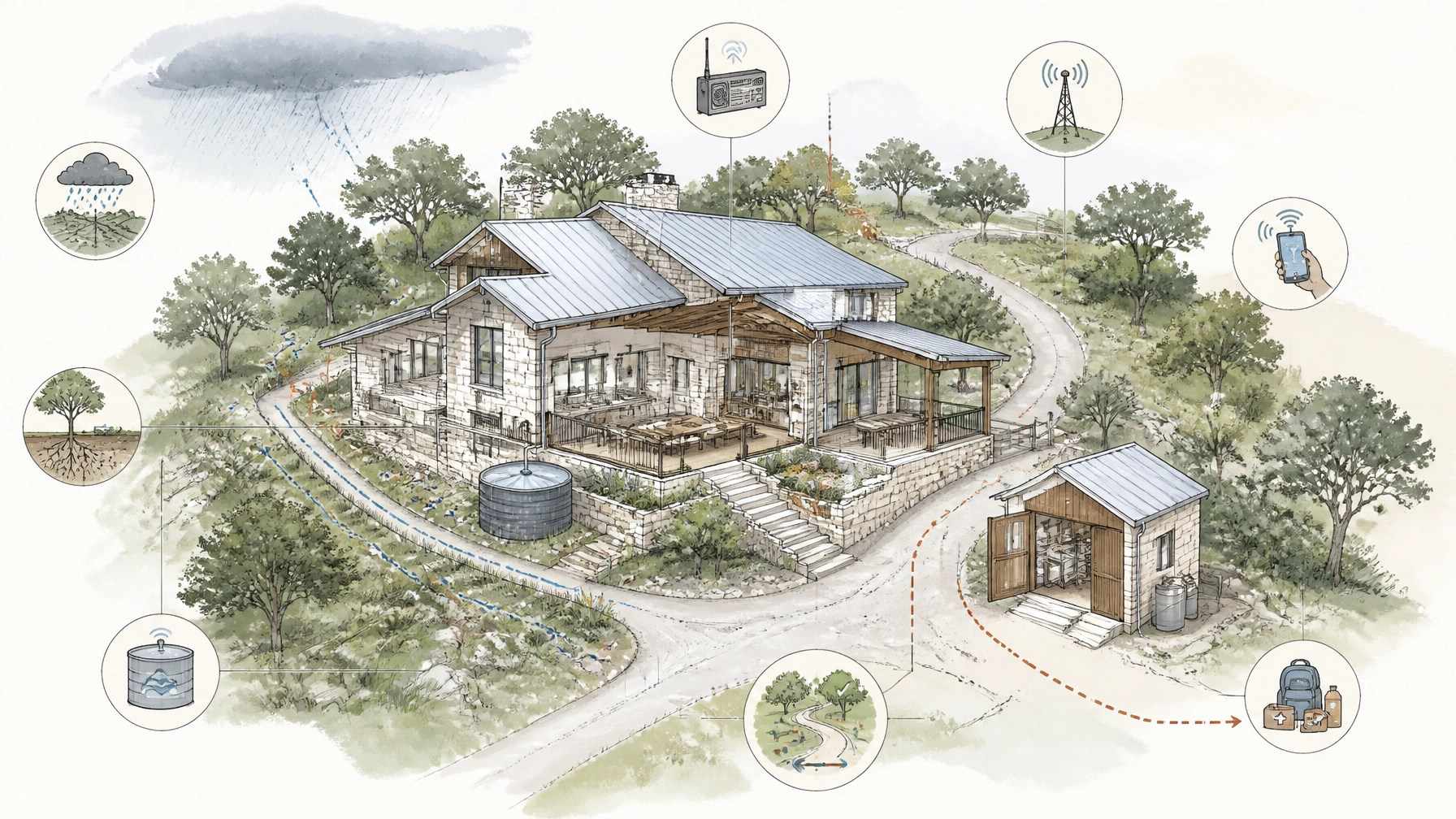
A luxury retreat in the Texas Hill Country is designed for comfort: limestone terraces, expansive windows, shaded patios, wine storage, guest accommodations, and peaceful views across the hills.
But comfort also depends on what happens when the weather turns.
Severe thunderstorms, hail, flash flooding, high winds, extreme heat, and extended power outages can affect even beautiful, well-built properties. For retirees and pre-retirees, resilience is not about creating a bunker or eliminating every risk. It is about making thoughtful decisions so your home remains safer, more functional, and easier to manage when ordinary services are temporarily disrupted.
The right approach is a layered one. Consider the land, the structure, the utilities, the driveway, communications, household supplies, and the plan your family will follow if conditions change quickly.
Start With the Property’s Actual Risk Profile
Before choosing equipment or upgrades, understand the property’s setting.
The Texas Hill Country is known for sudden rainfall and flash-flood risk. A home can sit outside a mapped high-risk flood zone and still experience runoff from nearby slopes, overwhelmed drainage routes, or a creek that rises rapidly after intense storms.
The FEMA Flood Map Service Center is a useful starting point for reviewing official flood hazard information. However, FEMA also explains that maps are not predictions of every possible flood. A local civil engineer, builder, or drainage professional can help you evaluate conditions the map may not show, including slope, culverts, swales, low-water crossings, and the flow of water across your specific site.
Ask practical questions:
- Is the home positioned above natural drainage paths?
- Where does water go during a heavy downpour?
- Could a culvert or bridge become impassable?
- Are mechanical systems located above likely water levels?
- Can emergency vehicles reach the home if a road is blocked?
- Does the property rely on a well, septic system, private road, or gate?
A property resilience review should be part of the relocation conversation, just like evaluating nearby healthcare, recreation, and community amenities. Our Hill Country healthcare access guide explores another important part of preparing for life in the region.
Strengthen the Home’s Protective Shell
The roof, windows, doors, and garage are the home’s first line of defense against wind and hail.
During a renovation or new build, ask qualified professionals about materials and assemblies designed for the local environment. Depending on the home’s design and location, considerations may include:
- Impact-resistant roofing products
- Properly secured roof edges and flashing
- Reinforced garage doors
- Strong exterior doors with quality hardware
- Laminated or impact-rated window systems
- Durable exterior materials such as stone or fiber cement
- Covered outdoor areas designed to handle wind-driven rain
Large windows are one of the pleasures of Hill Country living, but they also deserve careful attention. Ask how they perform against windborne debris, how replacement glass would be sourced, and whether exterior shading can reduce heat gain during a power outage.
The goal is not to make every decision based on worst-case scenarios. It is to identify the components that would be most difficult, expensive, or disruptive to replace after a storm.

Design Backup Power Around Critical Loads
A generator is only one part of a backup-power plan. The more important question is: What must continue working?
For one household, the priority may be a well pump, refrigerator, freezer, medical equipment, security system, and internet equipment. Another household may also want to support climate control for a bedroom, an elevator, a wine cellar, or a gate and security system.
Create a short list of critical loads before speaking with an electrician or generator professional. This helps avoid paying for capacity you may not need while ensuring the essentials are covered.
Possible solutions include:
- A permanently installed standby generator
- A portable generator used according to manufacturer instructions
- Battery storage for quiet, short-term backup
- Solar panels paired with battery storage
- Dedicated circuits for essential systems
- Manual or automatic transfer equipment
Generator safety is non-negotiable. The Consumer Product Safety Commission warns that portable generators should be operated outdoors and away from doors, windows, and vents because of carbon monoxide. Never run one inside a home, garage, or enclosed porch. A qualified electrician should install any transfer equipment, and generators should never be connected by “backfeeding” a household outlet.
Test the system before storm season. Confirm that it starts, that critical circuits operate, that fuel or battery capacity is adequate, and that everyone in the household knows what to do.
Plan for Water When the Grid Is Down
Water resilience deserves special attention in the Hill Country, particularly for properties using private wells.
A well may have water underground, but the pump still needs electricity. Ask whether the well pump can operate from your backup-power system and whether restarting the system requires a technician.
Households should also maintain stored drinking water. Ready.gov recommends including water in an emergency kit, while the CDC provides guidance on creating and storing an emergency water supply. A common baseline is at least one gallon per person per day for drinking, cooking, and basic hygiene, with additional planning for pets, medical needs, hot weather, and longer disruptions.
A cistern or rainwater collection system may supplement household planning, landscape irrigation, or other non-potable uses, depending on local requirements and professional design. Protect tanks, filters, pumps, and connections from floodwater and physical damage.
Also consider sanitation. If a property uses septic, ask a qualified professional how flooding, power loss, or prolonged water interruption could affect the system. Keep household supplies available for basic hygiene if normal plumbing service is temporarily limited.
Make the Driveway and Access Route Part of the Plan
A luxury home is not truly resilient if residents cannot safely reach it: or if emergency responders cannot.
Rural and semi-rural properties may depend on steep drives, narrow roads, private gates, bridges, or low-water crossings. Heavy rain can wash out shoulders, block culverts, or make familiar routes dangerous in a matter of minutes.

Consider:
- Maintaining clear, visible address markers
- Keeping gates accessible during emergencies
- Inspecting culverts and drainage channels
- Establishing an alternate route when possible
- Avoiding dependence on a low-water crossing
- Keeping trees and limbs trimmed away from access routes
- Maintaining a vehicle with adequate fuel during severe weather
- Leaving early if local officials recommend evacuation
Never drive through moving floodwater. The National Weather Service’s flood safety guidance emphasizes the danger of driving or walking into flooded areas, even when the water appears shallow.
Build Redundant Communications
A power outage may also interrupt internet, cell service, television, or local infrastructure. A resilient household should have more than one way to receive information.
The National Weather Service NOAA Weather Radio program broadcasts official watches, warnings, forecasts, and other hazard information around the clock. A battery-powered or hand-crank radio can be especially helpful if internet service is unavailable.
Consider maintaining:
- Wireless emergency alerts on mobile phones
- A NOAA Weather Radio
- Battery banks for phones
- A backup internet or hotspot option
- Two-way radios for household or nearby-property communication
- Printed contact information
- A list of local utility and emergency-management numbers
Ready.gov’s planning guidance recommends identifying how household members will receive alerts, communicate, shelter, evacuate, and reconnect if separated.
Do not rely entirely on a digital plan. Keep important contacts, medication information, property details, and evacuation routes in a waterproof printed folder.
Have the Insurance Conversation Before the Storm
Insurance is an important part of resilience, but coverage varies by policy, property, location, exclusions, deductibles, and endorsements. It is not the same for every household.
Before purchasing or renovating a Hill Country retreat, consider asking a licensed insurance professional:
- How are wind and hail losses handled?
- Is flood damage excluded from the primary policy?
- Are detached structures, gates, landscaping, and retaining walls covered?
- How are generators, solar equipment, batteries, or water systems treated?
- What documentation would be useful after a loss?
- Are there special deductibles or exclusions for certain hazards?
- Does the property’s remote location affect response or rebuilding costs?
Document the property before severe weather arrives. Keep photographs, receipts, serial numbers, improvement records, and an inventory of valuable furnishings in a secure cloud location and an offline backup. Ready.gov offers guidance on documenting and insuring property.
This is a conversation to have with the appropriate licensed professionals. This article provides general educational information only and is not a substitute for legal, insurance, or tax advice. For guidance specific to your situation, consult a qualified tax professional and other appropriate professionals.

Create a Simple Household Drill
Resilience becomes practical when everyone knows the sequence.
Once or twice a year, walk through a realistic scenario:
- A severe storm warning is issued.
- The power goes out.
- Internet service is unavailable.
- The driveway may be affected by flooding.
- A household member needs medication or powered equipment.
- The family must decide whether to shelter or leave.
Check the emergency kit, test flashlights and radios, verify backup-power equipment, inspect stored water, and review evacuation routes. Include pets, guests, caregivers, and anyone who may need assistance.
The Hill Country Alliance maintains a community resilience resource page with regional disaster-preparedness and recovery resources, including Texas A&M AgriLife guidance for preparing a disaster plan and kit.
“Preparation through education is less costly than learning through tragedy.” : Max Mayfield
Resilience Is Part of the Retirement Lifestyle
Storm readiness does not diminish the enjoyment of a luxury Hill Country retreat. It supports it.
A well-considered home can give you greater confidence during storm season, reduce disruption when utilities are interrupted, and make it easier to protect the lifestyle you worked to create. It can also help you evaluate properties more intelligently before making a relocation decision.
At Texas Hill Country Retirement, the focus is on helping retirees and pre-retirees explore the communities, homes, amenities, and lifestyle opportunities that make the region distinctive. For investment management and retirement income planning, Portafolio Capital Management dba Mau Sanchez Capital can help families coordinate their broader financial considerations with the life they want to enjoy.
Schedule a private meeting with a fiduciary financial advisor today by calling (512) 593-8380 or by visiting: https://calendly.com/portafoliocapital/15min
Portafolio Capital Management dba Mau Sanchez Capital is a Registered Investment Adviser. This content is for informational purposes only and does not constitute investment advice or a solicitation to buy or sell any security. Advisory services are provided only pursuant to a written advisory agreement.
This article may include stories, scenarios, and perspectives created or assisted by artificial intelligence. Although the individuals and circumstances described may be fictional, the topics are intended to reflect real financial, personal, and lifestyle issues that retirees and individuals commonly face.
The content is provided to encourage readers to consider different perspectives that may affect their retirement, regardless of whether they are currently planning, approaching retirement, or already retired. It is intended for general educational and informational purposes only and should not be interpreted as personalized investment, financial, tax, legal, medical, or retirement-planning advice.
Individual circumstances vary. Readers should independently verify any information presented and consult appropriately qualified professionals before making financial or personal decisions. No advisory, professional, or client relationship is created through the use of this website.
Leave a Reply