
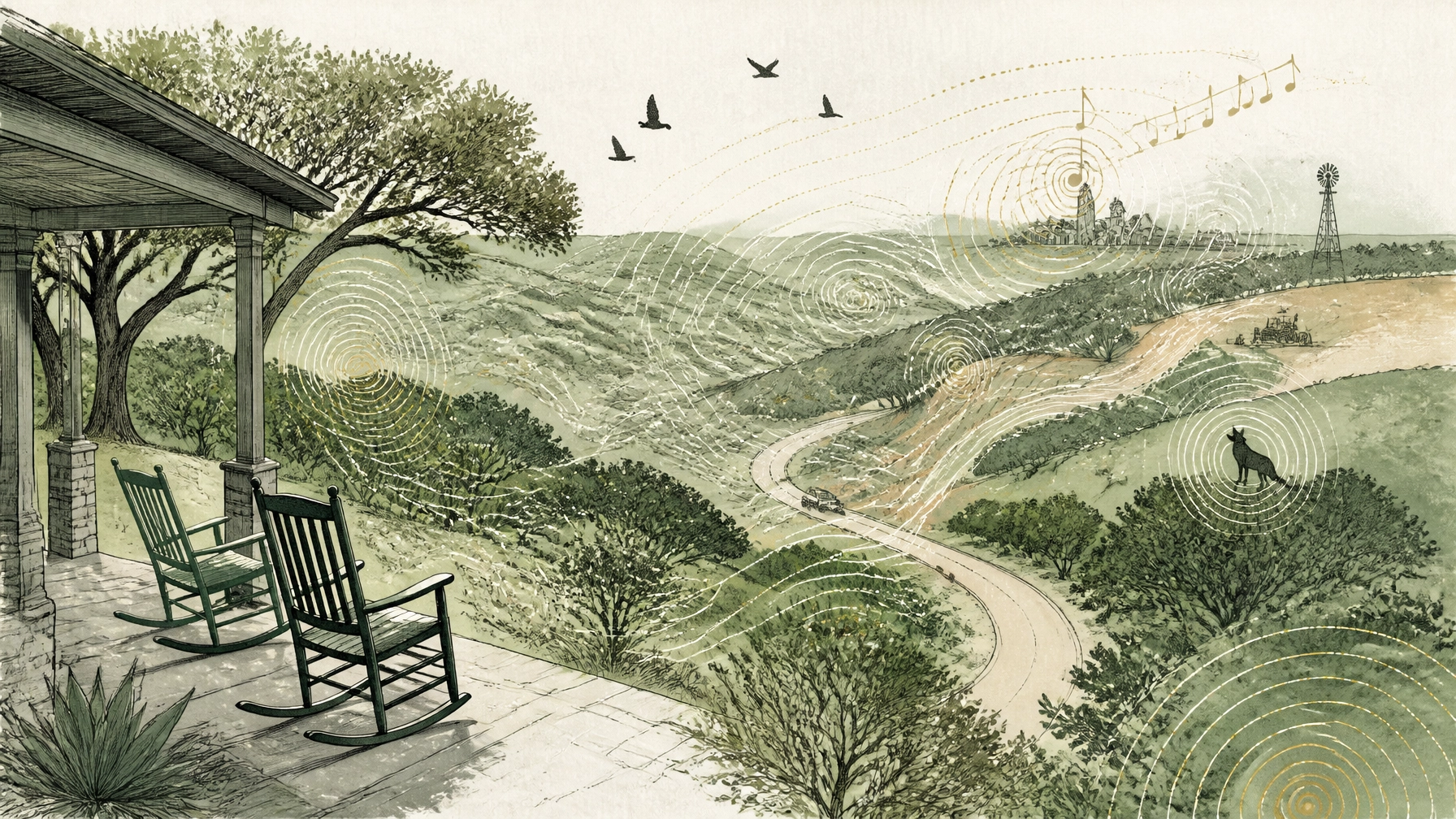
For many affluent retirees, the dream of a Texas Hill Country home includes more than generous square footage, limestone architecture, or a beautiful view. It includes a particular feeling: opening the doors in the morning and hearing birds instead of traffic, enjoying coffee on the porch without constant interruptions, and ending the day beneath a wide, peaceful sky.
But “quiet” does not always mean remote: and remote does not always mean quiet.
A home can sit on several acres and still be affected by road noise, agricultural activity, event traffic, or distant industrial operations. Conversely, a well-sited home near a charming town may offer a peaceful daily rhythm while keeping restaurants, galleries, healthcare, and social opportunities within easy reach.
The goal is not absolute silence. The goal is finding a soundscape that supports the retirement lifestyle you want.
“The right kind of quiet should make your world feel more spacious: not smaller.”
Quiet Has More Than One Meaning
Before touring properties, define what quiet means to you and your household.
For some retirees, quiet means no traffic after sunset. For others, it means being able to hear birds, wind through oak trees, or the occasional call of a coyote. Some people enjoy the sounds of a working ranch: tractors, cattle, gates, and livestock: while others prefer the managed calm of a private community.
You may also want to distinguish between:
- Constant noise: a nearby highway, busy farm-to-market road, or mechanical equipment
- Predictable noise: scheduled landscaping, seasonal harvesting, or regular community events
- Unexpected noise: late-night parties, fireworks, recreational shooting, or construction
- Natural sound: birds, cicadas, frogs, wind, livestock, and wildlife
- Social sound: neighbors visiting, outdoor dining, live music, or a nearby clubhouse
A peaceful retirement does not require eliminating every sound. It requires understanding which sounds will become part of daily life: and whether you will enjoy them.
Start With the Road, Not the Front Door
When touring a home or homesite, buyers often focus on the entrance, kitchen, primary suite, and outdoor living areas. For a sound-sensitive buyer, the first question should be: What roads influence this property?
A winding rural road may seem quiet during a midday showing but become busier during morning commutes, weekends, or local events. Farm-to-market roads can carry more commercial and recreational traffic than expected. A nearby highway may produce a steady background hum, while a quarry or construction route can create intermittent heavy-truck noise.
The Texas Department of Transportation’s traffic count maps can help you understand traffic volumes on state-maintained routes. For current incidents, construction, and closures, review DriveTexas before visiting.
Traffic counts are only one piece of the picture. Ask whether the road is used by:
- Delivery trucks or construction vehicles
- School buses
- Commuters traveling between growing towns
- Motorcycles and recreational vehicles
- Agricultural equipment during planting or harvest
- Visitors heading to popular wineries, rivers, festivals, or venues
A property’s total acreage matters less than the location of the home within that acreage. A smaller tract with a well-screened homesite may feel calmer than a larger property with the house close to the road.

Look Beyond the Property Line
Distance to neighbors is an important part of the soundscape, but it is not the only consideration. A distant neighbor with outdoor speakers may be more noticeable than a nearby neighbor who rarely spends time outdoors.
During a property visit, identify the location of:
- Neighboring homes and guest houses
- Swimming pools and outdoor kitchens
- Barns, workshops, and equipment sheds
- Dog runs, livestock areas, and poultry enclosures
- Shared roads and community amenities
- Potential future building sites
If the property is inside a luxury retirement community, ask how homes are oriented and how outdoor spaces are screened. A community may provide excellent amenities and social connection, but the location of a home relative to the clubhouse, pool, pickleball courts, golf cart paths, or event lawn can significantly shape the daily experience.
If the property is rural, review county parcel maps and ask what surrounds the tract. Large ranches, conserved land, and established open space may offer more stability than a landscape divided into many small parcels. The Hill Country Alliance land stewardship resources offer helpful regional context on conservation, development, and land-use pressures.
This is not about predicting the future with certainty. It is about recognizing whether the surrounding landscape is likely to remain compatible with the lifestyle you are choosing.
Respect the Sounds of Working Land
The Texas Hill Country is not a silent resort. It is a living region with farms, ranches, wildlife, businesses, and communities.
Agricultural activity may include early-morning tractors, hay equipment, livestock, chainsaws, generators, or seasonal work. A ranch property may bring the pleasure of watching cattle across the meadow: but also the occasional sound of gates, vehicles, or farm machinery.
Ask nearby residents:
- When does activity typically begin in the morning?
- Are there haying, harvesting, or livestock seasons?
- Are there working barns or equipment yards nearby?
- Are there hunting leases or informal shooting areas in the vicinity?
- Do neighboring properties use all-terrain vehicles?
- Are there recurring agricultural or community events?
These questions are especially important if you are accustomed to a highly controlled suburban or resort environment. Rural life can be deeply rewarding, but it has a different rhythm. The sounds may be less constant than city noise, yet more varied and less predictable.
A good home search does not treat these sounds as defects. It determines whether they fit your expectations.
Wildlife Is Part of the Evening Conversation
For many retirees, the natural soundtrack is one of the most appealing parts of Hill Country living.
At dawn, you may hear songbirds, doves, hawks, and seasonal migrants. At dusk, insects and frogs can become more prominent. In wooded or open areas, owls and coyotes may add a distinctly wild note after dark.
The Texas Parks and Wildlife Magazine guide to bird songs in Texas is a useful resource for becoming familiar with the region’s birdlife. It also points readers toward tools such as eBird and Merlin Bird ID for identifying what they hear outdoors.
Wildlife sounds can vary significantly by season, weather, vegetation, and proximity to water. A creekside property may have a richer evening chorus than an exposed ridge. A heavily wooded lot may feel acoustically intimate, while an open valley may carry sound over a greater distance.
Listen for the sounds you hope to hear: but also consider whether you are comfortable with the full natural setting. Quiet may include a rooster before sunrise, coyotes after sunset, or cicadas during a warm summer evening.

Visit at Three Different Times
One showing is not enough to evaluate quiet.
A thoughtful sound test should include at least three visits:
1. Early morning
Arrive before the day becomes active. Listen for commuting traffic, quarry or construction trucks, farm activity, barking dogs, birds, and mechanical systems.
If possible, visit between 5:00 and 7:00 a.m. You may learn more in ten quiet minutes at dawn than during an entire midday tour.
2. Late afternoon or early evening
This is when neighborhood activity, recreational traffic, outdoor entertaining, and nearby venues may become more noticeable. Walk the porch, patio, bedroom, and property edges. Imagine spending an ordinary weekday here.
3. Weekend night
A weekend evening can reveal music, gatherings, fireworks, motorcycles, event traffic, or simply a beautiful transition into natural quiet. Stay long enough to experience the property after sunset.
You should also visit under different weather conditions if possible. Wind can carry or mask sound. Rain changes the acoustic character of the landscape. Cooler evenings may encourage more outdoor activity, while hot afternoons may shift neighbors indoors.

Pay Attention to Events and Seasonal Traffic
A peaceful home near a lively Hill Country town can offer the best of both worlds: but only if you understand the calendar.
Wine festivals, art markets, concerts, holiday celebrations, weddings, and seasonal tourism can create temporary traffic and sound. That does not necessarily make a location unsuitable. Some retirees enjoy being close enough to participate without having to drive far. Others would rather live beyond the event corridor.
Check local city and county calendars, tourism websites, and event-organizer information. Ask how traffic is managed, whether temporary road closures occur, and how late amplified music typically continues.
You can also consult the relevant city’s non-emergency police or code-compliance office regarding local noise rules. Regulations vary, and an ordinance does not tell you how a location will feel; it simply gives you another piece of information to consider.
The key question is not, “Does this town ever get busy?” It is, “Can I comfortably live with its busiest moments?”
Build a Personal Sound Checklist
Bring a simple checklist to every property. Note:
- The loudest sound you hear
- The quietest part of the property
- The direction sound appears to travel from
- Whether noise is constant, intermittent, or seasonal
- The location of roads and neighboring outdoor spaces
- Any visible industrial, agricultural, or construction activity
- How the home’s bedrooms and porch are oriented
- Whether terrain and vegetation provide meaningful screening
- What you hear after sunset
- Whether the soundscape feels connected, lonely, peaceful, or distracting

Choosing Quiet Without Choosing Isolation
The most successful retirement relocations usually balance privacy with access.
You may want a home set back from the road, screened by native trees, and positioned away from event traffic. At the same time, you may value being close enough to reach a restaurant, medical provider, golf course, winery, gallery, or community gathering without a long drive.
That balance is personal. It also affects how you think about housing costs, ongoing maintenance, transportation, and the role of your home in your broader retirement plan. Mau Sanchez Capital specializes in helping families think through the financial considerations surrounding major retirement decisions, including lifestyle-focused relocation and investment management using client-specific portfolios built around transparent, liquid, publicly traded markets. Any discussion of tax-related considerations connected to a move, property ownership, or retirement income is intended for general educational purposes only and should not be interpreted as personalized tax advice, tax preparation guidance, or a recommendation about any reader’s individual tax position. Readers should consult a qualified tax professional for guidance specific to their own circumstances.
For more retirement resources, explore the Texas Hill Country Retirement guide or read about healthcare access in the Hill Country.
The right home will not necessarily be the most remote one. It may be the home where the sounds feel intentional: birds in the morning, a quiet road beyond the trees, neighbors close enough for friendship, and a lively town available when you want it.
That is the Hill Country soundscape worth choosing.
Schedule a private meeting with a fiduciary financial advisor today by calling (512) 593-8380 or by visiting: https://calendly.com/portafoliocapital/15min
Portafolio Capital Management dba Mau Sanchez Capital is a Registered Investment Adviser. This content is for informational purposes only and does not constitute investment advice or a solicitation to buy or sell any security. Advisory services are provided only pursuant to a written advisory agreement.
This article may include stories, scenarios, and perspectives created or assisted by artificial intelligence. Although the individuals and circumstances described may be fictional, the topics are intended to reflect real financial, personal, and lifestyle issues that retirees and individuals commonly face.
The content is provided to encourage readers to consider different perspectives that may affect their retirement, regardless of whether they are currently planning, approaching retirement, or already retired. It is intended for general educational and informational purposes only and should not be interpreted as personalized investment, financial, tax, legal, medical, or retirement-planning advice.
Individual circumstances vary. Readers should independently verify any information presented and consult appropriately qualified professionals before making financial or personal decisions. No advisory, professional, or client relationship is created through the use of this website.
Leave a Reply