
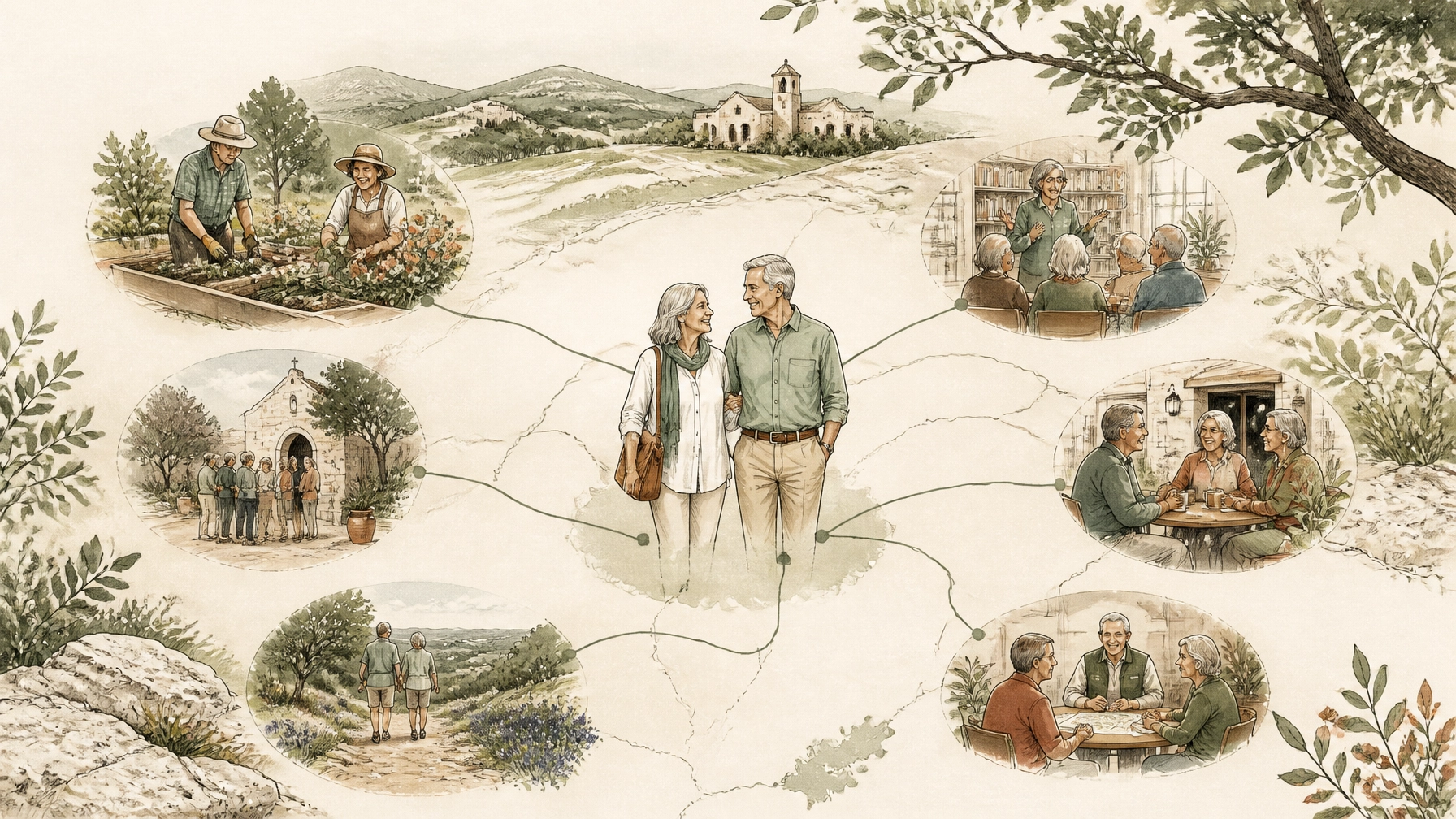
Moving to the Texas Hill Country can feel like stepping into a beautiful new chapter. The limestone landscapes are peaceful, the towns have character, and a slower pace gives you room to enjoy mornings on the patio, afternoons on the trail, and evenings with friends.
But beautiful surroundings do not automatically create a sense of belonging.
For affluent retirees and pre-retirees, the social transition can be surprisingly complicated. You may have moved from a neighborhood where you had decades of shared history, professional relationships, family routines, and familiar faces. In a new Hill Country community, you may know where to find the best coffee or hire a landscaper: but still be learning who to call for dinner, a walk, or a last-minute conversation.
The good news is that local friendships usually develop through repetition rather than chance. The goal is not to attend every event in town. It is to choose a few places where people will see you often enough to remember your name.
Start with three anchors
A practical way to build your first local network is to choose three different kinds of connection:
- One service activity where people work toward a shared purpose
- One learning or interest-based activity where conversation happens naturally
- One recurring neighborhood ritual that puts you in the same place regularly
This approach is more effective than filling your calendar with one-time receptions and large events. A service shift, weekly class, or standing coffee date creates continuity. Continuity gives acquaintances time to become friendships.
1. Volunteer where your contribution is useful
Volunteering is one of the most reliable ways to meet people after a move because it gives you an immediate role. You do not have to arrive with a clever introduction. You simply show up, help with a task, and work alongside others.
Look for opportunities that match your energy, experience, and preferred level of involvement.
If you enjoy practical, people-focused work, Hill Country Community Ministries lists opportunities in its food pantry and thrift store, including organizing donations, assisting clients, stocking shelves, administrative help, gardening, and other support roles. These kinds of assignments can be especially useful for new residents because they offer predictable shifts and regular contact with the same volunteers.
If nature is part of the reason you moved, Hill Country Conservancy offers volunteer work, educational hikes, and community events related to protecting Hill Country land and water. A conservation project or guided outdoor activity can be a natural fit for someone who prefers meaningful conversation while walking, planting, or learning.
In Kerrville, Riverside Nature Center describes volunteer roles ranging from wildflower-garden maintenance and nature education to special events, photography, writing, and library assistance. Training is provided, which makes it approachable even if you are new to environmental work.
For retirees who enjoy mentoring, leadership, or intergenerational relationships, Texas 4-H welcomes adult volunteers to mentor young people, lead clubs, assist with events, and create community-service projects. The program provides training and has screening requirements for adults working with youth.
Choose one opportunity and commit to attending several times before deciding whether it is a fit. The first visit may feel like an orientation. The second may involve remembering a few faces. By the fourth or fifth visit, you may have the beginnings of a local network.
“Watching the faces of children as they discover the wonders of nature has brought me back to RNC over and over again!” : Judy Ferguson, Riverside Nature Center volunteer page

2. Take a class that gives conversation a purpose
Large social gatherings can be difficult when you are new. A class is often easier because everyone arrives with a shared reason for being there.
Consider local library programs, community education, wellness classes, discussion groups, cooking workshops, gardening sessions, or continuing education. You do not need to choose something directly connected to your previous career. In fact, a new interest can make it easier to meet people outside your established professional identity.
Schreiner University’s Schreiner Alliance is one example of a community-oriented program in Kerrville that connects Hill Country residents with educational and cultural opportunities. Check current schedules and membership details before planning around a program, since offerings can change from season to season.
Public libraries in towns such as Kerrville, Boerne, Fredericksburg, Marble Falls, and New Braunfels can also be useful starting points. Browse their official calendars for adult programs, book discussions, lectures, technology sessions, and hands-on workshops.
The key is to attend the same program repeatedly. A one-time lecture may be interesting, but a monthly discussion group or weekly class creates recognition. Arrive a few minutes early, sit near the same general area, and ask a simple question:
- “Have you taken this class before?”
- “What brought you to this program?”
- “Is there another local class you would recommend?”
- “Do people usually stay for coffee afterward?”
These questions are low-pressure and invite local knowledge. Longtime residents often enjoy helping newcomers discover the area.

3. Explore faith communities beyond the service
For many retirees, a faith community can provide more than a weekly worship service. It may also offer small groups, volunteer ministries, study programs, music opportunities, support networks, and seasonal gatherings.
If faith is important to you, visit two or three congregations before choosing one. Pay attention not only to the service itself but also to what happens before and afterward. Are people lingering? Do members introduce themselves? Is there a clear way for newcomers to join a small group or service project?
Ask specifically about:
- Newcomer gatherings or orientation groups
- Weekday study or discussion groups
- Meal programs and food-pantry volunteering
- Men’s, women’s, or couples’ groups
- Choirs, music programs, or community outreach
- Opportunities to help with local families and nonprofits
Organizations such as Hill Country Daily Bread Ministries demonstrate how service and relationships can overlap. Volunteer roles may include resource distribution, event support, administrative assistance, and mentoring. Whether or not you participate through a congregation, service-oriented ministries can help you meet people who are actively invested in the well-being of the region.
You do not have to rush into membership. Begin by attending consistently and learning how the community serves others.
4. Join a club with a shared task: not just a social calendar
Interest-based clubs can be valuable, but the strongest connections often form when members have something concrete to do together.
Look for groups related to:
- Hiking, birding, gardening, or native plants
- Pickleball, tennis, golf, or cycling
- Local history and historic preservation
- Livestock, ranch activities, or land stewardship
- Civic service and community improvement
- Veterans’ programs or intergenerational mentoring
Service clubs such as Lions, Rotary, and other civic organizations may be especially useful if you want structure and purpose. Instead of attending a single luncheon and leaving, ask about an upcoming project. Helping prepare supplies, organize a fundraiser, or support a local drive gives you a more natural way to participate.
The same principle applies to recreation. If you join a walking group, attend the same morning each week. If you use a community fitness facility, become familiar with its regular schedule. You are not trying to meet everyone. You are trying to become a familiar presence.
5. Create a recurring neighborhood ritual
Friendships often begin with very ordinary habits: the same coffee stop, the same trail, the same farmers market visit, or the same weekday walk.
Choose a ritual that is enjoyable even if no one joins you at first. That makes it sustainable rather than dependent on immediate social success.
You might:
- Take a morning walk at the same time three days a week
- Visit a local coffee shop every Saturday
- Invite nearby neighbors for a casual sunset drink once a month
- Keep a standing lunch date with one new acquaintance
- Attend a recurring market, lecture, or community gathering
- Walk your dog along the same route and learn neighbors’ names
When you see someone repeatedly, introductions become easier. “We keep meeting here” is often all the opening you need.

A simple 90-day belonging plan
Days 1–30: Observe and select
Visit a volunteer organization, browse a library or community calendar, and identify one recurring neighborhood activity. Do not overcommit. Your goal is to notice where people naturally gather.
Days 31–60: Repeat and contribute
Return to the same volunteer shift, class, or group. Offer to help with a small task. Learn the names of two or three people and ask what else they enjoy locally.
Days 61–90: Invite and expand
Invite one or two acquaintances for coffee, a walk, lunch, or a casual meal at home. Add one adjacent connection: perhaps a friend from your class introduces you to a trail group, or a volunteer partner recommends a neighborhood gathering.
A strong social circle rarely appears all at once. It develops through small invitations, familiar routines, and the willingness to participate before you feel completely settled.

Let your lifestyle lead the way
Your social life should reflect the reason you chose the Texas Hill Country. If you moved for nature, build relationships outdoors. If you value learning, choose classes and lectures. If community service matters to you, volunteer where your skills can make a difference. If you want a quieter life, create smaller recurring rituals instead of pursuing a crowded calendar.
Texas Hill Country Retirement is a lifestyle and retirement resource for people considering the region’s communities, housing options, wellness opportunities, and slower pace. For families who also want to learn about coordinating lifestyle goals with general retirement income planning and investment management concepts, Portafolio Capital Management dba Mau Sanchez Capital provides educational information and, through a separate advisory relationship, professional guidance tailored to individual circumstances. Readers with questions about their own tax situation should consult a qualified tax professional.
The move from visitor to local happens when the Hill Country becomes more than a place you admire. It becomes the place where people recognize you, depend on you, and look forward to seeing you again.
Schedule a private meeting with a fiduciary financial advisor today by calling (512) 593-8380 or by visiting: https://calendly.com/portafoliocapital/15min
Portafolio Capital Management dba Mau Sanchez Capital is a Registered Investment Adviser. This content is for informational purposes only and does not constitute investment advice or a solicitation to buy or sell any security. Advisory services are provided only pursuant to a written advisory agreement.
This article may include stories, scenarios, and perspectives created or assisted by artificial intelligence. Although the individuals and circumstances described may be fictional, the topics are intended to reflect real financial, personal, and lifestyle issues that retirees and individuals commonly face.
The content is provided to encourage readers to consider different perspectives that may affect their retirement, regardless of whether they are currently planning, approaching retirement, or already retired. It is intended for general educational and informational purposes only and should not be interpreted as personalized investment, financial, tax, legal, medical, or retirement-planning advice.
Individual circumstances vary. Readers should independently verify any information presented and consult appropriately qualified professionals before making financial or personal decisions. No advisory, professional, or client relationship is created through the use of this website.
Leave a Reply