
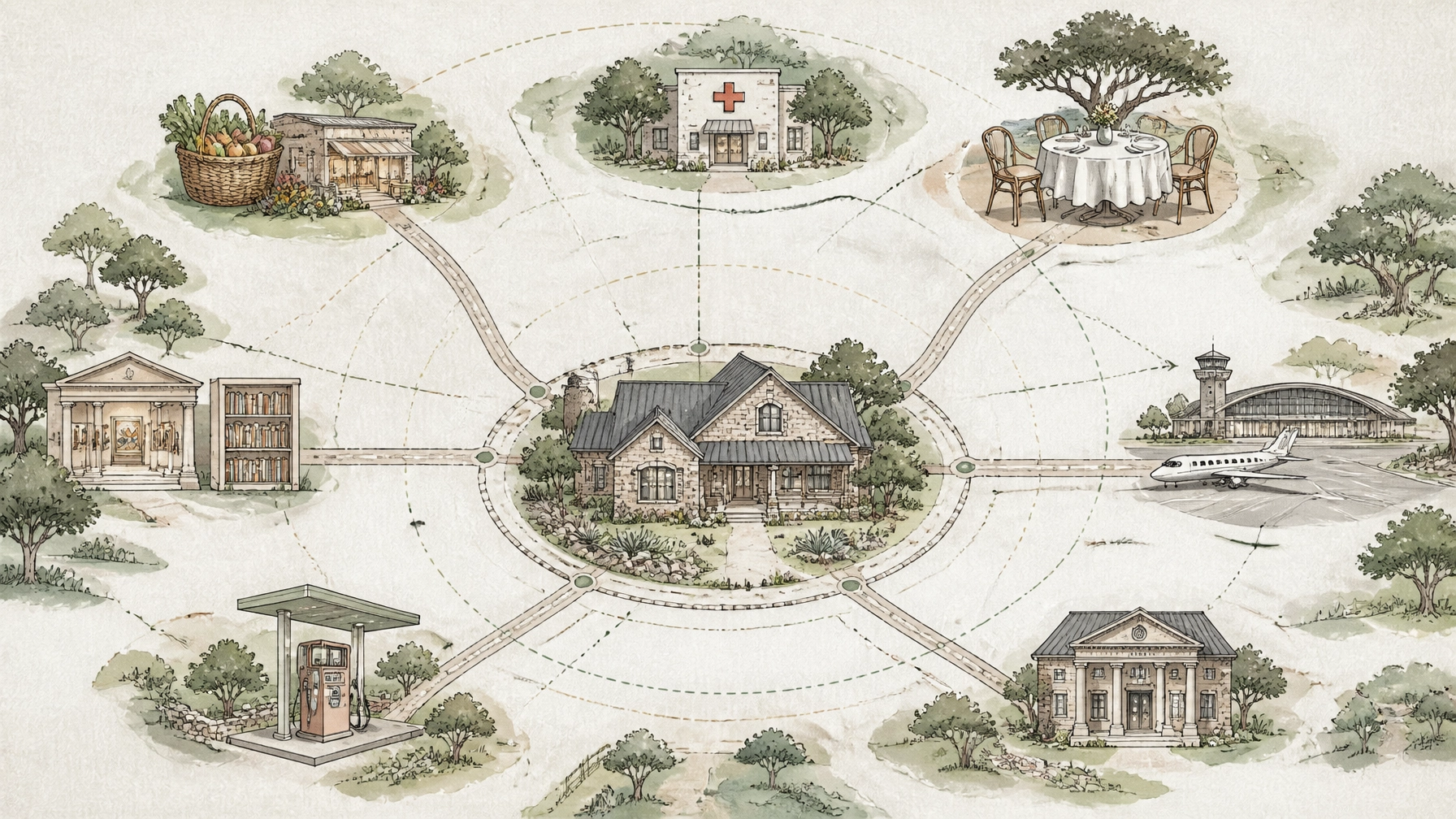
The Texas Hill Country can make almost any home look like the right home.
A limestone terrace, live oaks, distant ridgelines, and a quiet road can create an immediate emotional connection. But retirement is not lived from the terrace alone. It is also lived in the grocery aisle, at the pharmacy counter, in the driver’s seat on the way to an appointment, and at the restaurant you visit often enough to become a favorite.
That is why a beautiful property deserves more than a beautiful first impression. Before choosing where to live, try a Sunday Drive Test: a practical exercise that maps the ordinary trips shaping your future week.
The goal is not to compare Hill Country towns or produce a universal ranking. It is to understand whether a specific home location supports the lifestyle you actually want: both now and several years from now.
As William Morris wrote, “Have nothing in your house that you do not know to be useful, or believe to be beautiful.” The same principle can apply to the location around it. Your setting should be beautiful, but the surrounding routes should also be useful.
Start with your real retirement rhythm
Before opening a map, write down how often you expect to make each type of trip.
A typical affluent retirement household might include:
- Groceries and pharmacy: once or twice each week
- Dining and coffee: weekly, sometimes several times per week
- Fuel or vehicle service: every one to three weeks
- Banking and administrative errands: monthly or as needed
- Primary-care appointments: several times per year
- Specialist or diagnostic appointments: occasionally, but with greater importance
- Cultural activities: weekly or monthly
- Airport trips: several times per year, or much more often for frequent travelers
- Family visits and hosting: seasonal or recurring
This frequency matters. A 25-minute drive to a favorite winery may feel pleasant once a month. A 25-minute drive for groceries every Tuesday may feel very different.
Your Sunday Drive Test should measure not only distance, but repetition.
Build a personal destination map
Choose the home, neighborhood, or acreage property you are considering as the center point. Then create destination categories around it.
1. Groceries and pharmacy
Start with the places you would use for a normal weekly shop: not only specialty markets or farmers markets.
Identify:
- A full-service grocery store
- A second grocery option
- A pharmacy
- A place for household supplies
- A farmers market or local producer, if that matters to you
Measure the actual door-to-door route. A property that appears close on a straight-line map may require a longer drive because of winding roads, limited crossings, or highway access.
If you enjoy cooking, entertaining, or maintaining a second home, grocery convenience may matter more than you initially expect. Consider whether the trip is simple enough to make on a hot afternoon, after dark, or when one member of the household is not feeling well.
2. Medical appointments
This exercise is not a substitute for researching providers or evaluating healthcare access. It is a location exercise: how easy will it be to reach the care you already expect to use?
Map separate destinations for:
- Primary care
- A nearby clinic or urgent care facility
- Your preferred hospital
- Common specialists
- Imaging or laboratory services
- A pharmacy near those appointments
The important question is not simply, “How far away is the hospital?” Ask instead:
“What would this route feel like on a weekday morning, during heavy rain, or when I am tired after an appointment?”
Check the route in a navigation app, then drive it. Note left turns, narrow shoulders, confusing intersections, steep grades, and stretches where mobile service may be unreliable.
For current road conditions, construction, flooding, and closures, check TxDOT’s DriveTexas map before traveling. Rural Hill Country routes can change with weather, especially near creek crossings.
Map the trips that make life enjoyable
Errands are essential, but retirement is also about the activities you choose because they make the week richer.
3. Dining and coffee
Map three types of dining:
- A casual weekday restaurant
- A special-occasion destination
- A coffee shop, bakery, or lunch spot you would enjoy visiting regularly
Then ask whether these are places you would actually use: or merely places that look appealing during a real estate tour.
A restaurant 20 minutes away may be ideal if the drive is scenic and the meal becomes part of the outing. It may be less appealing if the route is difficult at night or if every visit requires navigating a busy commercial corridor.
Try the route at the time you would normally use it. Sunday brunch traffic, evening visitors, event weekends, and seasonal tourism can all change the experience.
4. Cultural activities and community life
Cultural access does not have to mean a major museum or performing arts center. It may include:
- Public library programs
- Galleries and working studios
- Historic sites
- Lecture series
- Live music
- Community theater
- Wine, food, or heritage events
- Churches, clubs, and volunteer opportunities
Use official sources such as the Texas Highways events calendar, Texas Time Travel events, and local city or library calendars to see what is actually happening throughout the year.
The test is simple: identify two or three activities you would attend repeatedly, then measure the route from home. If culture is central to your retirement, a scenic but isolated property may not support your preferred pace.

Include the practical stops people forget
5. Fuel and vehicle service
Fuel is easy to overlook when touring homes. Add the nearest dependable fuel station to your map, along with:
- A second fuel option
- An auto repair shop
- A tire or service center
- A car wash or detailer, if relevant
- Electric vehicle charging, if needed
Consider how the route works when combined with other errands. Can you fill the tank while buying groceries? Is the station on a road you already use? Would you have a backup if one location were closed or temporarily unavailable?
For households with multiple vehicles, recreational equipment, or long-distance travel habits, these details can affect the convenience of the entire property.
6. Banking and financial errands
Many financial tasks can be handled digitally, but some households still value nearby branches, safe-deposit access, notary services, or a familiar local contact.
Map:
- Your preferred bank branch
- A backup branch
- ATMs on regular routes
- Post office or shipping services
- A place to handle occasional administrative errands
You do not need every service within five minutes. You do need to understand whether a basic task becomes an all-day trip.
The same principle applies to professional appointments. If your relocation includes investment management or retirement income planning, consider whether meeting with your professional team is convenient in person or easy to handle virtually. Mau Sanchez Capital helps families think through the financial side of retirement decisions, including how lifestyle choices fit within a broader plan.
Treat airport access as a recurring lifestyle cost
Airport access may be occasional, but it can have an outsized effect on your retirement experience if you travel frequently or expect regular visits from family.
Map your likely airport route to:
- The terminal entrance
- Your preferred parking area
- Rental-car return
- A hotel or overnight stop, if you use one
- A backup airport
Many Hill Country households will consider Austin-Bergstrom International Airport or San Antonio International Airport, depending on their home location and travel patterns. Do not rely only on a generic “minutes to airport” listing. Drive the route early in the morning, during a typical departure window, and on a return trip after dark.
Also account for the emotional cost of the drive. A route that is technically manageable may still feel tiring if it includes heavy traffic, complicated interchanges, or a long stretch with few services.

Create a simple route scorecard
After the drive, record each destination in a table like this:
| Destination | Frequency | One-way time | Route comfort | Backup available? | Overall impression |
|---|---|---|---|---|---|
| Full grocery | Weekly | ||||
| Pharmacy | Weekly/as needed | ||||
| Primary care | Several times yearly | ||||
| Hospital or specialist | Occasional | ||||
| Dining | Weekly | ||||
| Culture | Weekly/monthly | ||||
| Fuel | Every few weeks | ||||
| Banking | Monthly/as needed | ||||
| Airport | Seasonal |
Then give each route a simple rating:
- Green: easy, comfortable, and consistent with your routine
- Yellow: manageable, but requires planning or compromises
- Red: likely to become frustrating or difficult over time
Do not average everything into one score. A property may have excellent grocery access but poor airport access. Another may offer a wonderful cultural life but require a longer medical drive. The purpose is to see the trade-offs clearly.
Repeat the test in different conditions
One Sunday is useful, but it is not the whole picture.
Repeat portions of the test:
- On a weekday morning
- During an evening return
- After rainfall
- During a festival or busy season
- In summer heat
- After dark
Ask current residents how routes change during construction, special events, tourist season, or severe weather. Review DriveTexas before testing rural roads, and never enter a closed or barricaded low-water crossing.
Finally, imagine making the same trips five or ten years from now. Would you still enjoy the drive? Would the route be comfortable if you were recovering from an illness, limiting nighttime driving, or relying more on family and local services?

Let the map refine the dream
The Sunday Drive Test is not designed to eliminate the romance of Hill Country living. It helps protect it.
When daily necessities are reasonably accessible, you have more freedom to spend your time on the things that drew you here: a long lunch, a gallery visit, an afternoon on the course, a concert under the oaks, or a quiet evening at home.
Before committing to a property, map the life around it. The right retirement setting is not necessarily the one with the shortest drive to everything. It is the one where the necessary drives feel manageable: and the enjoyable drives feel worth taking.
Schedule a private meeting with a fiduciary financial advisor today by calling (512) 593-8380 or by visiting: https://calendly.com/portafoliocapital/15min
Portafolio Capital Management dba Mau Sanchez Capital is a Registered Investment Adviser. This content is for informational purposes only and does not constitute investment advice or a solicitation to buy or sell any security. Advisory services are provided only pursuant to a written advisory agreement.
This article may include stories, scenarios, and perspectives created or assisted by artificial intelligence. Although the individuals and circumstances described may be fictional, the topics are intended to reflect real financial, personal, and lifestyle issues that retirees and individuals commonly face.
The content is provided to encourage readers to consider different perspectives that may affect their retirement, regardless of whether they are currently planning, approaching retirement, or already retired. It is intended for general educational and informational purposes only and should not be interpreted as personalized investment, financial, tax, legal, medical, or retirement-planning advice.
Individual circumstances vary. Readers should independently verify any information presented and consult appropriately qualified professionals before making financial or personal decisions. No advisory, professional, or client relationship is created through the use of this website.
Leave a Reply