
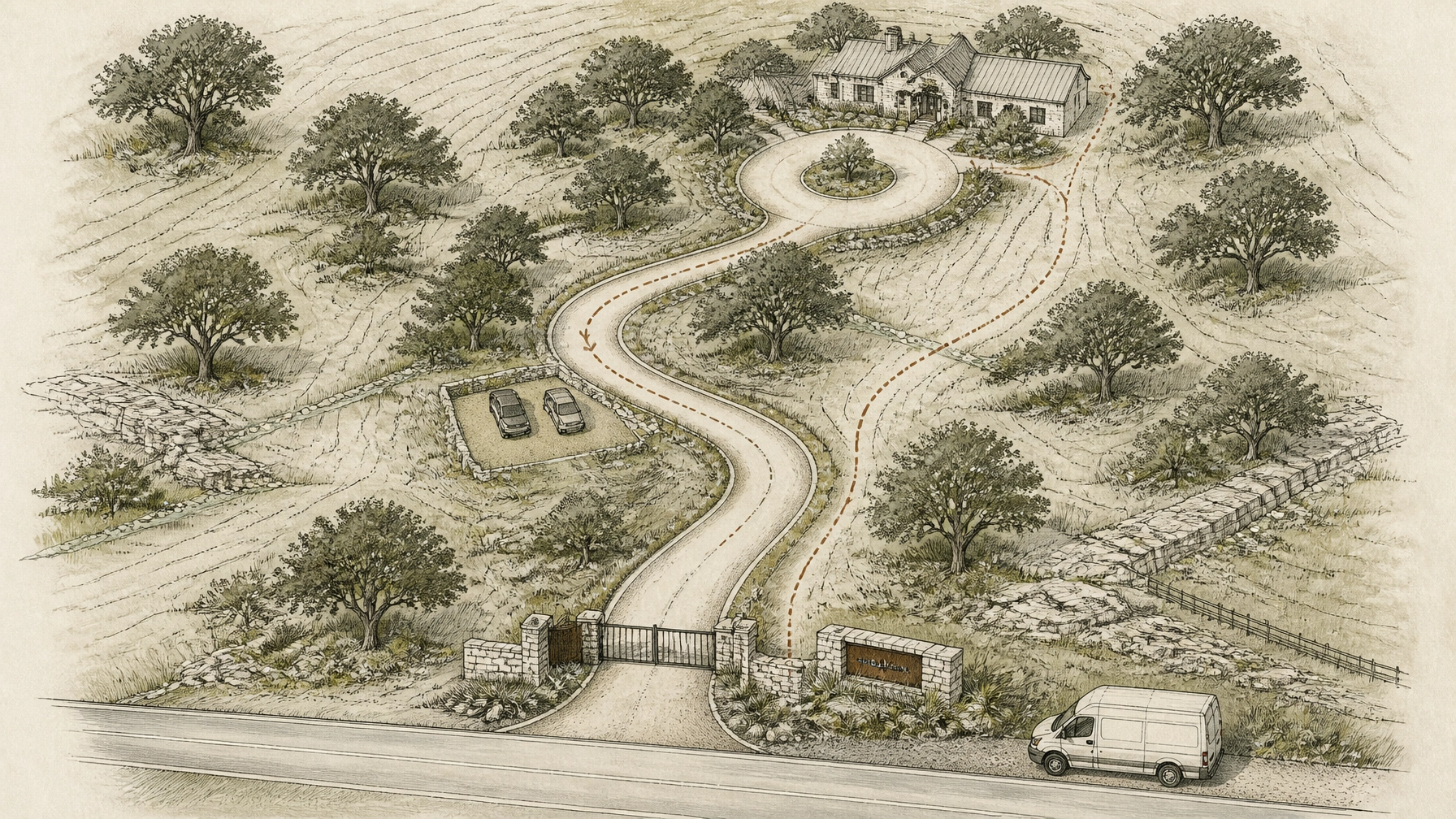
A long private driveway can be one of the most appealing features of a Texas Hill Country property. It creates privacy, frames the arrival, and separates the home from the road. For retirees considering acreage, however, the driveway is more than a path to the front door.
It is also the route used by guests, moving trucks, contractors, grocery deliveries, medical services, and emergency responders. Its design influences how easy the property is to enjoy: and how much effort it may require over time.
When evaluating Hill Country acreage, treat the driveway as part of the home’s everyday floor plan. Walk it, drive it, study it in different weather, and ask who is responsible for keeping it usable.
1. Start With the Arrival Sequence
Before looking at paving materials or decorative gates, consider how someone experiences the property from the public road.
A well-designed arrival sequence should answer several practical questions:
- Can a first-time guest identify the correct entrance?
- Can a delivery vehicle pull completely off the public road?
- Is there room to approach and open the gate safely?
- Can two vehicles pass if one is entering while another is leaving?
- Does the driveway lead naturally to guest parking and the front entry?
- Is there a clear route for emergency vehicles?
A winding driveway may be beautiful, but curves should not create blind corners, confusing branches, or uncomfortable reversing situations. If the property includes a guest house, studio, pool area, or detached garage, review how each destination connects to the main drive.
A simple site plan can reveal problems that are easy to miss during a showing. Mark the road, gate, driveway, parking areas, home, outbuildings, drainage crossings, and possible emergency route before making a purchase decision.
2. Evaluate Driveway Length and Slope Together
Driveway length affects cost and convenience, but length alone does not tell the whole story. A longer driveway with a gradual grade may be easier to use than a shorter driveway with steep sections, tight curves, or exposed limestone.
Walk or drive the entire route and note:
- Steep climbs and descents
- Sharp turns or limited sightlines
- Narrow sections
- Exposed rock or uneven shoulders
- Low-water crossings and culverts
- Areas where runoff could cross the drive
- Locations where vehicles may need to turn around
For retirees, the question is not simply whether a vehicle can reach the home. Consider whether the driveway will remain comfortable for visitors who are unfamiliar with the property, service providers carrying equipment, and future residents who may prefer not to navigate difficult terrain at night or during heavy rain.
A prospective buyer may also want a builder, civil engineer, or qualified site contractor to walk the proposed route before closing. That review can identify grading, excavation, drainage, or retaining-wall concerns that are not obvious from a listing photograph.
3. Treat the Gate as a Logistics Point, Not Just a Design Feature
A private gate can provide security and visual appeal, but it should also be easy to use.
The gate’s location matters. Ideally, a vehicle should be able to pull fully off the public roadway before the driver stops to enter a code, use a remote, or wait for the gate to open. A gate positioned too close to the road can create an uncomfortable queue, especially when a delivery truck or guest is unfamiliar with the property.
Review the following:
- Clear opening width
- Gate swing or sliding direction
- Space for a vehicle to wait inside the property
- Keypad visibility and weather protection
- Manual operation during a power outage
- Emergency access equipment approved by the local authority
- Clearance for moving trucks, trailers, and service vehicles
Local requirements vary. Some jurisdictions require specific emergency access systems, gate widths, or operating standards. For example, Seguin’s gated-access guidance addresses approved keyed or keyless emergency entry systems. A local fire marshal or emergency services district should confirm what applies to a particular property.

Do not assume that a beautiful custom gate is automatically convenient. Ask how often the current owners use it, whether the operator has needed repairs, and whether delivery drivers routinely have trouble finding or entering the property.
4. Make Guest Navigation Effortless
Acreage can feel wonderfully private: but too much privacy can become confusing for visitors.
Guests should be able to answer three questions without calling for instructions:
- Where is the entrance?
- Where should I park?
- How do I reach the front door?
Place a visible, reflective address marker near the driveway entrance according to county guidance. The Kerr County 911 addressing office recommends conspicuous address display, while Kendall County’s rural addressing information explains the importance of accurate access information for rural properties.
If the home is not visible from the road, the driveway sign becomes especially important. A sign on the house alone may not help a visitor: or a responder: identify the correct entrance.
Also consider the parking experience. A dedicated guest parking area or arrival court is usually more comfortable than asking visitors to park along a narrow drive. If the driveway ends at the house, a circular turnaround can prevent awkward three-point turns and reduce the likelihood of vehicles backing into landscaping, stone walls, or other cars.
5. Plan for Emergency Access Early
Emergency access should be reviewed before purchasing acreage or finalizing a homesite. The relevant authority may be a city or county fire marshal, an Emergency Services District, or another local agency.
Requirements differ by jurisdiction, but common considerations include:
- Clear width for emergency vehicles
- Vertical clearance beneath trees, signs, and structures
- Adequate turning radius
- All-weather driving surface
- A suitable turnaround for dead-end drives
- Access close enough to the home for hose operations
- Unobstructed gates and approaches
- Address signage visible from the public road
The National Fire Protection Association’s access guidance emphasizes maintaining clear, usable access for responding departments. Some Texas fire districts publish additional rural driveway and gate standards; Liberty Hill Fire & Rescue’s access information is one example.
These references are useful starting points, not universal approval. A property in Kerr County may not follow the same process as one in Hays, Blanco, Kendall, or Gillespie County. Ask the local authority to review the proposed driveway, gate, bridge, or turnaround before construction.
“The safest driveway is one that is easy to find, easy to open, and easy to navigate under pressure.”
6. Use Lighting for Orientation, Not Drama
A dark Hill Country sky is part of the appeal of rural living. Lighting should improve safety without turning the driveway into a brightly illuminated commercial entrance.
Concentrate low-glare, downward-facing fixtures at decision points:
- The address sign and gate
- Sharp curves or changes in grade
- Guest parking
- The walkway to the front door
- Any steps, retaining walls, or drainage crossings
Avoid lights aimed toward drivers, neighboring properties, or the night sky. A lighting system with timers, motion sensors, or carefully controlled zones may be more useful than fixtures placed continuously along the entire driveway.
During an evening property visit, turn off the vehicle headlights and observe the route. Can you see the gate, address marker, parking area, and front entry? Are there dark transitions where a person could trip or a driver could misjudge the edge?
7. Study Drainage and Road Surface
In the Hill Country, water can determine whether a driveway remains attractive and usable.
Look for evidence of erosion, standing water, tire ruts, washed-out gravel, cracked pavement, or sediment deposited across the driving surface. Pay special attention to dips and drainage crossings. A driveway can interrupt the natural path of water, so culverts, swales, crowns, and properly shaped shoulders may be necessary.

Surface choices involve trade-offs:
- Gravel can be attractive and comparatively straightforward to repair, but it may require periodic grading and replenishment.
- Concrete can offer a durable surface, particularly on selected grades, but installation and repair may be more involved.
- Asphalt or chip seal may provide a smoother arrival experience, with performance depending heavily on the underlying base and drainage.
Do not evaluate the surface without evaluating the base beneath it. A premium material cannot compensate for poor grading, insufficient compaction, or unmanaged runoff.
8. Clarify Who Maintains What
A private driveway may be entirely your responsibility, or it may be shared with neighbors through an easement, private road agreement, HOA, or property owners’ association.
Before closing, ask for written answers to these questions:
- Who repairs potholes and washouts?
- Who clears fallen limbs and removes vegetation?
- Who maintains culverts, bridges, and drainage ditches?
- Who pays for resurfacing or major grading?
- Are costs divided equally or according to use?
- Can a neighbor install a gate, fence, or landscaping that affects access?
- Are there restrictions on widening, paving, lighting, or improving the drive?
The title commitment, survey, recorded easements, subdivision documents, and road maintenance agreements should be reviewed with appropriate professionals. Readers with questions about how property decisions may affect their individual tax situation should consult a qualified tax professional. Austin County’s rural 911 sign guidance also illustrates why access identification and entrance placement deserve attention in rural settings.
A driveway that appears inexpensive to maintain may become a substantial responsibility if it is long, shared, steep, or exposed to repeated runoff.
A Practical Driveway Walkthrough
When evaluating acreage, visit the property at least twice: once in daylight and once after dark if possible. Use this checklist:
- Measure or estimate driveway length.
- Note steep grades, sharp curves, and narrow points.
- Check whether vehicles can pull off the public road at the gate.
- Confirm the gate has an emergency-approved access method.
- Locate reflective address signage.
- Test phone or intercom communication at the entrance.
- Identify guest parking and a vehicle turnaround.
- Look for erosion, standing water, and damaged culverts.
- Ask who maintains the drive and how costs are shared.
- Request local fire-marshal or ESD guidance before making improvements.
The right private driveway should feel private without feeling inconvenient. For affluent retirees, that balance can make a meaningful difference in daily life: arriving home after dinner, welcoming family for the weekend, receiving a delivery, or allowing help to reach the property quickly when needed.
Texas Hill Country Retirement offers lifestyle resources for families comparing communities, homes, and everyday living in the region. For the financial side of relocating, downsizing, or managing retirement income around a major property decision, learn more about Portafolio Capital Management dba Mau Sanchez Capital.
Schedule a private meeting with a fiduciary financial advisor today by calling (512) 593-8380 or by visiting: https://calendly.com/portafoliocapital/15min
Portafolio Capital Management dba Mau Sanchez Capital is a Registered Investment Adviser. This content is for informational purposes only and does not constitute investment advice or a solicitation to buy or sell any security. Advisory services are provided only pursuant to a written advisory agreement.
This article may include stories, scenarios, and perspectives created or assisted by artificial intelligence. Although the individuals and circumstances described may be fictional, the topics are intended to reflect real financial, personal, and lifestyle issues that retirees and individuals commonly face.
The content is provided to encourage readers to consider different perspectives that may affect their retirement, regardless of whether they are currently planning, approaching retirement, or already retired. It is intended for general educational and informational purposes only and should not be interpreted as personalized investment, financial, tax, legal, medical, or retirement-planning advice.
Individual circumstances vary. Readers should independently verify any information presented and consult appropriately qualified professionals before making financial or personal decisions. No advisory, professional, or client relationship is created through the use of this website.
Leave a Reply