
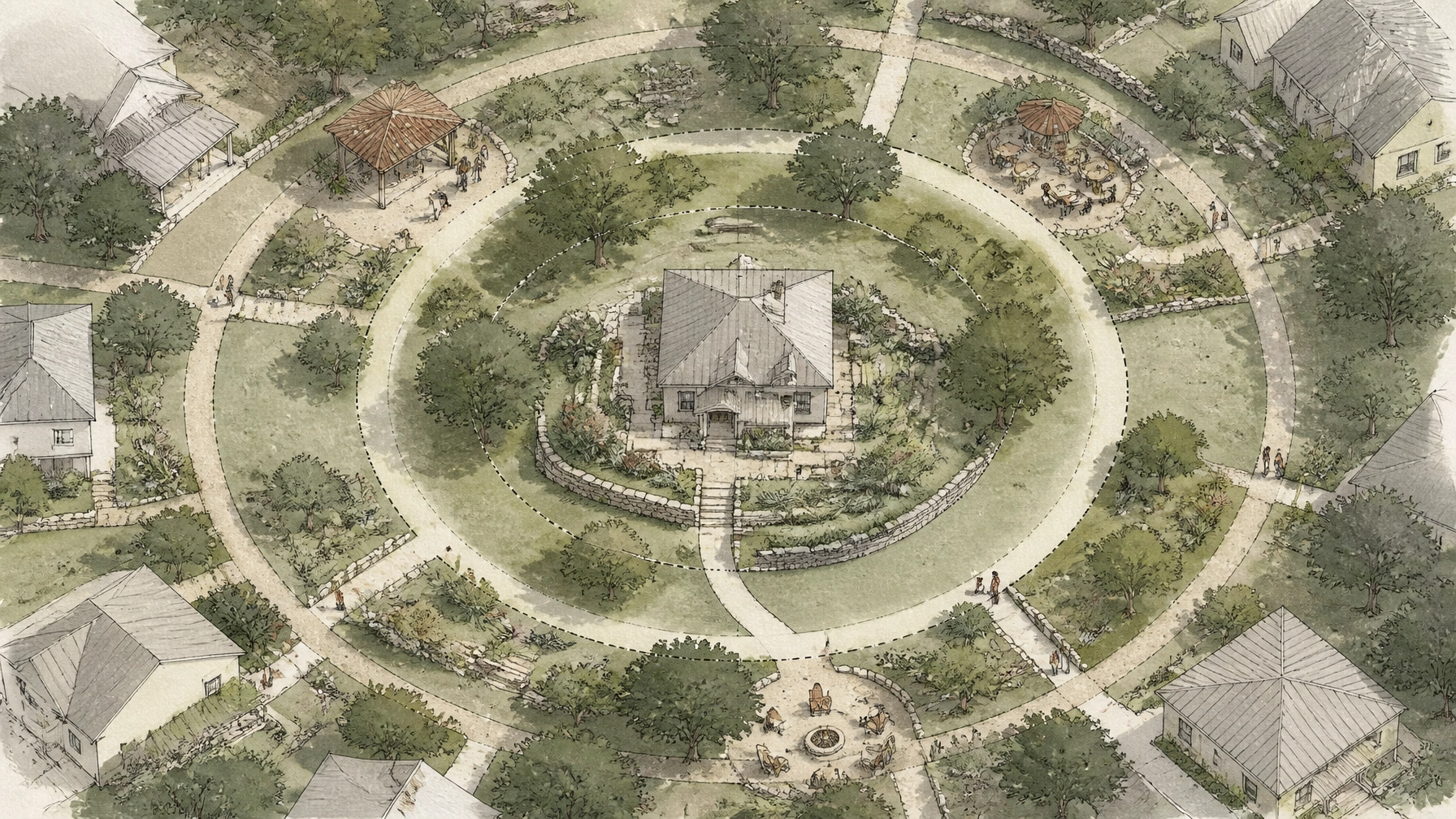
When choosing a retirement home, most people ask about the view, the floor plan, the kitchen, and the size of the primary suite. Affluent buyers may also consider a wine room, guest casita, outdoor kitchen, golf access, or acreage.
But one of the most important lifestyle decisions is less obvious:
How close do you want to be to other people?
The answer is rarely “as private as possible” or “as social as possible.” Most retirees want a home that feels peaceful without feeling isolated. They want control over interaction: quiet mornings when they choose, spontaneous conversations when they feel social, and easy access to friends, amenities, and community life.
That balance can be understood as your neighbor radius, the comfortable distance between your private retreat and the people, places, and experiences that make retirement feel connected.
What Is a Neighbor Radius?
Your neighbor radius is not simply the distance between one home and the next. It includes several layers of connection:
- How easily you can see neighboring homes from your windows or patio
- Whether people naturally pass by your property
- How far you must walk to reach a shared amenity
- Whether your neighborhood encourages casual interaction
- How easy it is to host guests without sacrificing privacy
- How much effort is required to reach dining, recreation, healthcare, and town life
A home on five acres may offer less visual privacy than a well-designed home on one acre if the lots are poorly positioned. Likewise, a home in a community may feel private if it has thoughtful landscaping, layered outdoor spaces, and a clear separation between public and personal areas.
“The ideal retirement setting gives you the freedom to choose connection, not the obligation to perform it.”
That principle is especially relevant in the Texas Hill Country, where retirement options range from private ranch properties to amenity-rich neighborhoods near Austin, Boerne, Dripping Springs, Kerrville, and other regional destinations.
Start With the Type of Privacy You Actually Want
Privacy is not one-dimensional. Before touring properties, decide which type matters most to you.
Visual privacy
Visual privacy concerns what you can see, and what others can see, from the home.
Consider:
- Can neighbors see into the primary bedroom?
- Are adjacent patios aligned with yours?
- Does the backyard face another home, a walking trail, or open land?
- Are windows positioned toward private courtyards or shared spaces?
- Will evening lighting expose more of the property after sunset?
Tree cover can be particularly valuable in the Hill Country. Mature live oaks and cedar elms may soften sightlines, create shade, and make outdoor spaces feel more secluded. However, trees should not be treated as a permanent guarantee. Ask about maintenance, irrigation, disease, storm damage, and whether nearby construction could change the view.
Acoustic privacy
A property can look private while still carrying sound from roads, pool areas, outdoor events, or neighboring patios.
During a site visit, pause and listen. Visit at different times of day if possible. Ask:
- Is there traffic noise during the morning commute?
- Can you hear activity from a clubhouse or common lawn?
- Are outdoor speakers used in shared areas?
- Does the home sit below or above nearby lots?
- Are mechanical systems, generators, or pool equipment close to bedrooms?
For many retirees, a small amount of natural neighborhood activity is pleasant. The concern is not silence; it is whether background noise matches the lifestyle you want.
Social privacy
Social privacy is your ability to decide when you want conversation and when you do not.
A front porch facing a walking path may create frequent opportunities to say hello. A courtyard-facing home may make it easier to recognize neighbors. A home at the end of a lane may reduce interaction but also make casual connection less likely.
Neither arrangement is automatically better. The right choice depends on whether you prefer planned gatherings, spontaneous interaction, or a combination of both.
Read the Lot Before You Read the Listing
A floor plan tells you how rooms connect. A site plan tells you how your life may connect with the neighborhood.
Study the lot from several directions:
Approach the property from the street.
Notice whether the front door feels exposed, welcoming, or hidden.Stand where the primary living areas will be.
Identify what is visible from the kitchen, great room, and main bedroom.Walk the likely outdoor living areas.
Imagine morning coffee, evening meals, gardening, and visits from family.Look beyond the property line.
A vacant lot may eventually become another home, a road, or a shared facility.Examine elevation changes.
A home higher on a slope may overlook neighboring yards. A lower lot may gain privacy from natural grade but receive less breeze or sunlight.
The most comfortable properties often have a natural transition between private and shared space. A front garden, low limestone wall, covered porch, or shaded walkway can create a welcoming edge without placing the interior of the home on display.

Think in Layers, Not Walls
A privacy buffer does not have to be a tall fence. In an attractive Hill Country setting, privacy can come from several smaller design decisions working together:
- A change in elevation
- A line of mature trees
- Native grasses or layered shrubs
- A screened porch
- A detached guest casita
- A covered walkway
- A low stone wall
- A side-entry garage
- Windows angled away from neighboring homes
- A courtyard that turns inward
Layered privacy is often more flexible than a hard boundary. It can preserve views, maintain a sense of openness, and keep the home connected to the landscape.
When evaluating a property, ask whether the landscaping is established or merely proposed. Request the community’s guidelines for fences, tree removal, exterior lighting, and additions. A privacy plan that depends on future plantings may take years to mature.
Measure Walking Distance in Real Life
A community may advertise walking trails and shared amenities, but the practical question is whether you will actually use them.
Walk the route from the home to:
- The clubhouse
- Fitness or wellness facilities
- A pool or dining area
- Mail and package locations
- Community gardens
- Nearby parks
- Guest parking
- The neighborhood entrance
Measure more than distance. Pay attention to shade, slope, surface quality, lighting, benches, crossing points, and drainage. A route that looks short on a map may feel very different in the Texas heat or after a heavy rain.
For public recreation, Texas Parks & Wildlife provides trail information and current park details for the Hill Country State Natural Area and other state parks. Local resources such as Destination Dripping Springs’ parks and nature guide can also help you understand the surrounding outdoor environment.

Evaluate Shared Amenities by Frequency, Not Just Quality
A beautiful clubhouse is appealing. The more useful question is how it fits into your weekly routine.
Consider whether shared amenities are:
- Close enough for spontaneous use
- Open during the hours you prefer
- Designed for both group and quiet activities
- Comfortable during hot or rainy weather
- Accessible without passing through an overly busy area
- Supported by rules that match your expectations
Look for multiple scales of gathering space. A large event lawn serves a different purpose than a small shaded seating area. A formal dining room creates a different experience than a casual café-style lounge. A walking trail may offer connection without requiring conversation.
The strongest neighborhood designs often provide optional participation. You can attend a gathering, take a class, use the fitness center, or simply walk past and wave. Connection is available, but solitude remains respected.

Consider How Your Preferences May Change
The home that feels perfect at 62 may not meet your needs at 78. That does not mean you should plan your retirement around worst-case scenarios. It does mean you should consider flexibility.
You may eventually value:
- A shorter walk to shared amenities
- A single-level floor plan
- A nearby neighbor who can notice when something seems unusual
- A covered route to the mailbox or clubhouse
- A guest suite for visiting family or support
- A quieter patio with easy access to the main living area
- Convenient proximity to healthcare and specialists
The Hill Country healthcare access guide can help you think more broadly about location and access as you compare communities.
Your desired social radius may also change. Some retirees begin with a full calendar and frequent entertaining. Later, they may prefer smaller gatherings, closer neighbors, and amenities that require less driving. A well-chosen home can accommodate both phases.

Create a Neighbor-Radius Scorecard
Before making a decision, rate each property from one to five in the following categories:
- Visual privacy
- Noise control
- Outdoor comfort
- Distance to shared amenities
- Walking-route quality
- Access to nearby town life
- Guest and family flexibility
- Healthcare convenience
- Ease of maintenance
- Ability to adapt over time
Then write a short description of your ideal ordinary day. Not your holiday weekend. Not the day of a neighborhood festival. Describe a typical Tuesday.
Where do you drink coffee? Do you walk before breakfast? Would you enjoy seeing a neighbor while collecting the mail? How often would you use a clubhouse? Do you want dinner in town to be a short drive or an occasional outing?
These answers reveal more than a list of amenities. They show whether the property’s social distance matches your life.
The Right Balance Is Personal
There is no universal formula for privacy and connection. One couple may want a secluded home near a shared trail system. Another may prefer a smaller lot with a front porch, nearby friends, and easy access to community events. A third may want a private residence that remains close to restaurants, healthcare, golf, wineries, and cultural activities.
The goal is not to find the most private home or the most connected community. It is to find a setting where your daily life feels intentional.
Texas Hill Country Retirement is a lifestyle and retirement resource for people exploring homes, communities, recreation, and relocation in the region. For the financial and investment-planning side of a move, Mau Sanchez Capital can help families evaluate how a housing decision fits within a broader retirement-income strategy, liquidity needs, and long-term portfolio design.
Frequently Asked Questions
How much privacy should a retirement home provide?
Enough to support quiet time, rest, and personal routines while preserving convenient access to people and amenities you enjoy. The right balance depends on your preferred level of social activity, hosting habits, maintenance expectations, and future mobility.
Is a larger lot always more private?
No. Lot orientation, elevation, tree cover, window placement, outdoor living areas, and neighboring development can matter more than acreage alone.
How can I tell whether a community is genuinely walkable?
Walk the routes yourself and evaluate shade, slopes, surfaces, benches, crossings, lighting, and access to amenities. Also visit during the season and time of day when you expect to use those routes.
Should I prioritize privacy or proximity to amenities?
Consider your ordinary routine rather than the amenities’ brochure appeal. A slightly smaller privacy buffer may be worthwhile if it gives you easier access to activities, friends, healthcare, and daily conveniences.
Schedule a private meeting with a fiduciary financial advisor today by calling (512) 593-8380 or by visiting: https://calendly.com/portafoliocapital/15min
Portafolio Capital Management dba Mau Sanchez Capital is a Registered Investment Adviser. This content is for informational purposes only and does not constitute investment advice or a solicitation to buy or sell any security. Advisory services are provided only pursuant to a written advisory agreement.
This article may include stories, scenarios, and perspectives created or assisted by artificial intelligence. Although the individuals and circumstances described may be fictional, the topics are intended to reflect real financial, personal, and lifestyle issues that retirees and individuals commonly face.
The content is provided to encourage readers to consider different perspectives that may affect their retirement, regardless of whether they are currently planning, approaching retirement, or already retired. It is intended for general educational and informational purposes only and should not be interpreted as personalized investment, financial, tax, legal, medical, or retirement-planning advice.
Individual circumstances vary. Readers should independently verify any information presented and consult appropriately qualified professionals before making financial or personal decisions. No advisory, professional, or client relationship is created through the use of this website.
Leave a Reply