
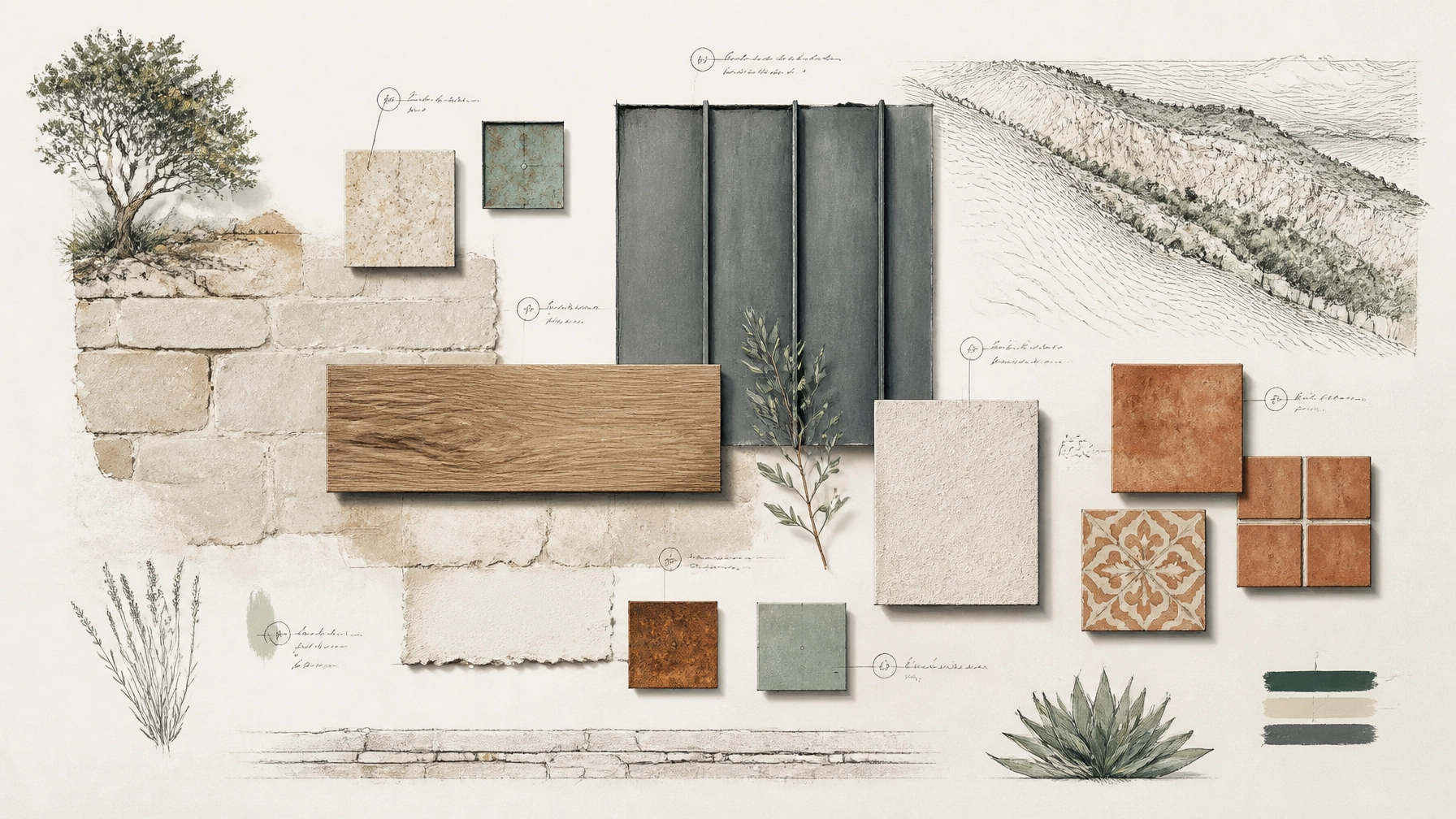
A well-designed Hill Country home should not look exactly the same ten or twenty years from now.
The limestone may soften in color. The metal roof may develop a quieter, more muted finish. Wood may move from warm brown to a silvery gray. Tile may gather the gentle marks of weather, shade, and daily life.
That evolution is not necessarily deterioration. In many cases, it is patina: the visible record of sun, rain, craftsmanship, and time.
For affluent retirees choosing or renovating a home in the Texas Hill Country, material selection is about more than initial appearance. It is about how a surface performs through intense sunlight, dramatic temperature changes, dry periods, heavy storms, and the ordinary rhythms of entertaining, traveling, and enjoying a slower-paced life.
The region’s shallow soils, exposed limestone, hills, and distinctive ecology all contribute to a strong sense of place. The Texas Parks and Wildlife Department’s overview of the Hill Country offers useful context for understanding the landscape that surrounds these homes.
The best materials do not fight that landscape. They settle into it.
Limestone: The Foundation of Hill Country Character
Limestone is the most immediately recognizable material in much of the Texas Hill Country. It appears in retaining walls, fireplaces, courtyards, exterior walls, garden borders, and entire facades.
Its appeal is partly visual, but its deeper value is its ability to feel both historic and current. Rough-cut blocks can evoke an old ranch compound, while carefully gauged stone can support a more contemporary design.
What limestone does well
Limestone handles strong sunlight beautifully. Rather than fading in the way painted materials can, it often develops a softer, more nuanced appearance. Its variations in cream, gray, buff, and warm beige can make a home feel connected to the surrounding ridges and outcroppings.
It also provides visual weight. On a large property, limestone can help anchor a home to the site instead of making it appear placed on top of the landscape.
What requires stewardship
Limestone is not maintenance-free. Mortar joints, sealants around openings, drainage at the base of walls, and coping stones should be inspected periodically. Heavy rain can expose weak points in poorly detailed walls, especially where water collects or flows toward the foundation.
A breathable approach is usually preferable to sealing every surface. Stone needs to manage moisture naturally, and an inappropriate sealer can trap water rather than protect the material.
The most successful limestone homes often use restraint. Stone does not need to cover every wall. It can be more effective when paired with smooth stucco, dark metal, warm wood, or a shaded porch.

Metal: A Quietly Practical Roof With Design Presence
Standing-seam metal roofing has become a defining feature of many high-quality Hill Country homes. It can look modern, ranch-inspired, or historically appropriate depending on the profile, color, roof pitch, and surrounding materials.
A metal roof is also a visual opportunity. A broad, low-slope roof in charcoal, bronze, muted green, or weathered gray can give a home a strong silhouette without competing with the landscape.
Heat, finish, and color
The Hill Country’s hot, sunny conditions make roof color and coating important design decisions. The U.S. Environmental Protection Agency explains that a cool roof “absorbs and transfers less heat from the sun to the building compared with a more conventional roof.” Learn more through the EPA’s guidance on cool roofs.
That does not mean every home needs a bright white roof. A lighter or specially coated metal finish may provide useful solar performance while still fitting a refined Hill Country palette. The ENERGY STAR cool-roof resource provides additional information about reflectance and roof products.
The roof assembly matters as much as the exterior finish. Insulation, ventilation, underlayment, decking, flashing, and installation quality all contribute to comfort and durability.
The beauty of controlled weathering
Metal can age gracefully, but not every form of aging is desirable. Fading, chalking, scratches, loose fasteners, and accumulated debris should be addressed before they become larger problems.
A maintenance review should include:
- Roof penetrations and flashing
- Seams and fasteners
- Areas beneath overhanging trees
- Scratches or exposed metal
- Gutters and downspouts
- Evidence of storm or hail damage
The goal is not to prevent every mark. It is to distinguish a pleasingly softened finish from a failure in the protective coating or water-shedding system.

Wood: Warmth That Needs Shade and Attention
Wood brings something limestone and metal cannot: warmth, touch, and a sense of domestic ease.
It works particularly well in covered porches, ceilings, shutters, entry doors, pergolas, beams, cabinetry, and carefully selected areas of siding. In a retirement home designed for indoor-outdoor living, wood can make the transition from conditioned space to garden or terrace feel more natural.
But exposed wood in the Hill Country requires thoughtful detailing.
Sun is the primary designer
South- and west-facing surfaces receive intense exposure. Clear finishes may fade or break down faster than expected, while darker stains can become uneven over time. Alternating drought and heavy rain can also encourage shrinking, swelling, checking, and movement at joints.
Wood lasts longer when it is protected by:
- Deep roof overhangs
- Covered porches
- Properly designed flashing
- Separation from grade
- Good ventilation behind siding
- Durable exterior coatings
- Thoughtful species selection
For a home that may be left unoccupied during travel, wood should be selected with the maintenance rhythm in mind. A smaller amount of high-quality, well-protected wood may provide more pleasure than extensive exposed siding that requires constant attention.
Letting wood turn silver
Some owners prefer to preserve the original color. Others appreciate the way cedar, oak, or similar materials move toward gray and silver under the sun.
Either approach can work. The important question is whether the weathering is even and intentional. A shaded beam that remains dark beside a sun-exposed wall that turns gray may look accidental unless the design anticipates the difference.

Stucco: Soft Texture With Serious Water Details
Stucco can give a Hill Country home a calm, monolithic appearance. It works well with limestone, metal roofing, wood accents, and shaded courtyards. Pale mineral tones also help reflect sunlight and complement native grasses and live oaks.
Its greatest vulnerability is not ordinary sunlight. It is water entering where it should not.
Stucco assemblies need a continuous water-resistive barrier, properly integrated flashing, and a reliable way for incidental moisture to drain. The Pacific Northwest National Laboratory’s guidance on drainage planes explains why the layer behind exterior cladding is so important.
Windows, doors, roof intersections, wall penetrations, and the base of the wall all deserve particular attention. The Building Science Corporation’s discussion of drainage planes provides further background.
Hairline cracks are not automatically a crisis, but they should be observed and addressed appropriately. A crack that allows repeated moisture entry can become more consequential than its size suggests.
For retirees, stucco’s greatest lifestyle benefit may be its visual quietness. It allows the landscape, art, furnishings, and changing light to take the lead.
Tile: Underfoot, Overhead, and Full of Personality
Tile offers one of the most flexible ways to introduce pattern and texture without overwhelming a home.
Clay tile roofing can provide a warm, established character. Porcelain and ceramic tile can support low-maintenance interiors, shaded terraces, entryways, and outdoor rooms. Terracotta can make a courtyard feel established from the first day, while pale stone-look tile can create a cooler, more contemporary mood.
The trade-offs deserve attention:
- Roof tile can be heavy and should be matched to the structure.
- Hail and storm exposure should be considered during product selection.
- Outdoor tile should be rated for the intended conditions.
- Surfaces near pools, fountains, and drainage paths should be chosen with slip resistance in mind.
- Grout, movement joints, and transitions require periodic care.
Tile is especially effective when it is allowed to show variation. Slight differences in tone, handmade edges, or mineral marks can make a floor feel collected rather than mass-produced.

Designing for Patina Instead of Perfection
The most enduring Hill Country homes usually share a consistent philosophy: they are designed for life, not for permanent showroom conditions.
That means asking different questions before choosing a material:
- How will this surface look after five summers?
- Will the finish age evenly on every side of the home?
- Can a local professional inspect or repair it easily?
- Does the material suit the amount of travel we expect to do?
- Will maintenance support the lifestyle, or compete with it?
- Does the material feel connected to the land and architecture?
A useful materials schedule should include not only purchase and installation costs, but also cleaning, recoating, inspection, repair, replacement cycles, and the inconvenience of future work. For households planning a major relocation or lifestyle transition, the What If Workbook from Texas Hill Country Retirement can encourage broader conversations about how a new home fits into the years ahead.
Ultimately, patina is not neglect. It is managed aging.
Limestone becomes more familiar. Metal becomes more integrated into the landscape. Wood records the movement of the sun. Stucco gains subtle variation. Tile carries the marks of gatherings, weather, and time.
That is the art of choosing materials for the Hill Country: creating a home that becomes more itself as the years pass.
CTA: Schedule a private meeting with a fiduciary financial advisor today by calling (512) 593-8380 or by visiting: https://calendly.com/portafoliocapital/15min
Portafolio Capital Management dba Mau Sanchez Capital is a Registered Investment Adviser. This content is for informational purposes only and does not constitute investment advice or a solicitation to buy or sell any security. Advisory services are provided only pursuant to a written advisory agreement.
This article may include stories, scenarios, and perspectives created or assisted by artificial intelligence. Although the individuals and circumstances described may be fictional, the topics are intended to reflect real financial, personal, and lifestyle issues that retirees and individuals commonly face.
The content is provided to encourage readers to consider different perspectives that may affect their retirement, regardless of whether they are currently planning, approaching retirement, or already retired. It is intended for general educational and informational purposes only and should not be interpreted as personalized investment, financial, tax, legal, medical, or retirement-planning advice.
Individual circumstances vary. Readers should independently verify any information presented and consult appropriately qualified professionals before making financial or personal decisions. No advisory, professional, or client relationship is created through the use of this website.
Leave a Reply