
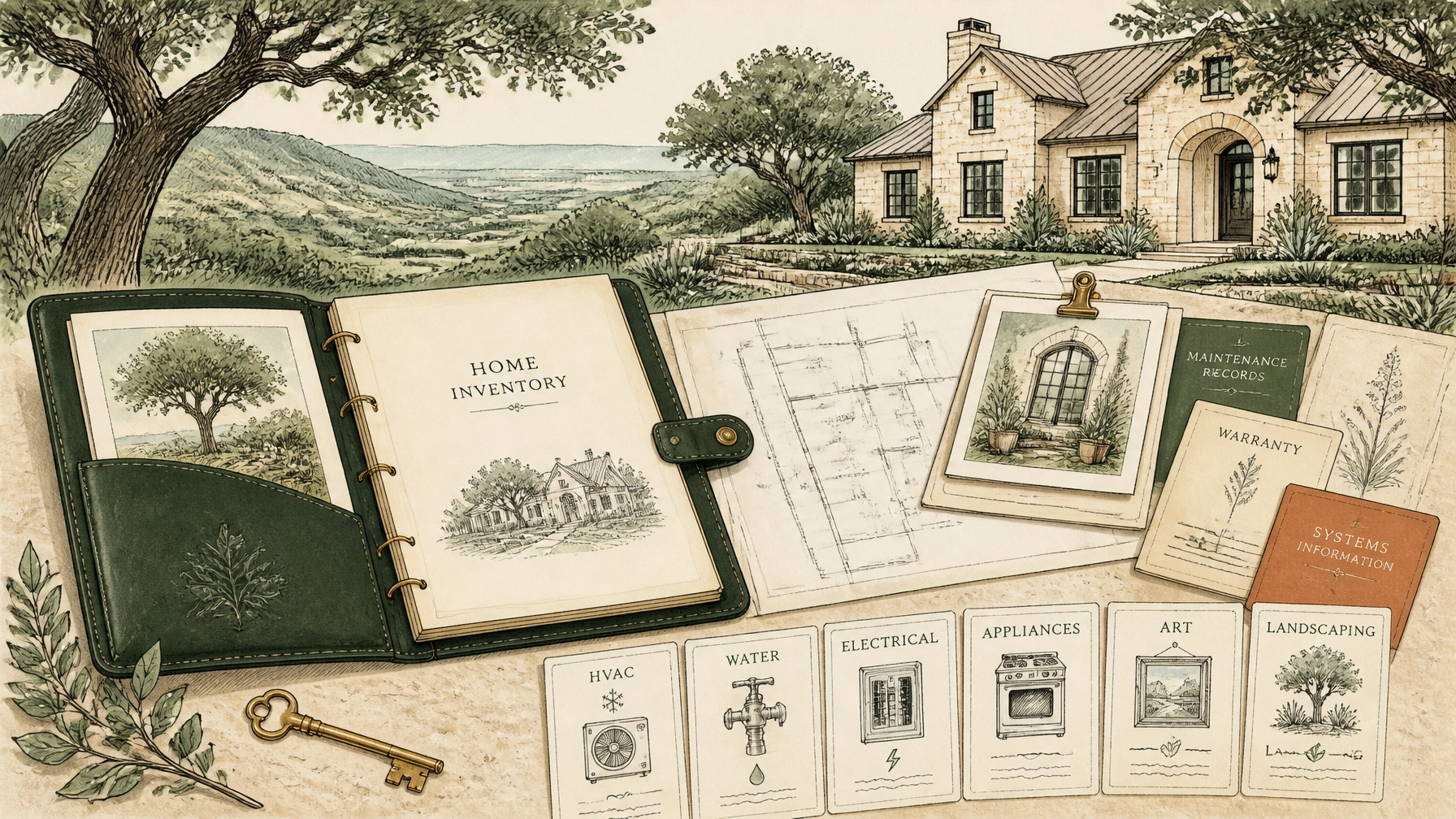
Moving into a Hill Country home is more than receiving keys. It is the beginning of your relationship with a property: its limestone surfaces, custom finishes, appliances, artwork, landscape, and essential systems.
Before boxes disappear into closets, create a durable property record. A well-organized home inventory can help you understand what you own, preserve important details, support an insurance claim if necessary, and make future maintenance or resale conversations far easier.
The goal is not to create another moving checklist. It is to establish a reliable reference library for the home you are about to enjoy.
“Having a detailed home inventory is important if you ever need to make an insurance claim,” advises the Texas Department of Insurance.
Begin With a Room-by-Room Record
Start with the home in its new, unoccupied: or nearly unoccupied: condition. This gives you a baseline before furniture, artwork, and personal possessions change the appearance of each room.
Create a digital folder for every major area:
- Entry and foyer
- Kitchen and pantry
- Dining room
- Living areas
- Primary suite
- Guest bedrooms
- Offices or libraries
- Media rooms
- Garages and workshops
- Outdoor kitchens, patios, and terraces
- Storage rooms and closets
For each room, record the date, room name, and general condition. Take wide photographs from the corners and doorways, then add closer images of notable finishes or built-in features.
Document details such as:
- Flooring materials and condition
- Cabinetry, millwork, and hardware
- Countertops and backsplashes
- Light fixtures and ceiling treatments
- Doors, windows, shutters, and specialty glass
- Fireplaces and stonework
- Built-in shelving or entertainment systems
- Visible marks, scratches, cracks, or unfinished items
A simple room diagram can make the record more useful. Mark the location of shutoff valves, electrical panels, thermostats, water equipment, alarm components, and other items you may need to locate later. The diagram is not a substitute for professional documentation; it is a quick visual reference.

Photograph the Home as a Record, Not a Showcase
Beautiful photographs are useful, but documentation photographs serve a different purpose. They should show condition, placement, identifying details, and scale.
Use consistent lighting when possible. Photograph each room from several directions, and include close-ups of:
- Appliance model and serial plates
- HVAC equipment labels
- Water heaters and filtration equipment
- Electrical panels and labeled breakers
- Irrigation controls
- Security devices and smart-home hubs
- Flooring transitions and specialty surfaces
- Existing imperfections
- Valuable furniture, rugs, and decorative objects
- Mature trees, planted beds, fountains, pools, and outdoor structures
A narrated video walkthrough can supplement still photographs. Open closets, drawers, cabinets, and storage areas while briefly describing what the camera is showing. The Texas Department of Insurance recommends photographing or recording each room, including garages and sheds, and keeping the record somewhere away from the home.
Use a naming convention that will still make sense years from now:
2026-09-02_Kitchen_Refrigerator_SerialPlate.jpg
2026-09-02_LivingRoom_Fireplace_WideView.jpg
Back up the files in at least two locations, such as cloud storage and an external drive kept away from the property. Avoid storing the only copy on a phone that could be lost or damaged.
Build a Systems Register
Your systems register should identify what is installed, where it is located, and how to find its documentation. The focus is not on creating a service schedule; it is on preserving the property’s technical identity.
Create a record for each major system with these fields:
| Field | What to capture |
|---|---|
| System | HVAC, water heater, security, irrigation, filtration, and so on |
| Location | Exact room, closet, garage wall, attic access, or exterior location |
| Manufacturer | Company name |
| Model | Full model number |
| Serial number | Exact number from the equipment label |
| Installation date | If known |
| Installer | Company or contractor |
| Warranty period | Start date and expiration date |
| Documents | Manual, invoice, permit, inspection, or certificate |
| Notes | Special settings, access instructions, or related equipment |
Include equipment that may be easy to overlook: wine refrigerators, ice makers, whole-house audio, electric gates, specialty lighting controls, workshop equipment, pool controls, and outdoor kitchen appliances.
For a property with sophisticated features, take a photograph of each control panel and label its location in your records. If a system has an app, note the platform name and where account credentials are securely stored. Do not place passwords in a general home inventory document.

Catalog Appliances and Built-In Features
Affluent Hill Country homes often include more than standard kitchen and laundry appliances. Document every significant item, whether freestanding or built in.
For each appliance, record:
- Make and model
- Serial number
- Purchase or installation date
- Current condition
- Warranty information
- Original invoice, if available
- Filter or accessory specifications
- Location of the manual
This may include:
- Refrigerators, freezers, and wine storage
- Ranges, ovens, and warming drawers
- Dishwashers and specialty sinks
- Washers and dryers
- Ice makers
- Espresso equipment
- Outdoor grills and refrigerators
- Garage refrigerators or freezers
- Generators or backup equipment, if present
- Smart thermostats and lighting controls
The National Association of Insurance Commissioners recommends grouping belongings by room or category, taking photographs, and exporting the information so it can be retained securely.
Give Artwork and Valuables Their Own File
Artwork, antiques, jewelry, collectibles, and fine furnishings deserve more than a line in a general spreadsheet. Create a separate valuables register with a photograph and a short description for each item.
Capture:
- Artist, maker, or designer
- Title or identifying description
- Medium and materials
- Dimensions
- Date acquired
- Purchase price, if available
- Current appraisal date
- Provenance or ownership history
- Condition notes
- Exact location in the home
- Framing, mounting, or display details
- Related receipts and certificates
Photograph artwork straight on, then photograph the back, frame, signature, labels, and any installation hardware. For jewelry or small valuables, include a size reference when appropriate, but avoid displaying sensitive security information.
Ask your insurance professional whether special documentation or separate coverage is appropriate for particular items. A home inventory is a record: not a replacement for reviewing your policy.
Record Finishes and Landscape Features
A property record should preserve the character of the home, not just its mechanical components.
For custom finishes, document the source and specifications whenever possible:
- Paint colors and manufacturers
- Stone type and quarry or supplier
- Tile collections and grout colors
- Wood species and stain
- Countertop material
- Upholstery fabrics
- Wallpaper patterns
- Exterior stains and sealants
- Replacement bulbs or specialty hardware
For the landscape, photograph the property by area rather than attempting to identify every plant. Note mature oaks, specimen trees, native plantings, planted beds, retaining walls, water features, outdoor lighting, gates, fencing, and built-in furniture.
A simple landscape map can show where each major feature is located. Add plant names only when they are known and useful. If the property came with landscape plans or planting records, scan them and preserve the originals.
Create a Warranty and Contact Directory
Keep warranty documents together with the systems register, but also create a one-page directory for quick access.
Include contacts for:
- Builder or general contractor
- HVAC installer
- Appliance providers
- Security and smart-home professionals
- Landscape designer or maintenance provider
- Pool or water-feature specialist
- Gate and access-control provider
- Specialty finish or stone-care provider
- Art installer or storage professional
- Home insurance representative
For each contact, include the company name, primary contact, phone number, email address, website, and the service associated with the property. Record the date of the last update.
Keep invoices, inspection reports, paid receipts, manuals, permits, and warranty certificates in both paper and digital formats. Use clear folders such as:
01 Property Documents02 Systems03 Appliances04 Finishes05 Artwork and Valuables06 Landscape07 Maintenance History
Add a Seasonal Maintenance Record
A seasonal record is different from a task list. It establishes what was observed, what was completed, who performed the work, and when the matter should be reviewed again.
Use a recurring table with these columns:
| Date | Area or system | Observation or work completed | Provider | Cost | Next review |
|---|
Create separate tabs or folders for spring, summer, fall, and winter. Add photographs when work changes the property: for example, after a landscape redesign, exterior finish project, major appliance replacement, or significant repair.
Over time, this record can reveal patterns and preserve institutional knowledge about the house. It can also help a future caretaker, family member, or buyer understand how the property has been maintained.

Review the Record Once a Year
Set aside one afternoon each year to update the inventory. Add new purchases, remove items no longer owned, photograph renovations, and verify that warranties and contact information are current.
You may also want to review the inventory after:
- A major remodel
- A significant art or jewelry purchase
- A change in insurance coverage
- The arrival or departure of a family member
- A change in property manager or caretaker
- A large landscaping project
- The sale or replacement of major equipment
Your Hill Country home should feel relaxed and effortless. A well-built property record supports that experience quietly in the background. It gives you a clearer view of what you own, what the home contains, and how its story is being preserved.
For broader retirement lifestyle and relocation resources, visit Texas Hill Country Retirement. For personalized conversations about how a new property fits into your larger retirement picture, learn more about Portafolio Capital Management dba Mau Sanchez Capital.
Schedule a private meeting with a fiduciary financial advisor today by calling (512) 593-8380 or by visiting: https://calendly.com/portafoliocapital/15min
Portafolio Capital Management dba Mau Sanchez Capital is a Registered Investment Adviser. This content is for informational purposes only and does not constitute investment advice or a solicitation to buy or sell any security. Advisory services are provided only pursuant to a written advisory agreement.
This article may include stories, scenarios, and perspectives created or assisted by artificial intelligence. Although the individuals and circumstances described may be fictional, the topics are intended to reflect real financial, personal, and lifestyle issues that retirees and individuals commonly face.
The content is provided to encourage readers to consider different perspectives that may affect their retirement, regardless of whether they are currently planning, approaching retirement, or already retired. It is intended for general educational and informational purposes only and should not be interpreted as personalized investment, financial, tax, legal, medical, or retirement-planning advice.
Individual circumstances vary. Readers should independently verify any information presented and consult appropriately qualified professionals before making financial or personal decisions. No advisory, professional, or client relationship is created through the use of this website.
Leave a Reply