
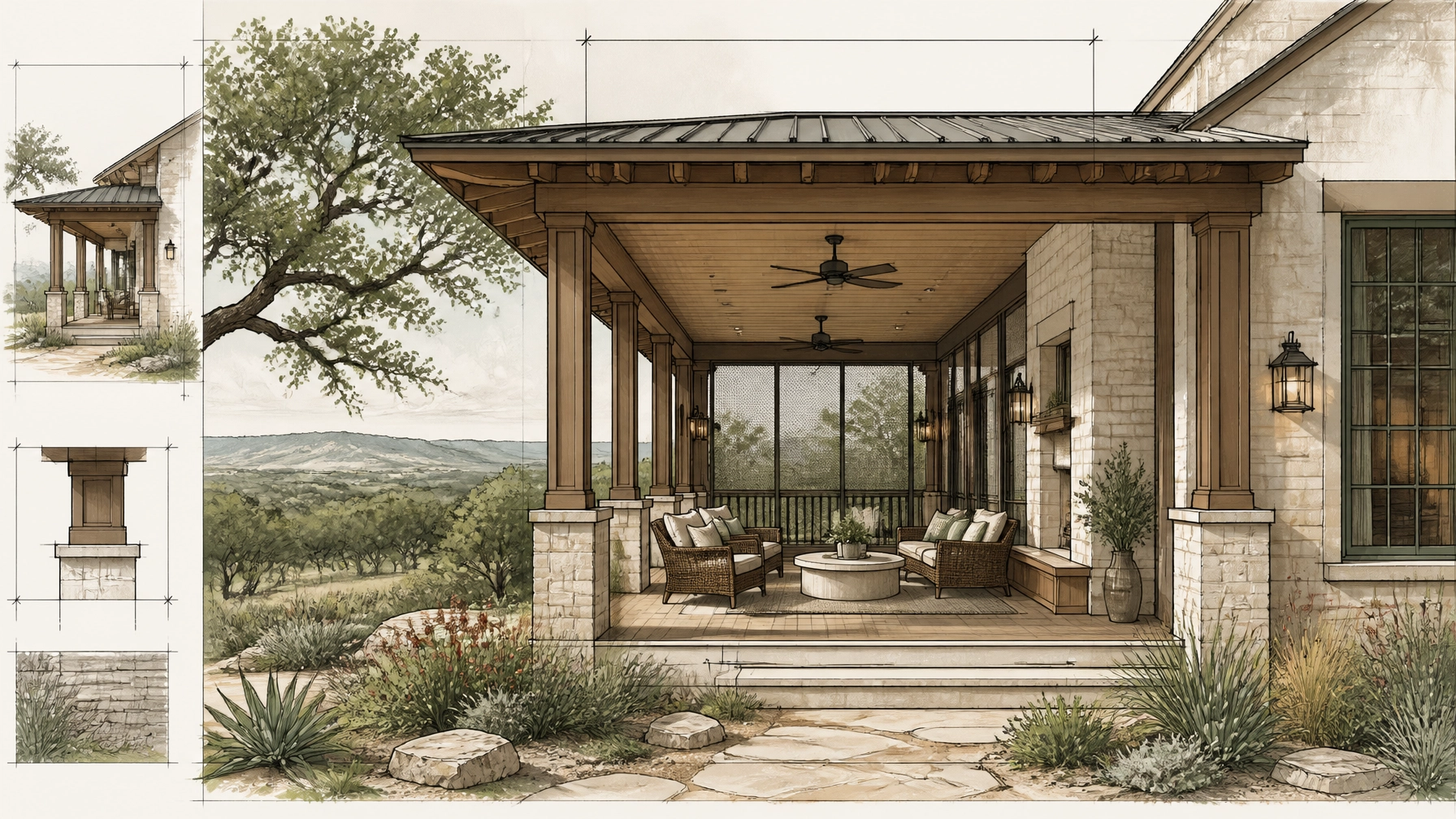
In the Texas Hill Country, a porch can be much more than a covered entrance. Designed thoughtfully, it becomes the place where the day begins, the afternoon slows down, and the evening gathers around a view.
For retirees and pre-retirees choosing a home near Austin, Fredericksburg, Kerrville, Boerne, or the Highland Lakes, the porch deserves the same attention as the kitchen or primary suite. Its depth, orientation, screening, furniture, lighting, and relationship to the landscape all determine whether it becomes a beloved daily room: or an attractive space that is rarely used.
A successful Hill Country porch sits between architecture and nature. It offers shelter without isolation, openness without exposure, and comfort without losing the character of the land.
Begin with the life you want to live there
Before selecting finishes or furniture, imagine a typical week.
Will you drink coffee outside before the day becomes warm? Read in the afternoon? Watch birds near the trees? Enjoy a glass of wine after dinner? Work on a laptop for an hour? Welcome visiting children and grandchildren? Keep a shaded place for a dog?
These small, repeated activities should shape the porch more than occasional entertaining. A dining table may be useful, but a comfortable chair, convenient side table, reading light, and a clear view may matter more if the porch is intended for daily use.
The best porch is not designed around a single photograph. It is designed around a rhythm.
As one custom-home design perspective explains, “The goal is a porch that naturally extends living space rather than simply marking a transition between indoors and out.” Read the full discussion of integrated porch design.
Porch depth determines whether the space feels generous
Depth is one of the most important: and most frequently underestimated: porch decisions.
A shallow porch may accommodate a pair of chairs, but it usually cannot support comfortable circulation, a meaningful view corridor, and more than one piece of furniture. For a porch intended to function as an outdoor room, six feet is often a practical minimum. Eight to ten feet creates significantly more flexibility.
An eight-foot porch can allow for:
- Two lounge chairs and a small table
- A built-in bench along the wall
- A walking path between the porch and the yard
- A compact dining or breakfast area
- Comfortable clearance around doors
At nine or ten feet, the porch can begin to support distinct zones. One end might hold two reading chairs, while the other accommodates a small dining table. The space feels less like a passageway and more like a room with purpose.
A porch-design resource makes a similar distinction, noting that greater depth allows homeowners to create separate areas for dining, privacy, and socializing. See the reference discussion on eight- and ten-foot porch depths.
Of course, greater depth affects roof structure, proportions, drainage, and construction. The final dimensions should be reviewed with a qualified architect or builder, especially where local codes, lot setbacks, and roof pitch are involved.

Let orientation choreograph the day
A porch can be beautifully furnished and still be uncomfortable if it faces the wrong direction.
For many Hill Country homes, an east-facing porch is appealing because it welcomes gentle morning light while avoiding the strongest late-afternoon heat. A north-facing porch may offer more consistent shade, particularly during the hottest months.
South-facing porches can work well when designed with appropriate roof overhangs, trellises, or shade structures. West-facing areas may capture memorable sunsets, but they often need additional protection from glare and heat. A deep roof, carefully placed trees, exterior shades, or screened sections can make a west-facing porch more usable.
Orientation should also respond to breeze patterns and the land itself. A porch that opens toward a breezeway, oak grove, canyon, or pasture may feel naturally cooler and more peaceful than one pointed toward a driveway or neighboring structure.
Rather than asking only, “Which direction has the best view?” consider:
- Where will the sun be during your favorite hour?
- Which direction offers the most comfortable breeze?
- Will headlights, road noise, or neighboring homes affect the experience?
- Can the porch frame a view without exposing the entire interior?
- Where will rainwater flow during a storm?
A smaller porch in the right location can outperform a larger porch in the wrong one.
Screens should support: not erase: the landscape
Screening is especially valuable for evening use, when insects can discourage people from lingering outdoors. But a screened porch should not feel like a sealed box.
Fine-mesh screens, large openings, and carefully proportioned columns can preserve the sense of connection with the surrounding property. If possible, place the screened portion on the shadier side of the home, where it is less likely to collect heat.
A hybrid design can be particularly effective:
- An open section for unobstructed views and fresh air
- A screened section for dining, reading, and evening use
- Retractable shades or curtains for moments when additional privacy is needed
- Generous doors connecting the porch to the kitchen, living room, or primary suite
The transition matters. A porch feels more intentional when the flooring, ceiling material, and door placement relate naturally to the room behind it. The goal is not to make the porch look like an interior room, but to make movement between the two feel effortless.
Treat the ceiling as part of the architecture
The ceiling is often the most visible surface on a covered porch. It also plays a major role in comfort.
A beadboard or tongue-and-groove ceiling can bring warmth and texture to a limestone or stucco home. Exposed beams may reinforce a ranch or lodge-inspired design. A higher ceiling can make a deep porch feel open while helping warm air rise above the seating area.
Ceiling fans are more than decorative accents in the Texas Hill Country. They create air movement that can make the porch feel more comfortable when natural breezes are still. On a long porch, two appropriately sized outdoor-rated fans may distribute air more evenly than one oversized fixture.
Place fans over the zones where people actually sit rather than centering them only for visual symmetry. A fan above a dining table and another above a lounge area can make the porch feel designed around use.
Choose furniture for long, unhurried hours
Porch furniture should encourage people to stay.
For a retirement home, that may mean selecting deeper chairs with supportive backs, cushions that are easy to rise from, and tables positioned within comfortable reach. Furniture should be durable enough for the climate but still feel residential rather than commercial.
Consider combining:
- A pair of supportive lounge chairs for reading or conversation
- A small sofa or built-in bench for flexible seating
- A round table that makes coffee, cards, or conversation easy
- Ottomans that can serve as footrests or occasional seating
- Outdoor rugs to define zones without visually closing them in
- Storage for cushions, throws, games, or gardening tools
Avoid filling every corner. A porch needs room for circulation, views, and the occasional change in arrangement. Leave clear paths from the interior door to the steps, garden, or driveway.
For long-term comfort, thoughtful details matter: nonslip flooring, stable handrails, adequate lighting at changes in level, and seating heights that do not require excessive effort to use.

Use lighting to extend the porch into the evening
A porch should not go dark the moment the sun sets. Layered lighting allows it to remain useful without washing out the night sky or creating glare.
Begin with soft ambient light from ceiling fixtures or discreet recessed lighting. Add wall sconces near doors and steps, then use smaller accents near reading chairs, planters, or architectural columns.
Warm color temperatures: often in the 2700K to 3000K range: tend to complement natural wood, limestone, and muted exterior finishes. The fixtures should illuminate the people and surfaces on the porch without pointing directly toward the view.
A well-lit porch might include:
- A dimmable ceiling fixture for general illumination
- Low-glare sconces near entrances
- A pendant above a dining table
- Step or pathway lighting for safe movement
- Subtle landscape lighting beyond the porch
- Portable lamps rated for outdoor use
Keep lighting controls convenient. If the switches are hidden inside a distant hallway, the porch will be less likely to receive regular evening use.

Frame views while preserving privacy
Privacy does not have to mean closing off the landscape.
Columns, screens, half-height walls, built-in benches, and layers of native planting can direct attention toward a desirable view while softening less appealing sightlines. A porch near a road may benefit from shrubs and ornamental grasses. A porch near a neighboring home may need a trellis, a low stone wall, or carefully placed trees.
Think in layers:
- Foreground: planters, grasses, and low walls that define the porch edge
- Middle ground: shrubs, small trees, or a trellis that soften direct views
- Background: live oaks, limestone outcroppings, pasture, or distant hills
The goal is not to block everything. It is to create a sense of enclosure while maintaining the spaciousness that makes Hill Country living appealing.

Design for the porch you will use on an ordinary Tuesday
The most successful porch is often the one that supports unremarkable moments.
It is where you read the morning news, take a phone call, sort through mail, watch a summer storm, or enjoy ten quiet minutes before dinner. It should have shade where you need it, light when you need it, and enough comfort that going outside requires no special preparation.
For anyone evaluating a future home in the Texas Hill Country, the porch can reveal a great deal about the larger lifestyle. Does the property invite you to slow down? Is the landscape part of daily life? Can the home support both privacy and connection?
As you explore relocation options, resources such as the Texas Hill Country Retirement home page and the ultimate residency checklist can help place the home search within the broader decision of how: and where: you want to live.
A porch is not simply an architectural accessory. At its best, it is a daily invitation: step outside, settle in, and let the landscape become part of home.
Schedule a private meeting with a fiduciary financial advisor today by calling (512) 593-8380 or by visiting: https://calendly.com/portafoliocapital/15min
Portafolio Capital Management dba Mau Sanchez Capital is a Registered Investment Adviser. This content is for informational purposes only and does not constitute investment advice or a solicitation to buy or sell any security. Advisory services are provided only pursuant to a written advisory agreement.
This article may include stories, scenarios, and perspectives created or assisted by artificial intelligence. Although the individuals and circumstances described may be fictional, the topics are intended to reflect real financial, personal, and lifestyle issues that retirees and individuals commonly face.
The content is provided to encourage readers to consider different perspectives that may affect their retirement, regardless of whether they are currently planning, approaching retirement, or already retired. It is intended for general educational and informational purposes only and should not be interpreted as personalized investment, financial, tax, legal, medical, or retirement-planning advice.
Individual circumstances vary. Readers should independently verify any information presented and consult appropriately qualified professionals before making financial or personal decisions. No advisory, professional, or client relationship is created through the use of this website.
Leave a Reply