
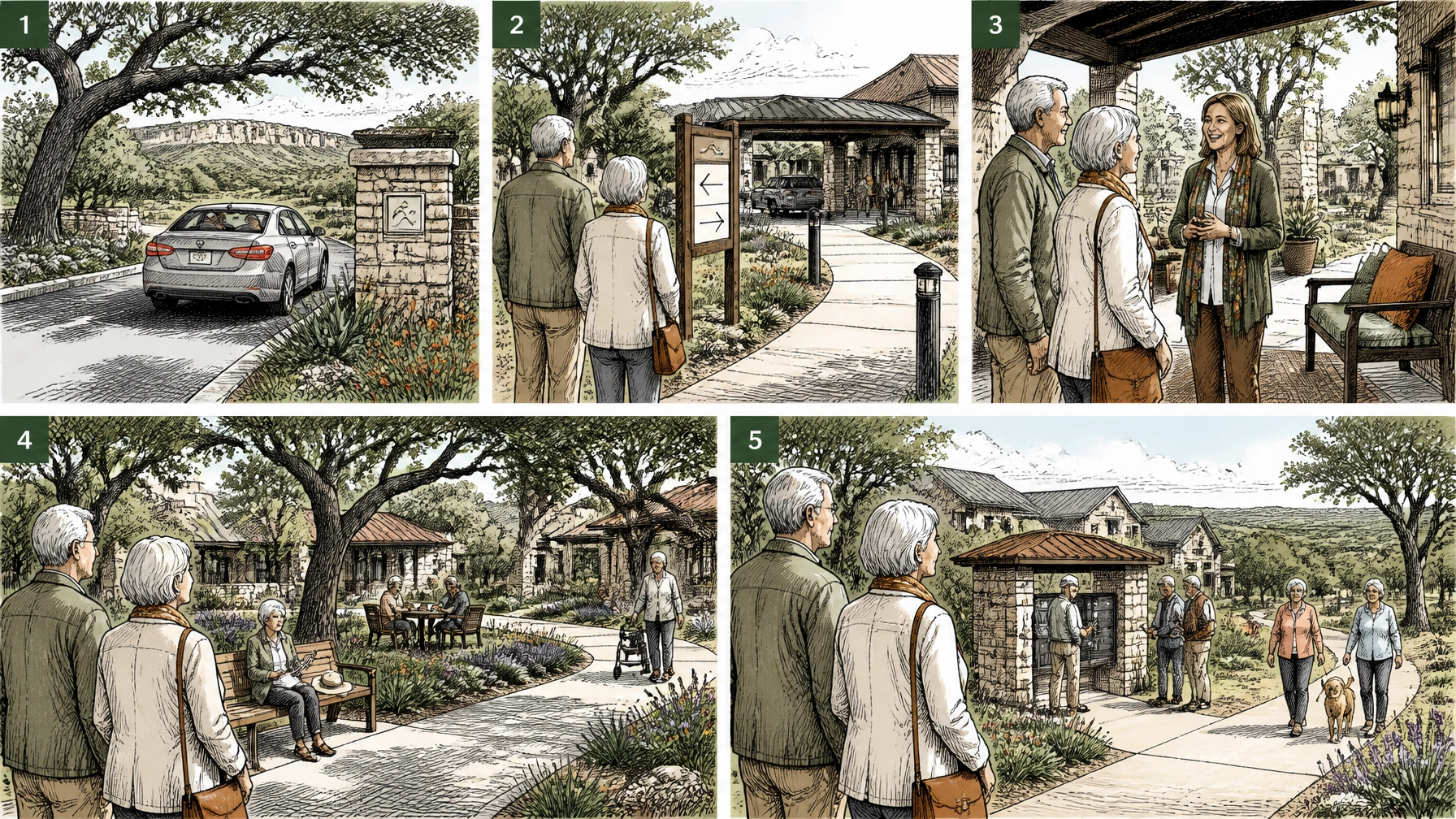
A retirement community can look impressive in a brochure, online gallery, or carefully choreographed tour. But before you see the model residence, taste the dining menu, or hear about the activity calendar, the community has already begun introducing itself.
The introduction happens at the entrance.
The first five minutes can reveal how easy the property is to understand, how thoughtfully it welcomes visitors, how residents move through the space, and whether the setting feels genuinely livable beyond the polished presentation. This is not a substitute for due diligence. It is an early field test: a way to notice the details that are easy to overlook when a tour is moving quickly.
“The best way to understand a community is to observe how it works when nobody is performing for you.”
For retirees exploring the Texas Hill Country, that distinction matters. A community may promise peaceful living near Austin, beautiful landscapes, and an active social calendar. The arrival experience helps you determine whether those promises are visible in ordinary moments.
Minute One: Read the Approach Before You Park

Do not wait until you reach the reception desk to begin evaluating the community. Start while you are still on the road.
Notice whether the entrance is easy to identify from a natural driving approach. Are the community’s signs visible without being oversized or cluttered? Does the road narrow abruptly? Is the turn comfortable for a driver unfamiliar with the property? Are there clear indications of visitor parking, guest drop-off, or accessible entry?
Hill Country terrain can create unique design challenges. Sloped roads, limestone outcroppings, winding lanes, and mature trees can add character, but they can also affect visibility and ease of movement. A beautiful entrance should still feel intuitive.
Look for:
- A clearly marked visitor entrance
- Adequate lighting, particularly if residents drive after sunset
- A drop-off area that does not force visitors into active traffic
- Parking spaces close enough to the entrance for guests with limited stamina
- A route that appears smooth, stable, and free of unnecessary obstacles
- Landscaping that frames the entrance without obscuring signs or sightlines
The U.S. Access Board’s accessibility standards describe the importance of an accessible route connecting site arrival points, such as parking and passenger loading zones, to an accessible entrance. Those standards are not a complete evaluation of a residential community, but they provide a useful reference point when asking how easily people can move from vehicle to building.
If the first turn feels confusing, take note. A community does not need to look institutional to be easy to navigate.
Minute Two: Follow the Signs: and See What They Assume
Once you leave the car, let the signs guide you. Resist the urge to ask for directions immediately.
Can you tell where visitors are expected to go? Is the path to reception obvious? Do signs point toward restrooms, common areas, elevators, dining spaces, or outdoor courtyards? Are the letters large enough to read comfortably, and do they contrast with their background?
Good wayfinding does not demand attention. It quietly reduces the number of decisions a new resident must make.
This is especially important in a larger community, where residents may regularly travel between a residence, dining room, wellness space, mail area, and activity rooms. An attractive property can still become frustrating if every destination requires guesswork.
Pay attention to the difference between decorative signs and functional signs. A carved stone marker may reinforce the Hill Country aesthetic, but it cannot replace clear directional information. Likewise, a directory filled with too many names, arrows, and abbreviations may be technically informative while remaining difficult to use.
Ask yourself:
- Could a first-time visitor find the restroom without assistance?
- Would a resident know which path leads to the dining room?
- Are elevators and stairs identified consistently?
- Are there places to pause if someone needs to rest?
- Does the accessible route feel like the normal route: or a hidden detour?
If you use a cane, walker, wheelchair, or simply prefer shorter walking distances, follow the route you would realistically use. Do not allow the tour guide to select the easiest path on your behalf without explaining the alternatives.
Minute Three: Study the Welcome, Not Just the Greeting

A warm hello is pleasant. A thoughtful welcome is more revealing.
Notice how staff respond when you arrive. Are you acknowledged promptly, or do you wait while people continue private conversations? Does the host introduce themselves and explain what will happen next? Do they ask how you would like to tour the property, or do they immediately begin reciting features?
The best welcome is personal without being intrusive. It may include a glass of water, a comfortable seat, a brief explanation of the layout, or an offer to adjust the pace. If one person in your party has mobility, hearing, or vision concerns, observe whether staff respond naturally and respectfully.
Staff should guide rather than point.
There is a meaningful difference between “The dining room is down that hallway” and walking with you far enough to make sure the route is clear. The second response may indicate a broader culture of attentiveness.
During the first few minutes, listen for how employees speak about residents. Do they use names? Do they pause when a resident approaches? Do they refer to people as neighbors and individuals, or primarily as occupants, units, and care levels?
You may also want to ask one unplanned question:
“If we came back next week without an appointment, what would we notice that we might not see today?”
The answer can reveal whether the community is comfortable with ordinary observation or prefers to control every visit.
Minute Four: Listen for the Community’s Soundtrack

Noise is easy to underestimate during a tour, especially when the guide is speaking and your attention is focused on architecture.
Pause for a moment and listen.
What do you hear from the entrance? Is there traffic from a nearby road? Mechanical equipment? Golf carts? Delivery vehicles? Music from a common room? Echoes in a large lobby? Construction activity? A busy commercial area beyond the property?
None of these sounds is automatically a problem. The question is whether the sound matches your preferred rhythm.
A lively community may have more activity near dining, fitness, or social spaces. A secluded residence may be quiet but farther from services. Some people want the gentle energy of neighbors coming and going; others want a retreat where mornings are nearly silent.
Also notice whether the landscaping supports the experience. Mature live oaks, native grasses, limestone walls, shaded paths, and courtyards can create a strong sense of place. But the practical details matter just as much:
- Are paths maintained after rain?
- Do trees provide shade where people actually walk?
- Are benches placed at useful intervals?
- Is outdoor seating protected from intense afternoon sun?
- Do plants create a welcoming environment without narrowing walkways?
- Are there signs of routine maintenance, such as trimmed edges and functioning lights?
A community’s outdoor areas should not exist only for photographs. Look for evidence that residents use them in ordinary ways.
Minute Five: Watch the Neighbors, Then Look Beyond the Tour
The final minute of the arrival test is about social behavior.
Do residents acknowledge one another? Does anyone make eye contact with visitors? Are people sitting together, walking independently, waiting for transportation, collecting mail, or heading toward an activity? Are common spaces occupied naturally, or do they appear arranged for inspection?
You are not looking for constant conversation or artificial cheerfulness. A healthy community can include quiet residents, private moments, and different levels of engagement. Instead, look for variety and ease.
One resident reading alone is not a warning sign. A courtyard that is empty at lunchtime, despite being presented as a social hub, may deserve a question.
Ask whether the tour includes the parts of the community that residents use every day:
- Mail and package areas
- Laundry or utility spaces
- Transportation pickup points
- Trash and recycling areas
- Secondary walking paths
- Dining room entrances during a normal meal period
- Outdoor seating away from the model residence
The difference between a staged tour and daily life is often visible in the transitions. Model homes are designed to impress. Hallways, parking areas, service routes, and shared spaces reveal how the community actually operates.
The Second-Visit Rule: Test the Ordinary Version
A first visit provides an impression. A second visit provides context.
Return at a different time of day, preferably without a tightly scheduled tour. Try a weekday morning, late afternoon, or mealtime. Weather can also change the experience. A sunny spring visit may feel very different from a hot Texas afternoon or a rainy day.
On the second visit, observe:
- Whether the entrance remains easy to find
- How quickly staff acknowledge an unscheduled visitor
- Whether the noise level changes
- How residents use outdoor spaces
- Whether paths are shaded and comfortable
- How long people wait for transportation or assistance
- Whether staff appear relaxed, rushed, or understaffed
- Whether the community feels connected to its surrounding Hill Country town
This is not about catching a community off guard. It is about seeing more than one version of the place.
The right retirement community will not be perfect in every moment. It should, however, feel coherent. The arrival, the staff culture, the surroundings, and the resident experience should support the lifestyle being presented.
Turning the Arrival Test Into a Better Decision
After each visit, write down your impressions before comparing floor plans or monthly fees. Use specific language rather than a vague rating.
Instead of writing “nice community,” record:
- “We found the entrance without calling.”
- “The accessible route was longer but clearly marked.”
- “The host walked with us instead of pointing.”
- “The courtyard was beautiful but had little afternoon shade.”
- “Residents greeted staff by name.”
- “Road noise was noticeable near the front residences.”
- “The tour focused on the model home but did not show the mail area.”
These observations will help you compare communities based on the life you may actually live: not simply the presentation you received.
Texas Hill Country Retirement is a lifestyle and retirement resource for people considering communities, homes, towns, and experiences throughout the region. When a relocation decision also changes your housing costs, travel patterns, charitable giving, or retirement income needs, Portafolio Capital Management dba Mau Sanchez Capital can help families evaluate the broader financial picture through client-specific planning and investment management. Any tax-related considerations mentioned in a general educational context should be reviewed with a qualified tax professional for guidance based on your individual circumstances.
The first five minutes will not tell you everything. But they may tell you whether the community is easy to enter, easy to understand, and comfortable to inhabit. That is a meaningful place to begin.
Schedule a private meeting with a fiduciary financial advisor today by calling (512) 593-8380 or by visiting: https://calendly.com/portafoliocapital/15min
Portafolio Capital Management dba Mau Sanchez Capital is a Registered Investment Adviser. This content is for informational purposes only and does not constitute investment advice or a solicitation to buy or sell any security. Advisory services are provided only pursuant to a written advisory agreement.
This article may include stories, scenarios, and perspectives created or assisted by artificial intelligence. Although the individuals and circumstances described may be fictional, the topics are intended to reflect real financial, personal, and lifestyle issues that retirees and individuals commonly face.
The content is provided to encourage readers to consider different perspectives that may affect their retirement, regardless of whether they are currently planning, approaching retirement, or already retired. It is intended for general educational and informational purposes only and should not be interpreted as personalized investment, financial, tax, legal, medical, or retirement-planning advice.
Individual circumstances vary. Readers should independently verify any information presented and consult appropriately qualified professionals before making financial or personal decisions. No advisory, professional, or client relationship is created through the use of this website.
Leave a Reply