
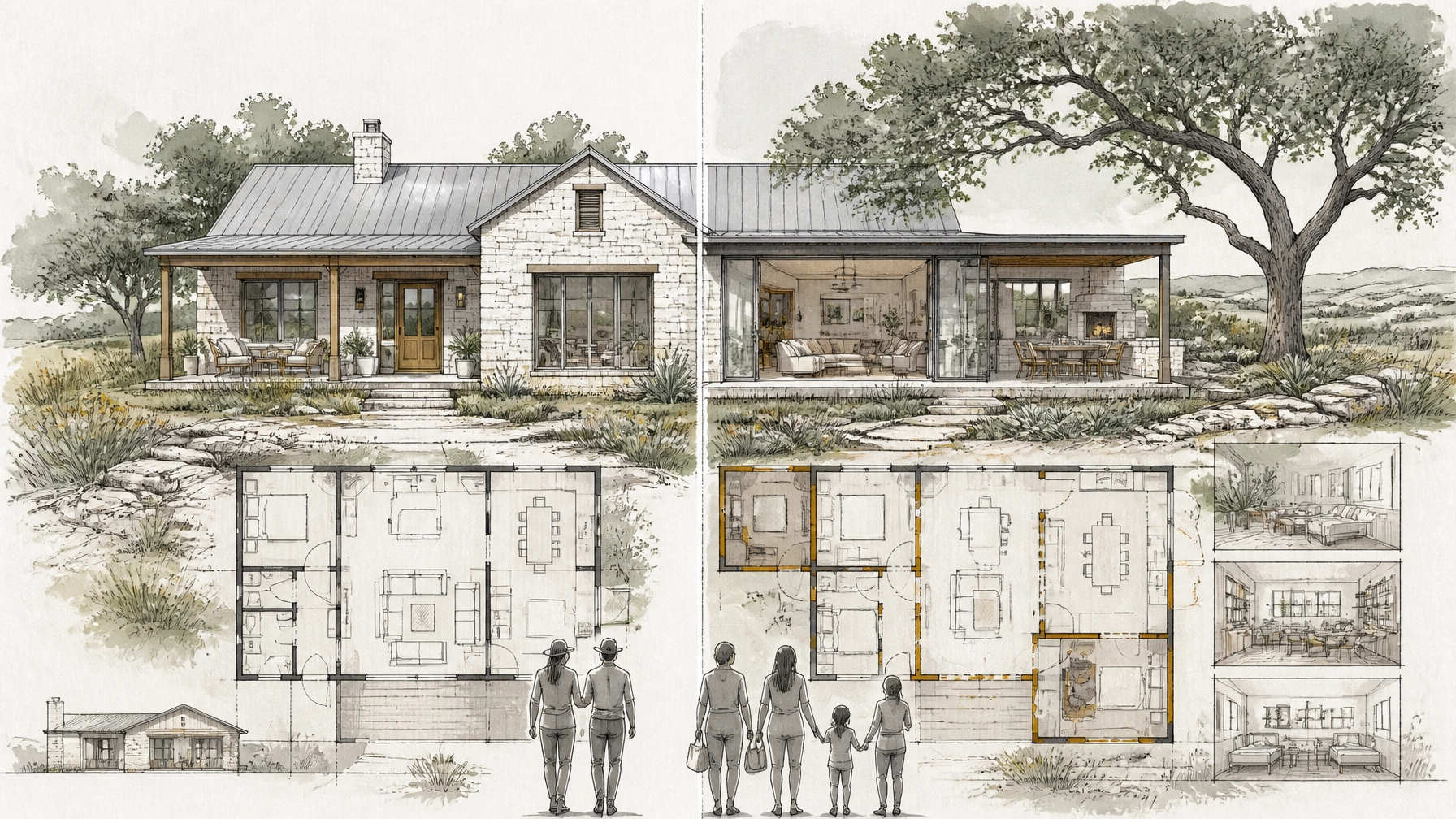
A Texas Hill Country home should feel personal. The limestone, shaded porch, native oaks, and long views are part of the reason you chose the region in the first place.
But a home can become too personal.
A custom wine room, highly specialized workshop, dramatic interior finishes, or a difficult-to-maintain landscape may be perfect for one chapter of life and limiting in the next. If you are an affluent retiree or pre-retiree thinking about long-term flexibility, the goal is not to create a generic house. It is to create a home with enough character to feel rooted, and enough adaptability to welcome a future buyer.
That is the central idea behind “buying for the next buyer.” You are not trying to predict exactly who will purchase the property. You are preserving options for several likely households, lifestyles, and stages of life.
Start With Optionality, Not Trends
The most resilient Hill Country homes tend to have a clear identity without being locked into one use.
That often means choosing a flexible plan over a collection of highly specialized rooms. A room labeled “media room” today might become a library, office, guest room, studio, or quiet retreat later. A generous dining area might support formal entertaining, family gatherings, or a work-from-home arrangement.
Consider these adaptable planning principles:
- A mostly single-level layout, or at least a primary suite, kitchen, laundry, and main living areas on the entry level
- A dedicated flex room near, but not inside, the main living space
- A split-bedroom arrangement that allows privacy for owners and guests
- A guest suite that can also serve as a caregiver, family, or extended-stay space
- Pocket doors or thoughtfully placed partitions that can separate rooms without making them feel closed off
- Clear circulation between the garage, entry, kitchen, bedrooms, and outdoor living areas
- Storage that can support changing hobbies, equipment, and household needs
This is not about designing for one narrow future scenario. It is about avoiding a floor plan that works only if the current owners continue living exactly as they do today.
As one custom-home design perspective puts it, “A floor plan should grow with your family, not against it.” The same principle applies to resale: rooms should be able to evolve without requiring a major renovation.
For a broader look at preparing for changing retirement circumstances, Texas Hill Country Retirement’s “What If” Workbook offers a useful planning mindset that can also apply to a long-term home decision.
Let Accessibility Be Quietly Inclusive
Accessibility does not have to make a home feel clinical or institutional. In a well-designed Hill Country residence, many features can be incorporated so naturally that every buyer simply experiences them as comfort and quality.
Examples include:
- Wider doorways and comfortable hallway clearances
- Minimal thresholds between interior and exterior spaces
- A main entrance connected to a level or gently sloped path
- A primary bathroom with a low-threshold shower
- Blocking behind bathroom walls for future grab bars, even if they are not installed now
- Lever-style door hardware
- Good lighting at entries, stairs, hallways, and work areas
- Electrical outlets placed where they are convenient rather than hidden behind furniture
- A garage-to-home transition that does not require navigating multiple steps
These details can be valuable to older buyers, multigenerational families, guests with mobility considerations, and anyone who appreciates a home that is easy to use.
The key is restraint. Avoid announcing every adaptable feature. Instead, integrate them into the architecture so the house remains warm, elegant, and unmistakably Hill Country.
Choose Materials That Age With the Landscape
Character comes from materials that belong to the place.
Native or regional limestone, durable masonry, standing-seam metal roofing, timber accents, deep overhangs, and shaded porches remain closely associated with the Hill Country aesthetic. These materials can also withstand the region’s heat, sun, weather shifts, and outdoor lifestyle when properly selected and maintained.
The objective is not to make every surface indestructible. It is to choose materials that develop a good patina rather than look dated or neglected.
Prioritize:
- Stone and masonry that complement the surrounding terrain
- Exterior finishes designed for intense sun exposure
- Durable flooring in high-traffic areas
- Quality windows that balance expansive views with heat management
- Hardware and fixtures that can be repaired or replaced without requiring custom fabrication
- Roofing and drainage systems that are accessible for inspection and maintenance
- Timeless interior colors that allow future owners to add their own personality
Be careful with materials that imitate Hill Country character without actually supporting it. A short-lived trend can be expensive to remove, especially when it has been applied throughout the home.

Respect the Maintenance Reality
A home’s resale appeal includes more than its first impression. Future buyers will want to understand what it takes to operate the property year after year.
This is especially important for acreage, large lots, second homes, and properties with extensive outdoor amenities.
Before adding another feature, ask:
- How often will it need service?
- Is the required expertise readily available nearby?
- What happens if the property is unoccupied for several weeks?
- Does the system require specialized parts?
- Will a future owner understand how everything works?
- Is the maintenance burden proportional to the lifestyle benefit?
Pools, elaborate gardens, outdoor kitchens, fountains, long private drives, detached structures, and sophisticated mechanical systems can all be appropriate. But they should be selected with open eyes.
A low-water landscape using native and well-adapted plants may be more durable than a formal lawn that requires frequent irrigation. Guidance from the Hill Country Alliance and San Antonio Water System’s Hill Country landscape resources both emphasize the value of native landscaping, limited turf, and thoughtful water use.
A future buyer may appreciate a landscape that feels natural, beautiful, and manageable, not one that looks impressive on closing day but demands a full-time groundskeeping plan.
Invest in Infrastructure Buyers Cannot Easily See
Some of the best future-proofing decisions are hidden behind walls, under the foundation, or above the ceiling.
In the Hill Country, infrastructure deserves particular attention because properties can vary significantly in terrain, soil, water access, wastewater systems, and utility availability.
Important questions include:
- Was the foundation designed for the site’s soil and limestone conditions?
- Is drainage directing water away from the structure?
- Is the property served by a dependable municipal water system, well, or shared system?
- If there is a septic system, are records, maintenance history, and capacity documented?
- Does the electrical service have room for future changes?
- Is there conduit for potential solar, battery storage, or electric vehicle charging?
- Is the home prepared for reliable high-speed internet?
- Are HVAC systems efficient, appropriately sized, and easy to service?
- Are insulation, air sealing, and window specifications documented?
The U.S. Department of Energy and ENERGY STAR both identify insulation, air sealing, efficient windows, and properly performing heating and cooling systems as central components of a comfortable, efficient home.
These improvements are not glamorous, but they influence how the property feels every day. A house that remains comfortable in a Texas summer and does not create unnecessary maintenance surprises will often make a stronger impression than one with a more elaborate but less dependable amenity package.
As one homebuilding executive summarized, “Building science plays a big role in how a home performs over time.” That is particularly true when the next buyer may be evaluating the property from a distance, through inspection reports and operating records.

Understand What Regional Buyers May Expect
The Hill Country is not one market. A luxury property near Austin may attract a different buyer from a ranch-style home near Fredericksburg, Boerne, Kerrville, or New Braunfels.
Even so, several preferences appear repeatedly across the region:
- A strong connection between indoor and outdoor living
- Covered porches and shaded entertaining areas
- Views framed without sacrificing privacy
- A practical kitchen with generous storage
- A home office or flex room
- Guest accommodations that do not compromise the owners’ privacy
- A manageable relationship between the home, land, and surrounding landscape
- Authentic materials that reflect the regional setting
- Adequate parking, garage storage, and space for recreational equipment
The best approach is to study the character of the area without copying every trend. A home should feel like it belongs in its community, but it should not look as though it was assembled from a catalog of fashionable features.
Know When Personalization Goes Too Far
Personal expression is part of luxury living. The challenge is distinguishing between a meaningful improvement and a permanent limitation.
Features that may narrow the future buyer pool include:
- A room designed for only one hobby
- Highly dramatic or difficult-to-reverse color schemes
- Built-ins that prevent ordinary furniture arrangements
- Oversized specialty appliances
- Private amenities that require substantial upkeep
- Excessively formal landscaping
- Outdoor spaces with complicated levels and stairs
- A floor plan that sacrifices storage for visual drama
- Technology that depends on proprietary systems or complicated controls
This does not mean you should never build a wine room, art studio, theater, or workshop. It means you should consider whether the room can serve another purpose later.
A flexible wine room might also be a climate-controlled pantry or tasting room. A workshop may be designed with enough light and finished surfaces to become a studio. A theater can retain comfortable seating and sound control without making the room unusable for other activities.
The most valuable customization often improves the experience of the entire home rather than serving only one narrow interest.

Create a Resale Story, Not Just a Beautiful House
A future buyer will not experience your home only through its architecture. They will also evaluate how clearly the property has been cared for.
Keep a simple, organized record of:
- Roof installation and service dates
- HVAC specifications and maintenance
- Foundation reports and drainage work
- Well, septic, or water-system records
- Appliance manuals and warranties
- Landscape plans and irrigation information
- Energy audits or efficiency improvements
- Contractor contacts and product specifications
- Major repairs, renovations, and permits
Documentation reduces uncertainty. It can help a buyer understand the property’s systems, prepare for future upkeep, and appreciate improvements that are not immediately visible. For property-specific tax questions related to homeownership, readers should consult a qualified tax professional for individualized guidance.
Preserve Character by Preserving Choices
Future-proofing a Hill Country home is not about removing personality. It is about making sure personality does not eliminate flexibility.
Choose authentic materials. Protect the views. Keep the porch inviting. Let the landscape reflect the land. Build rooms that can change purpose. Make infrastructure dependable. Treat maintenance as part of the design rather than an afterthought.
Most importantly, leave room for someone else’s story.
Texas Hill Country Retirement is a lifestyle and relocation resource for people considering the region’s communities, homes, amenities, and slower pace of living. When a home decision is part of a larger retirement transition, Portafolio Capital Management dba Mau Sanchez Capital can help families consider how housing choices fit within their broader financial picture.
Schedule a private meeting with a fiduciary financial advisor today by calling (512) 593-8380 or by visiting: https://calendly.com/portafoliocapital/15min
Portafolio Capital Management dba Mau Sanchez Capital is a Registered Investment Adviser. This content is for informational purposes only and does not constitute investment advice or a solicitation to buy or sell any security. Advisory services are provided only pursuant to a written advisory agreement.
This article may include stories, scenarios, and perspectives created or assisted by artificial intelligence. Although the individuals and circumstances described may be fictional, the topics are intended to reflect real financial, personal, and lifestyle issues that retirees and individuals commonly face.
The content is provided to encourage readers to consider different perspectives that may affect their retirement, regardless of whether they are currently planning, approaching retirement, or already retired. It is intended for general educational and informational purposes only and should not be interpreted as personalized investment, financial, tax, legal, medical, or retirement-planning advice.
Individual circumstances vary. Readers should independently verify any information presented and consult appropriately qualified professionals before making financial or personal decisions. No advisory, professional, or client relationship is created through the use of this website.
Leave a Reply