
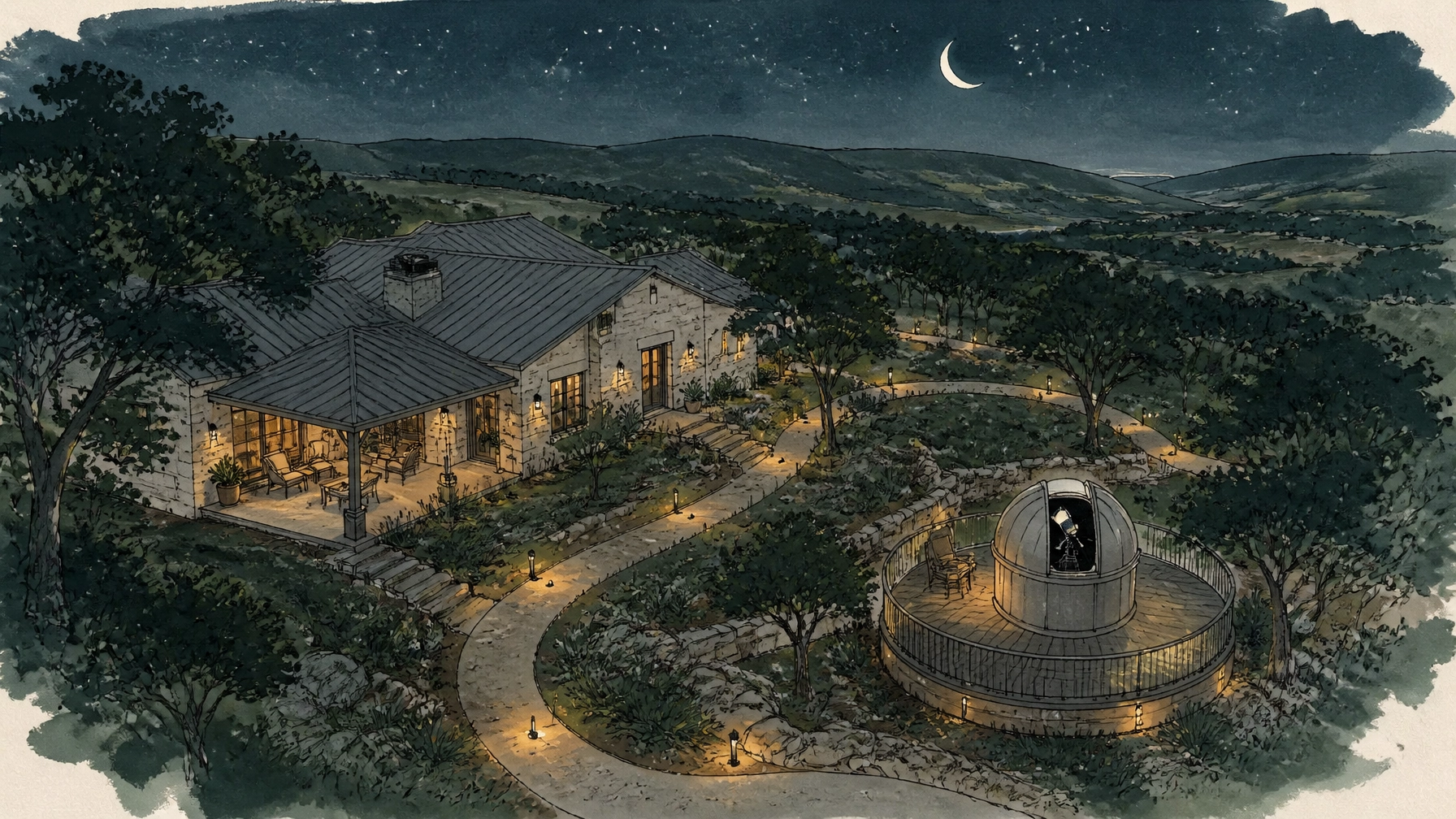
For many retirees and pre-retirees, one of the great pleasures of owning a Hill Country property begins after sunset. The limestone walls soften in the moonlight, the landscape grows quiet, and the stars become part of the home’s design.
Thoughtful outdoor lighting can make a property safer and more enjoyable without washing out that experience. The goal is not to eliminate light. It is to use the right amount of light, in the right place, for the right amount of time.
The Hill Country Alliance explains that the region’s night skies are a valuable part of its natural character: and that communities, homeowners, and businesses can help preserve them through better lighting choices.
Begin With a Nighttime Walk-Through
Before replacing fixtures, walk the property after dark. This is one of the most useful steps when evaluating a ranch, acreage property, luxury home, or retirement community residence.
Notice:
- Where you naturally walk after sunset
- Which entrances feel difficult to navigate
- Whether steps, changes in grade, or stone borders are visible
- Where existing lights create glare
- Whether light spills toward neighboring homes or roads
- Which areas should remain intentionally dark
- Where outdoor entertaining takes place
- Whether security lights illuminate useful areas: or simply flood the landscape
A nighttime walk-through often reveals that the property does not need more lighting everywhere. It may need better placement, warmer bulbs, shielding, or improved controls.
This is particularly important when comparing homes. A beautifully landscaped property may look entirely different at night, especially if fixtures are overly bright or poorly aimed.
Choose Low-Glare, Fully Shielded Fixtures
The foundation of dark-sky-friendly lighting is shielding. A fully shielded fixture directs light downward and prevents the bulb or LED source from being visible from the side, above, or off the property.
That simple design choice helps reduce:
- Glare in the eyes
- Light trespass onto neighboring properties
- Skyglow above the home
- Unnecessary illumination of trees and open land
- Disruption to nighttime views
The Hill Country Alliance’s lighting guidance describes fully shielded lighting as having a barrier around and above the light source, with the fixture angled so the source cannot be seen by nearby people or wildlife.
A practical test is simple: stand at the edge of the driveway or property line. If you can see the bare light source directly, the fixture may be creating unnecessary glare.
For a refined Hill Country property, consider:
- Downward-facing wall sconces at doors
- Shielded fixtures beneath porch ceilings
- Short path lights with concealed light sources
- Recessed lighting under steps or railings
- Carefully aimed floodlights used only for specific security needs
Avoid fixtures that send light upward, expose bright bulbs, or create large pools of harsh white light across the entire yard.

Keep Pathways Visible Without Overlighting Them
Pathway lighting should help you see where you are going: not turn the entire landscape into a runway.
For walkways, use modest, evenly spaced fixtures that illuminate the walking surface without shining directly into your eyes. The most comfortable paths often have small pools of warm light separated by areas of natural darkness.
Pay special attention to:
- Steps and changes in elevation
- Curved paths
- Driveway edges
- Transitions between stone, gravel, and grass
- Pool decks and outdoor stairs
- Routes from the home to a detached garage or guest house
Avoid placing bright fixtures directly across from one another. This can create visual competition and excessive brightness. Instead, stagger lights along the route and aim them toward the ground.
For affluent retirees, pathway lighting is also a design consideration. Fixtures should complement the architecture and landscape rather than dominate them. Bronze, dark metal, stone, and other subdued finishes often work well with Hill Country materials.
Design Security Lighting Around Visibility, Not Brightness
Security lighting is most effective when it supports awareness. More brightness does not automatically mean more security, and excessive glare can make it harder to see beyond the illuminated area.
A better strategy includes:
- Motion sensors near gates, entries, and outbuildings
- Shielded fixtures aimed at doors, locks, and approach routes
- Timers for occasional-use areas
- Low-level lighting near frequently used entrances
- Separate controls for the home, driveway, barn, and guest areas
A motion-activated fixture can be useful at a remote gate or side entrance, but it should illuminate the relevant area: not the entire pasture or tree line. Keep floodlights aimed downward and away from neighboring windows, roads, and dark viewing areas.
Also consider how lighting performs when you are not home. A well-designed system can create a lived-in appearance without leaving every light on all night.
Protect the Darkest Parts of the Property
A Hill Country property benefits from having intentional dark zones. These might include:
- The edge of a creek or drainage area
- A wooded boundary
- A stargazing deck
- A meadow or pasture
- A distant view corridor
- A quiet seating area away from the house
Responsible fixture placement means deciding where light should stop. Do not automatically illuminate every tree, retaining wall, or landscape feature. Uplighting mature oaks may look dramatic in a brochure, but it can also create glare, diminish the stars, and change the character of the land after sunset.
Dark areas can make the illuminated portions of the property feel more elegant. A softly lit terrace framed by a darker landscape often feels calmer and more intentional than a uniformly bright yard.
Use Warm Color Temperatures
Color temperature describes the apparent warmth or coolness of a light source. Cooler, blue-rich light tends to look harsher and can contribute more to glare and skyglow.
The Hill Country Alliance recommends outdoor lighting no higher than 3,000 Kelvin, while McDonald Observatory recommends 2,700 Kelvin or below for night-sky-friendly lighting.
For most Hill Country residences, warm white or soft amber lighting is a comfortable starting point. When selecting bulbs or fixtures, look for descriptions such as:
- 2,200K
- 2,700K
- Warm white
- Soft white
- Amber
- Night-sky friendly
- Fully shielded
- Full cutoff
Warm lighting can be especially attractive around limestone, wood, native stone, and natural landscaping. It creates visibility while preserving the quiet character of the setting.
Make Astronomy Part of the Property Plan
If stargazing is part of your vision for retirement, plan for it before installing outdoor lighting.
A dedicated astronomy area might be a terrace, a bench at the edge of the property, or simply a comfortable place with an unobstructed view. Keep nearby fixtures off, shielded, or controlled separately. A red astronomy flashlight can help with navigation while preserving night vision.
Consider creating a “dark sky switch” that turns off nonessential lights around the viewing area. Guests can still safely reach the location using a low-level path light that turns off once they arrive.

As McDonald Observatory puts it, night-sky-friendly lighting should have a clear purpose and should be turned off, placed on a timer, or activated by motion when it is no longer needed.
Keep Wildlife Areas Dark at Night
This guide is about lighting rather than broad wildlife management, but fixture placement still matters. Bright, poorly directed light can extend into tree canopies, water features, and undeveloped areas where nighttime activity occurs.
To reduce unnecessary disturbance:
- Keep lights away from creek beds and wooded edges
- Avoid illuminating tree canopies from below
- Use warm, low-intensity fixtures
- Turn off decorative lighting after entertaining
- Use motion controls rather than constant illumination
- Preserve darker corridors between the home and open land
You do not need to treat every dark area as a sanctuary. The practical point is to avoid spreading light farther than the property’s actual needs require.
Coordinate With Neighbors Before Installing Bright Fixtures
In rural and semi-rural areas, a single fixture can affect several properties. Before installing a new security light, gate light, tennis-court fixture, or barn floodlight, look outward from the proposed location.
Ask:
- Could the light shine toward a neighbor’s bedroom?
- Will it be visible from the road?
- Does it illuminate a shared view?
- Will it reduce the darkness of a nearby stargazing area?
- Can the fixture be lowered, shielded, dimmed, or repositioned?
A neighborly conversation can prevent frustration later. It is much easier to agree on responsible placement before installation than to correct a glare problem after the fact.
Local rules also vary. The Hill Country Alliance maintains resources on ordinances, resolutions, and Dark Sky designations. Check the applicable city, county, homeowners association, or community requirements before adding or replacing fixtures.
Create a Comfortable Outdoor Entertaining Plan
Outdoor entertaining should feel connected to the landscape, not separated from it by a wall of brightness.
For patios and terraces, use layers:
- Ambient lighting beneath a porch or covered roof
- Task lighting near grills, counters, and serving areas
- Path lighting between the terrace, home, and parking area
- Accent lighting used sparingly on architectural details
Install separate controls so the lighting can change as the evening progresses. A brighter setting may be helpful while guests arrive. Later, dimmer lighting can create a more relaxed atmosphere and restore the view of the stars.

The best outdoor lighting often becomes almost invisible. Guests notice the comfortable walk, the softly defined steps, and the welcoming porch: but not a harsh fixture shining in their eyes.
A Simple Property Lighting Checklist
Whether you are buying a new home or improving an existing one, use this checklist:
- Walk the property after dark
- Identify areas that truly need illumination
- Replace exposed bulbs with fully shielded fixtures
- Choose warm light, generally 3,000K or lower
- Use the lowest practical brightness
- Add motion sensors to occasional-use areas
- Put decorative lighting on timers
- Keep floodlights aimed downward
- Preserve dark zones for views and stargazing
- Check for light trespass at property lines
- Review local ordinances and community rules
- Reassess the system after installation
A well-designed lighting plan can support safety, hospitality, privacy, and enjoyment while protecting one of the Hill Country’s most memorable amenities: the night itself.
For broader lifestyle considerations when evaluating a relocation, explore the Texas Hill Country Retirement resource and our guide to choosing between Hill Country golf communities.
Schedule a private meeting with a fiduciary financial advisor today by calling (512) 593-8380 or by visiting: https://calendly.com/portafoliocapital/15min
Portafolio Capital Management dba Mau Sanchez Capital is a Registered Investment Adviser. This content is for informational purposes only and does not constitute investment advice or a solicitation to buy or sell any security. Advisory services are provided only pursuant to a written advisory agreement.
This article may include stories, scenarios, and perspectives created or assisted by artificial intelligence. Although the individuals and circumstances described may be fictional, the topics are intended to reflect real financial, personal, and lifestyle issues that retirees and individuals commonly face.
The content is provided to encourage readers to consider different perspectives that may affect their retirement, regardless of whether they are currently planning, approaching retirement, or already retired. It is intended for general educational and informational purposes only and should not be interpreted as personalized investment, financial, tax, legal, medical, or retirement-planning advice.
Individual circumstances vary. Readers should independently verify any information presented and consult appropriately qualified professionals before making financial or personal decisions. No advisory, professional, or client relationship is created through the use of this website.
Leave a Reply