
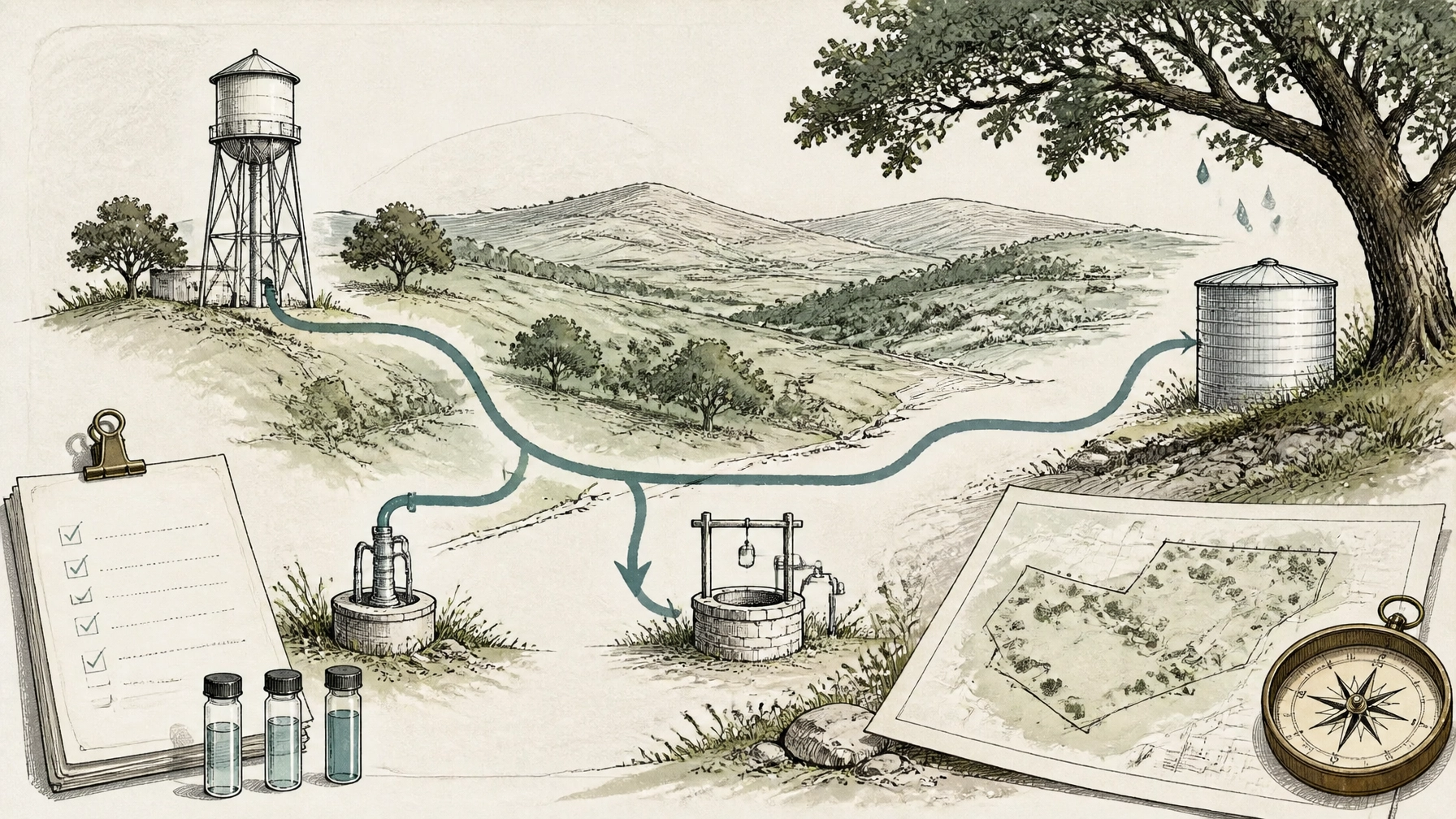
A beautiful Hill Country property can make an immediate impression: limestone views, mature live oaks, a quiet road, perhaps a guest house or acreage for gardening and outdoor living.
But before you fall in love with the architecture, ask a less glamorous question:
How does water reach the property, and how dependable is that arrangement likely to be?
Water due diligence is not limited to rural ranches. It matters for luxury homes outside Austin, golf communities, small-town residences, and any property where municipal service, a private well, a shared system, storage, or irrigation plays a role.
The goal is not to make a property feel complicated. It is to replace assumptions with documentation. A thoughtful water review can help you understand the home’s operating realities before you commit to the lifestyle, maintenance obligations, and long-term costs that come with it.
Start with the source, not the sales description
Begin by identifying every water source connected to the property. “City water,” “a strong well,” or “live water” may describe only part of the situation.
Ask:
- Is the home served by a city, municipal utility district, water control and improvement district, or rural Water Supply Corporation?
- Does the property have a private well?
- Is the well shared with neighbors, an HOA, or an ownership group?
- Is rainwater collected in a cistern?
- Is there a storage tank or pressure tank?
- Is surface water used for irrigation, livestock, or another purpose?
- Are there multiple systems serving the main home, guest house, pool, landscaping, or outbuildings?
Request a simple written diagram showing the source, meter or wellhead, pumps, tanks, treatment equipment, and main lines. If the seller cannot clearly explain the system, that is a reason to investigate further, not necessarily a reason to walk away.
The Texas Water Development Board’s groundwater data resources can help you locate well records, construction details, aquifer information, water levels, and available water-quality data.
If the property uses municipal water
Municipal service is often viewed as the simplest option, but you still need to understand the provider and the terms of service.
Questions to ask
- Who is the actual water provider?
- Is the property already connected, or is service merely available nearby?
- Is there a tap fee, impact fee, transfer fee, or outstanding balance?
- What is the current rate structure?
- Are there minimum monthly charges?
- Has the property experienced low pressure, service interruptions, or boil-water notices?
- Are there restrictions on irrigation, pool filling, or other outdoor uses?
- What drought stages can the provider impose?
- Is the property inside a service area with future expansion or connection limitations?
Ask the seller for recent utility bills and service records. Billing history can reveal seasonal irrigation demand, unusually high usage, or long periods when a home was vacant.
You should also ask the utility for its current drought contingency plan and the latest Consumer Confidence Report. TCEQ explains that community public water systems prepare annual reports describing water quality and source information; those reports can be accessed through the agency’s Consumer Confidence Report resources.
The provider’s water source matters, too. A utility drawing from groundwater, a lake, a regional system, or purchased treated water may face different operational conditions. You do not need to predict every future drought. You do need to understand how the utility communicates restrictions and manages shortages.

If the property uses a private well
A private well is a system, not simply a hole in the ground. Its practical performance depends on construction, pump equipment, aquifer conditions, water quality, power, storage, and maintenance.
Request:
- The original well report or driller’s report
- The well depth and completed aquifer
- The well’s state well number or tracking number
- Pump specifications and installation date
- Static water-level and drawdown information, if available
- Yield or pump-test results
- Repair and replacement invoices
- Water-treatment equipment records
- Recent laboratory water-quality reports
- Any well registration or permit documents required by the local groundwater conservation district
The TWDB maintains a Groundwater Database and links to the Groundwater Data Interactive Viewer. These tools may help you compare the seller’s information with public records. Newer well reports may also be available through the Submitted Driller’s Report Database, while older records may be found through the TCEQ Water Well Report Viewer.
Ask the well professional a practical question: What happens after several dry months and heavy household use?
A single yield number may not tell the full story. You want to understand whether the well has performed consistently through hot summers, whether water levels have changed, and whether the source can support the property’s intended use. Household needs, irrigation, a swimming pool, livestock, gardens, and guest accommodations can create very different demand profiles.
Rules also vary by location. The TWDB Groundwater Conservation Districts page can help you identify the local district. The district, not the listing description, can explain applicable permitting, registration, spacing, production, and reporting requirements.
Treat testing as a condition of knowledge
A clear glass of water is not a water-quality report.
Before closing, arrange testing through an appropriate certified laboratory and confirm the lab’s sampling instructions in advance. TWDB provides private well sampling guidance, including links to laboratories and information on selecting tests.
At a minimum, ask about testing for:
- Total coliform and E. coli or fecal coliform bacteria
- Nitrate and nitrite
- Total dissolved solids
- Other minerals or contaminants suggested by local conditions
Depending on the property, broader testing may be appropriate. Potential considerations can include arsenic, fluoride, metals, hardness, iron, manganese, or contaminants associated with nearby land uses. A qualified water professional can help determine the appropriate panel.
TWDB states plainly: “The State of Texas does not regulate the water quality of private water wells.” That means a private well owner is responsible for identifying and addressing water-quality concerns.
Ask:
- Who collected the sample?
- When was it collected?
- Was it taken before or after treatment equipment?
- Does the report identify the property and the tested source?
- Were any results outside applicable health-based standards?
- What treatment is currently installed?
- What does that treatment cost to operate and maintain?

Shared wells require shared accountability
A shared well can work well when the agreement, equipment, and relationships are clear. It can become frustrating when responsibilities are informal.
Request the complete recorded shared-well agreement and ask:
- Who owns the well, pump, pressure equipment, and storage?
- How many properties are connected?
- How are electricity, repairs, testing, and replacement costs divided?
- Who has authority to approve repairs?
- What happens if an owner does not pay?
- Is there a reserve fund?
- Are there volume, flow, or irrigation limits?
- What is the process during an outage or drought?
- Are all waterlines and access routes protected by recorded easements?
If a rural system is actually a Water Supply Corporation, request its bylaws, service rules, rate schedule, membership documents, outage history, and drought policies. Confirm whether the property receives a membership, share, tap right, or another form of service entitlement.
Do not rely on a verbal promise that “the neighbors have always taken care of it.” Ask your title company and a Texas real estate attorney to review the recorded documents when water access depends on them.
Review storage and backup capacity
Storage can provide flexibility when a well pump cycles, electricity fails, demand spikes, or a utility imposes restrictions. It does not create an unlimited supply, but it can make the system easier to manage.
Inspect:
- Tank or cistern capacity
- Construction material and age
- Signs of cracking, leaks, corrosion, or contamination
- Tank location and accessibility
- Pump and pressure controls
- Filtration and treatment equipment
- Backup power options
- Automatic shutoffs and alarm systems
- Maintenance and cleaning records
Ask how many days of ordinary household use the current storage supports. Then compare that with your intended lifestyle. A couple who travels frequently may have different needs from a household that hosts family, maintains extensive landscaping, or operates multiple residences on one tract.
Rainwater collection can be a useful supplemental resource, particularly for landscape or non-potable applications, but confirm how the system is designed, maintained, and connected. Do not assume that a decorative tank provides meaningful household redundancy.
Read the map and title documents together
Water rights and water access are often defined by documents rather than by what can be seen from the porch.
Review the title commitment, survey, recorded plats, and seller disclosures together. Look for:
- Utility easements
- Well-site easements
- Waterline easements
- Access easements to pumps or tanks
- Shared-well agreements
- Restrictions on drilling or irrigation
- Conservation easements
- Severed or reserved groundwater rights
- Surface-water permits or agreements
- Leases or rights involving off-property water use
A creek, spring, pond, or river may add beauty and recreation, but its appearance does not automatically establish a right to divert or use the water. For questions involving surface-water rights, consult the TCEQ water-rights resources and obtain qualified legal guidance.

Ask for service records, not just assurances
The most useful records often reveal the property’s history.
Request invoices and reports for:
- Pump repairs and replacements
- Well disinfection
- Pressure-tank service
- Water softener or filtration work
- Tank cleaning
- Leak detection
- Irrigation repairs
- Emergency water deliveries
- Low-pressure complaints
- Utility outages
- Drought-related restrictions
Then ask the seller or service provider to explain any gaps. Missing records do not prove a problem, but they do make a professional inspection more important.
A practical water due-diligence file
Before your option period expires, try to assemble one file containing:
- A written description of every water source
- Utility bills and provider contact information
- Drought contingency and service policies
- Well reports, permits, and pump records
- Certified laboratory test results
- Shared-well agreements or Water Supply Corporation documents
- Storage and treatment equipment specifications
- Survey, title commitment, and relevant easements
- Surface-water permits, if applicable
- A written inspection report from a qualified water or well professional
The right Hill Country property should support the life you want to live: not just the view you want to admire. Water due diligence helps you evaluate both.
For broader relocation considerations, you can also review our Texas residency checklist. When property decisions intersect with retirement income, liquidity, and long-term portfolio design, Portafolio Capital Management dba Mau Sanchez Capital can help families evaluate those financial considerations alongside their broader retirement goals.
Schedule a private meeting with a fiduciary financial advisor today by calling (512) 593-8380 or by visiting: https://calendly.com/portafoliocapital/15min
Portafolio Capital Management dba Mau Sanchez Capital is a Registered Investment Adviser. This content is for informational purposes only and does not constitute investment advice or a solicitation to buy or sell any security. Advisory services are provided only pursuant to a written advisory agreement.
This article may include stories, scenarios, and perspectives created or assisted by artificial intelligence. Although the individuals and circumstances described may be fictional, the topics are intended to reflect real financial, personal, and lifestyle issues that retirees and individuals commonly face.
The content is provided to encourage readers to consider different perspectives that may affect their retirement, regardless of whether they are currently planning, approaching retirement, or already retired. It is intended for general educational and informational purposes only and should not be interpreted as personalized investment, financial, tax, legal, medical, or retirement-planning advice.
Individual circumstances vary. Readers should independently verify any information presented and consult appropriately qualified professionals before making financial or personal decisions. No advisory, professional, or client relationship is created through the use of this website.
Leave a Reply