
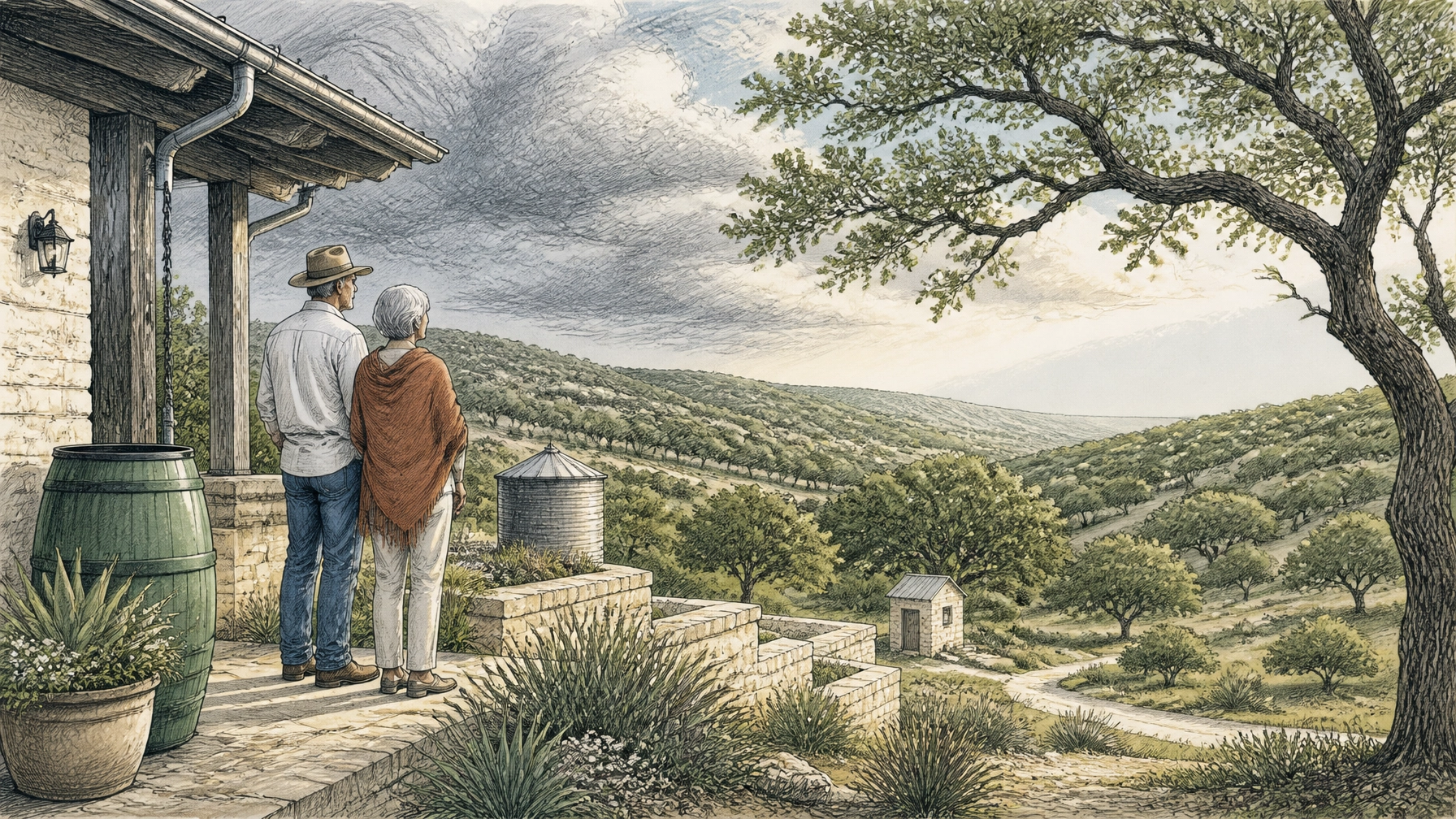
Buying a home or acreage in the Texas Hill Country is more than a real estate decision. It is an invitation to live closer to the land, to watch storms move across limestone ridges, enjoy evenings beneath live oaks, and become part of a community shaped by water, weather, wildlife, and conservation.
For affluent retirees and new homeowners, thoughtful stewardship can help protect both the enjoyment and the long-term value of a Hill Country property. The goal is not to manage every acre like a full-time rancher. It is to understand the property’s systems, prepare for regional conditions, and create a practical rhythm for maintenance.
As TexasReady puts it: “Be informed. Make a plan. Build a kit.” That principle applies just as well to owning a Hill Country home as it does to preparing for an emergency.
1. Prepare for Hill Country Weather
The region’s weather is part of its beauty, and one of its responsibilities. New homeowners should be prepared for extreme heat, drought, flash flooding, severe thunderstorms, occasional winter freezes, and wildfire conditions.
Start with a property-specific weather plan:
- Identify nearby creeks, low-water crossings, steep drainage areas, and evacuation routes.
- Sign up for county emergency alerts and monitor the National Weather Service Austin/San Antonio office.
- Keep a seven-day supply of drinking water, medications, nonperishable food, flashlights, batteries, and pet supplies.
- Store important documents and valuables above the garage floor or other areas vulnerable to water intrusion.
- Know where the main electrical, gas, and water shutoffs are located.
- Keep a vehicle ready for an evacuation, especially if your property is in a canyon, near heavy cedar cover, or accessed by a narrow road.
Seasonal weather checklist
Before summer:
- Service the HVAC system and replace filters.
- Inspect attic ventilation and window seals.
- Confirm that outdoor activities can be moved to early morning or evening.
- Review backup power needs for medical equipment, refrigeration, well pumps, or security systems.
Before winter freezes:
- Insulate exposed pipes and exterior faucets.
- Remove garden hoses and protect irrigation equipment.
- Locate the main water shutoff valve.
- Bring vulnerable potted plants indoors or cover them appropriately.
- Review the state’s Texas winter storm preparedness guidance.
If your home relies on a private well, winter preparation deserves special attention because a pump outage can affect both water access and fire protection.

2. Understand Your Water System and Well
Water is one of the most important stewardship issues in the Hill Country. Some properties use municipal service, while others depend on private wells, rainwater systems, or a combination of sources.
If you have a well, keep a file containing:
- The well location and construction details.
- Pump and pressure-tank information.
- Recent water-quality test results.
- Service records and the contact information for a qualified well professional.
- Instructions for shutting off power to the pump.
- Any applicable groundwater district requirements.
The Texas Water Development Board’s groundwater resources are a useful starting point for understanding aquifers, groundwater conditions, and regional water information.
Consider testing private well water regularly for bacteria and other potential contaminants. The appropriate testing schedule depends on your location and circumstances, so consult a qualified local water professional or public health resource. Keep fuel, fertilizers, pesticides, and other contaminants away from the wellhead and from areas where runoff could move toward it.
Simple ways to conserve water
- Repair dripping faucets, running toilets, and irrigation leaks promptly.
- Install efficient indoor fixtures.
- Water plants early in the morning and adjust irrigation after rainfall.
- Use drip irrigation for garden beds and trees where appropriate.
- Group plants according to their water needs.
- Consider rainwater collection for landscape use, subject to local requirements.
- Replace high-maintenance turf with native or well-adapted plants.
Conservation is especially valuable for retirees who want a beautiful property without turning landscape care into a daily obligation.
3. Choose Native Landscaping for Beauty and Resilience
Native landscaping can make a property feel more connected to the Hill Country while reducing irrigation needs and supporting birds, butterflies, and pollinators.
A thoughtful landscape may include native grasses, wildflowers, shrubs, and shade trees suited to the local soil, sun exposure, and rainfall patterns. Before planting, observe your property through several seasons. Note where water collects, where afternoon heat is strongest, and which areas remain shaded beneath live oaks.
A practical native landscaping plan should:
- Place thirsty plants close to the home or irrigation source.
- Reserve naturally drier areas for drought-tolerant species.
- Use mulch to retain moisture and moderate soil temperatures.
- Leave adequate space around structures, driveways, and utility equipment.
- Avoid invasive plants and dense vegetation that can become difficult to maintain.
- Create attractive outdoor rooms with paths, seating, and shade rather than relying only on large expanses of lawn.
The Native Plant Society of Texas provides regional information for homeowners interested in plants that support Texas ecosystems.
For a luxury property, native landscaping does not have to look rustic or unfinished. A professional landscape designer can create a refined composition of stone, pathways, mature trees, native color, and carefully framed views.

4. Coexist with Hill Country Wildlife
Deer, songbirds, raptors, roadrunners, rabbits, foxes, and reptiles are part of the Hill Country experience. Good stewardship allows homeowners to enjoy wildlife without encouraging unsafe or destructive behavior.
The Texas Parks and Wildlife Department’s wildlife resources offer guidance on native species and responsible coexistence.
Keep these habits in place:
- Do not intentionally feed deer, raccoons, coyotes, or other wild animals.
- Store trash, pet food, and compost in secure containers.
- Use fencing or protective cages around vegetable gardens and young trees.
- Keep dogs leashed or within secure fencing.
- Keep cats indoors or in enclosed outdoor spaces.
- Clean birdbaths regularly and avoid creating standing water where mosquitoes can breed.
- Remove brush piles and clutter near the home.
- Use caution around woodpiles, rock gardens, tall grass, and outbuildings.
Wildlife coexistence also means knowing when to call a qualified professional. If an animal is injured, trapped inside a structure, or behaving unusually, avoid handling it yourself and contact the appropriate local wildlife or animal-control resource.

5. Reduce Wildfire Exposure
Many Hill Country homeowners appreciate the privacy created by trees and natural terrain. Those same features can increase wildfire exposure if vegetation, roofs, access roads, and outbuildings are not maintained.
Walk outward from the home and look at the property in zones:
- Immediately around the home: Remove leaf litter, dead vegetation, and combustible clutter. Keep gutters and roof valleys clear.
- Near trees: Prune lower branches and prevent vegetation from creating a continuous “ladder” to the canopy.
- Around outbuildings: Separate woodpiles, propane storage, sheds, and other combustible materials from the primary residence where practical.
- Along access routes: Keep driveways clear of low branches and overgrown vegetation. Make sure house numbers are visible from the road.
- Across the broader property: Thin dense growth where appropriate and maintain open, accessible areas that can help firefighters work safely.
The Texas A&M Forest Service offers wildfire preparedness and home-protection resources. Local fire departments can also provide site-specific recommendations, particularly for homes near canyons, steep slopes, or heavy cedar cover.

6. Build a Manageable Maintenance Rhythm
A second home, ranch property, or retirement residence should enhance your lifestyle: not create an endless list of obligations. Consider creating a written maintenance calendar and deciding which responsibilities should be handled by a trusted property manager or local vendors.
Monthly
- Check irrigation systems and outdoor faucets.
- Look for roof, gutter, fence, or drainage problems.
- Inspect well equipment and pressure readings if applicable.
- Remove fallen limbs and accumulated yard debris.
- Test security, lighting, and backup-power systems.
Quarterly
- Service or inspect HVAC equipment as recommended.
- Review pest-control needs.
- Trim vegetation away from structures and utility lines.
- Walk the property after significant rain to understand drainage.
- Confirm that emergency supplies are current.
Annually
- Test private well water as appropriate.
- Schedule septic maintenance if the property uses a septic system.
- Review insurance coverage, deductibles, and replacement-cost assumptions.
- Inspect driveways, retaining walls, decks, roofs, and outbuildings.
- Update your household emergency and evacuation plan.
7. Include Property Stewardship in Your Financial Plan
Owning Hill Country land creates ongoing costs beyond the mortgage or purchase price. A complete retirement plan should account for insurance premiums, property-related expenses, utilities, well and septic service, landscaping, tree work, road maintenance, security, and periodic capital improvements. Readers should consult a qualified tax professional for individualized guidance on tax-related questions.
Many homeowners find it useful to separate expenses into three categories:
- Routine costs: utilities, landscaping, pest control, and regular service.
- Reserve costs: roofs, HVAC replacement, pumps, fencing, vehicles, and major tree work.
- Contingency costs: storm damage, wildfire-related repairs, water-system failures, or emergency relocation.
A dedicated cash reserve can help prevent an unexpected property expense from forcing an untimely portfolio withdrawal. For broader retirement planning, you may also find it helpful to review The “What If?” Workbook: Stress-Testing Your Retirement Plan and Is Your Retirement Ready for a Texas Summer?.
Mau Sanchez Capital helps families think through retirement income, liquidity, portfolio construction, and wealth preservation in the context of their broader lifestyle goals. That may include maintaining sufficient liquidity for property ownership while investing through transparent, publicly traded markets and a client-specific mix of equities and traditional fixed income.
The most enjoyable Hill Country homes are not necessarily the ones with the most acreage or the most elaborate improvements. They are the properties whose owners understand the land, prepare for the region’s conditions, and build a sustainable plan for caring for both the home and the lifestyle it supports.
Schedule a private meeting with a fiduciary financial advisor today by calling (512) 593-8380 or by visiting: https://calendly.com/portafoliocapital/15min
Portafolio Capital Management dba Mau Sanchez Capital is a Registered Investment Adviser. This content is for informational purposes only and does not constitute investment advice or a solicitation to buy or sell any security. Advisory services are provided only pursuant to a written advisory agreement.
This article may include stories, scenarios, and perspectives created or assisted by artificial intelligence. Although the individuals and circumstances described may be fictional, the topics are intended to reflect real financial, personal, and lifestyle issues that retirees and individuals commonly face.
The content is provided to encourage readers to consider different perspectives that may affect their retirement, regardless of whether they are currently planning, approaching retirement, or already retired. It is intended for general educational and informational purposes only and should not be interpreted as personalized investment, financial, tax, legal, medical, or retirement-planning advice.
Individual circumstances vary. Readers should independently verify any information presented and consult appropriately qualified professionals before making financial or personal decisions. No advisory, professional, or client relationship is created through the use of this website.
Leave a Reply