
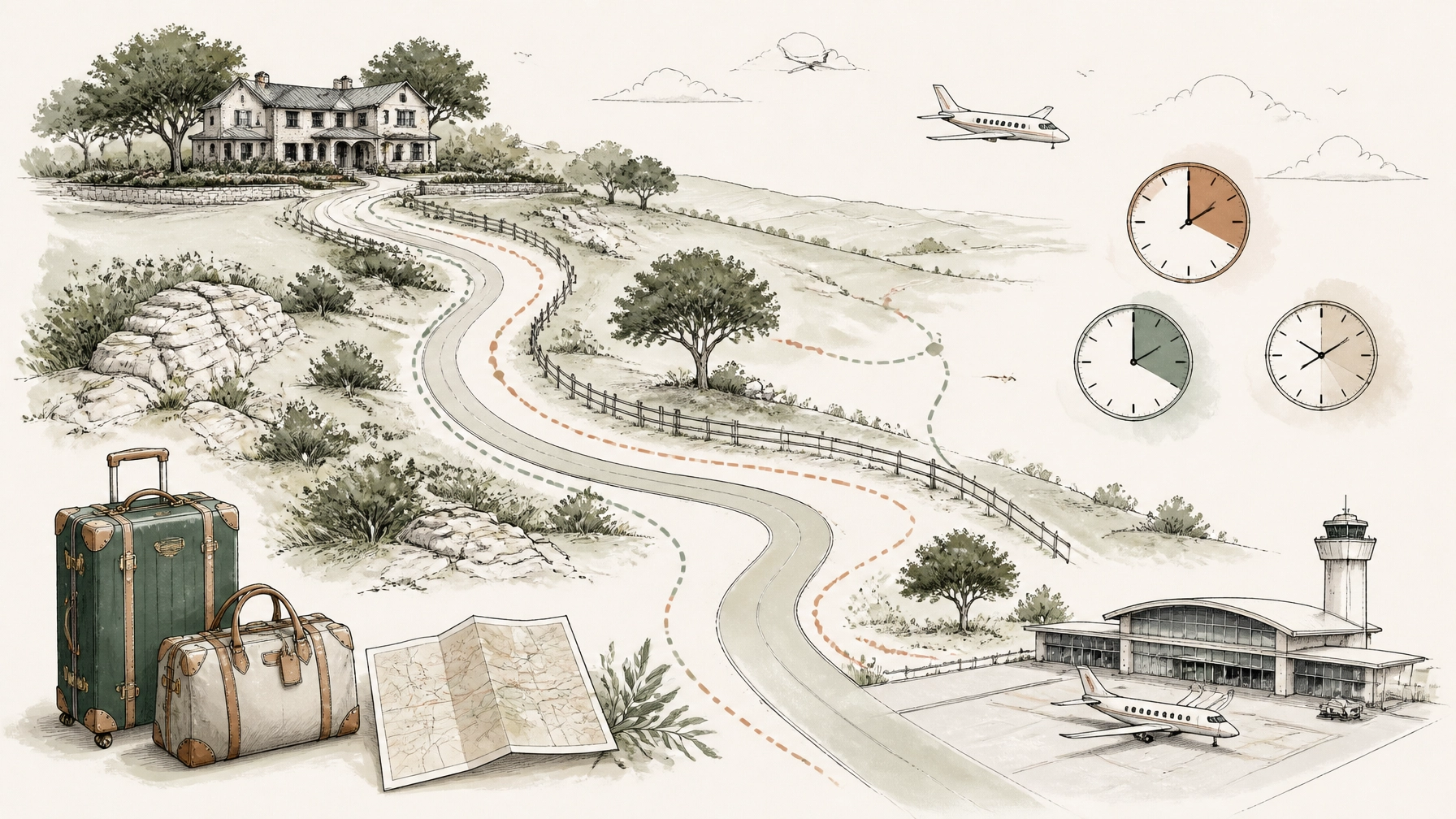
Retiring in the Texas Hill Country can mean slower mornings, open views, historic towns, and more time outdoors. But for retirees who travel often: or divide their time between Texas and another home: the location decision involves more than scenery.
The practical question is simple:
How easily can you get from your front door to your departure gate, private aircraft, or visiting family?
Airport access can shape the rhythm of an entire retirement. A home that feels delightfully secluded on a weekend tour may become less appealing when an early flight requires a pre-dawn departure, a long rural drive, and extra time for traffic near Austin or San Antonio.
The right choice is not necessarily the community closest to an airport. It is the place that offers the best balance between your preferred Hill Country lifestyle and the travel logistics you will actually use.
Start With Your Real Travel Pattern
Before comparing roads or airports, examine how you travel now: and how you expect to travel after relocating.
Consider:
- How many commercial flights do you take each year?
- How often do you travel internationally?
- Do you usually fly early in the morning or later in the day?
- Will you return with multiple bags, golf equipment, or specialty luggage?
- Do adult children and grandchildren visit frequently?
- Will you maintain a second home?
- Do you expect to use private or general aviation?
- Will someone else drive you, or will you prefer to drive yourself?
A couple taking four leisurely trips each year may be comfortable with a longer drive to Fredericksburg or Kerrville. Someone traveling twice a month for family, business, medical appointments, or a second residence may place a much higher value on predictable access.
Travel frequency should influence location choice just as much as views, dining, golf, or home design.
Understand the Main Commercial Gateways
For many Hill Country residents, Austin-Bergstrom International Airport (AUS) will be the primary commercial gateway. The airport’s official website reports that AUS serves approximately 20 million passengers annually and is home to more than 15 airlines, along with multiple parking options near the Barbara Jordan Terminal. You can review current airport information through the official AUS website.
AUS also maintains a current nonstop-flight directory, but routes and schedules change. Frequent travelers should evaluate the destinations they use most: not simply count the number of available flights.
Depending on where you live, San Antonio International Airport (SAT) may also be worth considering. Residents in the western and southern Hill Country may find SAT practical for certain routes, while those closer to Austin may prefer AUS. The best airport can vary by destination, departure time, airline preference, and traffic conditions on a particular day.
For relocation planning, consider both airports even if one becomes your regular choice. Having a second commercial option can be useful when schedules, fares, or connections differ.
Treat Drive Time as a Range, Not a Promise
Online maps often display an attractive drive time based on light traffic. That number may not reflect the experience of leaving home at 5:30 a.m., returning on a holiday weekend, or driving through heavy rain.
Approximate travel ranges from Hill Country communities to AUS can vary considerably:
- Austin-adjacent areas may be roughly 35 to 60 minutes away.
- Wimberley, Johnson City, Blanco, and Marble Falls may often fall within approximately 50 to 90 minutes.
- Fredericksburg and Kerrville can require approximately 90 minutes to more than two hours, depending on the route and conditions.
These are planning ranges, not guarantees. Construction, weather, collisions, roadwork, and seasonal traffic can change the experience.
Before making an offer on a home, test the route at the times you would realistically travel. Check DriveTexas for current road conditions, closures, and construction. For Austin-area traffic, the TxDOT Austin District traffic map can provide additional information about incidents and roadway conditions.

Evaluate the Road, Not Just the Mileage
Two homes may be the same distance from an airport yet offer very different travel experiences.
Ask how much of the trip involves:
- Divided highways
- Two-lane rural roads
- Curves and elevation changes
- Construction zones
- Bridges or low-water crossings
- School traffic
- Weekend congestion
- Poorly lit roads
- Limited fuel or rest stops
A scenic route can be beautiful, but frequent travelers may prefer a more direct and predictable corridor. A few extra miles on a well-maintained highway may be more convenient than a shorter route with winding roads, limited shoulders, or frequent slowdowns.
Also consider the final approach to the home. A long private drive may feel peaceful, but it can be less convenient when returning late at night with luggage. Look for adequate lighting, clear address signage, reliable pavement, and a covered area where passengers can safely unload.
Think Through Luggage and Arrival Details
Travel logistics do not end when the plane lands.
Frequent travelers should consider:
- Where will luggage be stored?
- Is there a garage or covered drop-off area?
- Can a vehicle comfortably hold multiple suitcases?
- Will you need space for golf clubs, skis, bicycles, or other equipment?
- Is there room for a second vehicle at the home?
- Can a driver or family member meet you without disrupting the household?
- Is the entry easy to navigate after a long trip?
A well-designed home can make arrival feel effortless. A shaded porch, accessible entry, organized luggage area, and convenient garage can matter more in daily life than a dramatic but impractical layout.
If you split time between homes, consider how each property will be secured, maintained, and prepared before your arrival. Travel is more enjoyable when you are returning to a home that is clean, cool, stocked, and ready: not one that requires a long list of errands before you can relax.
Account for Guests and Service Providers
A frequent-travel lifestyle often includes more than the homeowners. Guests may arrive while you are away, household staff may need access, and service providers may need to maintain the property during extended absences.
Evaluate whether the location supports:
- Reliable home-management services
- Housekeeping and maintenance professionals
- Pool and landscape care
- Vehicle detailing or storage
- Grocery and package delivery
- Pet care
- Home security monitoring
- Airport transportation
- Guest accommodations
Remote properties can offer privacy, but service availability may be more limited or expensive. Ask local residents, property managers, and real estate professionals how long it typically takes to arrange repairs or specialized services.
This is particularly important for a second home. The more often you travel, the more valuable dependable local support becomes.

Consider Private and General Aviation Carefully
Private aviation can change the airport-to-home equation, but proximity to an airfield is only one part of the decision.
The Hill Country includes several general aviation options. For example, Gillespie County Airport serves the Fredericksburg area and is a public-use general aviation facility. Other communities have municipal or private-use airfields, but access, runway characteristics, operating hours, hangar availability, fuel, maintenance, and ground transportation can vary.
If you expect to use private aviation regularly, investigate:
- Aircraft size and runway requirements
- Instrument approach availability
- Hangar or tie-down options
- Fuel availability
- Maintenance support
- Weather limitations
- Airport access rules
- Ground transportation after landing
- Whether your preferred aircraft operator uses the field
A home near an airfield is not automatically convenient. Noise, flight patterns, access restrictions, and limited services may affect the experience. Speak with airport management and aviation professionals before assuming a particular runway will meet your needs.

Use a Travel-Time Budget
One useful way to compare locations is to create a personal travel-time budget.
For each airport trip, estimate:
- Time from the home to the main highway
- Normal drive time to the airport
- A realistic traffic allowance
- Parking, drop-off, or vehicle handoff time
- Security and terminal time
- Time required to reach the gate
For a domestic flight, AUS advises travelers to review its travel guidance and airline requirements; many travelers plan to arrive approximately two hours before departure. International flights commonly require more time. Your personal buffer should reflect your comfort level, airport familiarity, mobility needs, and whether you are checking luggage.
Then multiply the travel burden by your annual trip count.
A 90-minute drive each way may feel insignificant for four annual trips. At 30 trips a year, it becomes a meaningful part of your calendar. That does not make a deeper Hill Country location wrong: it simply means the lifestyle benefit should be substantial enough to justify the recurring travel cost.
Test the Full Journey Before Choosing a Home
Do not evaluate a property only during a leisurely afternoon showing. Re-create the experience.
Try:
- Driving from the community to AUS or SAT before an early flight
- Returning after dark
- Traveling with the amount of luggage you typically carry
- Checking traffic on a weekday and a weekend
- Using the route during summer heat or rain
- Finding fuel, food, and rest stops along the way
- Testing airport parking or drop-off procedures
- Asking how long local service providers take to respond
If you plan to split time between homes, test the return journey as well. A location that works beautifully for departures may be less convenient when you are tired, carrying luggage, or arriving late.
The goal is not to eliminate every inconvenience. It is to understand the trade-off clearly.
Make Convenience Part of the Lifestyle Design
The Texas Hill Country offers many ways to live well, from vineyard country and historic downtowns to ranch-style properties and resort-oriented communities. For frequent travelers, the ideal home adds a practical layer to that lifestyle.
You may prefer a closer-in location with easier access to AUS. Or you may decide that greater privacy and a deeper rural setting are worth the additional planning. You may want to remain within reach of both AUS and SAT, or place greater emphasis on a nearby general aviation airport.
There is no universal answer. The best decision reflects how often you travel, who travels with you, what you carry, how much flexibility you have, and how much time you want to spend on the road.
Texas Hill Country Retirement can help you think through lifestyle and relocation considerations. When the decision also affects cash flow, housing costs, travel spending, and the design of an investment portfolio, Portafolio Capital Management dba Mau Sanchez Capital can help families evaluate those financial planning questions through a fiduciary relationship.

Schedule a private meeting with a fiduciary financial advisor today by calling (512) 593-8380 or by visiting: https://calendly.com/portafoliocapital/15min
Portafolio Capital Management dba Mau Sanchez Capital is a Registered Investment Adviser. This content is for informational purposes only and does not constitute investment advice or a solicitation to buy or sell any security. Advisory services are provided only pursuant to a written advisory agreement.
This article may include stories, scenarios, and perspectives created or assisted by artificial intelligence. Although the individuals and circumstances described may be fictional, the topics are intended to reflect real financial, personal, and lifestyle issues that retirees and individuals commonly face.
The content is provided to encourage readers to consider different perspectives that may affect their retirement, regardless of whether they are currently planning, approaching retirement, or already retired. It is intended for general educational and informational purposes only and should not be interpreted as personalized investment, financial, tax, legal, medical, or retirement-planning advice.
Individual circumstances vary. Readers should independently verify any information presented and consult appropriately qualified professionals before making financial or personal decisions. No advisory, professional, or client relationship is created through the use of this website.
Leave a Reply