
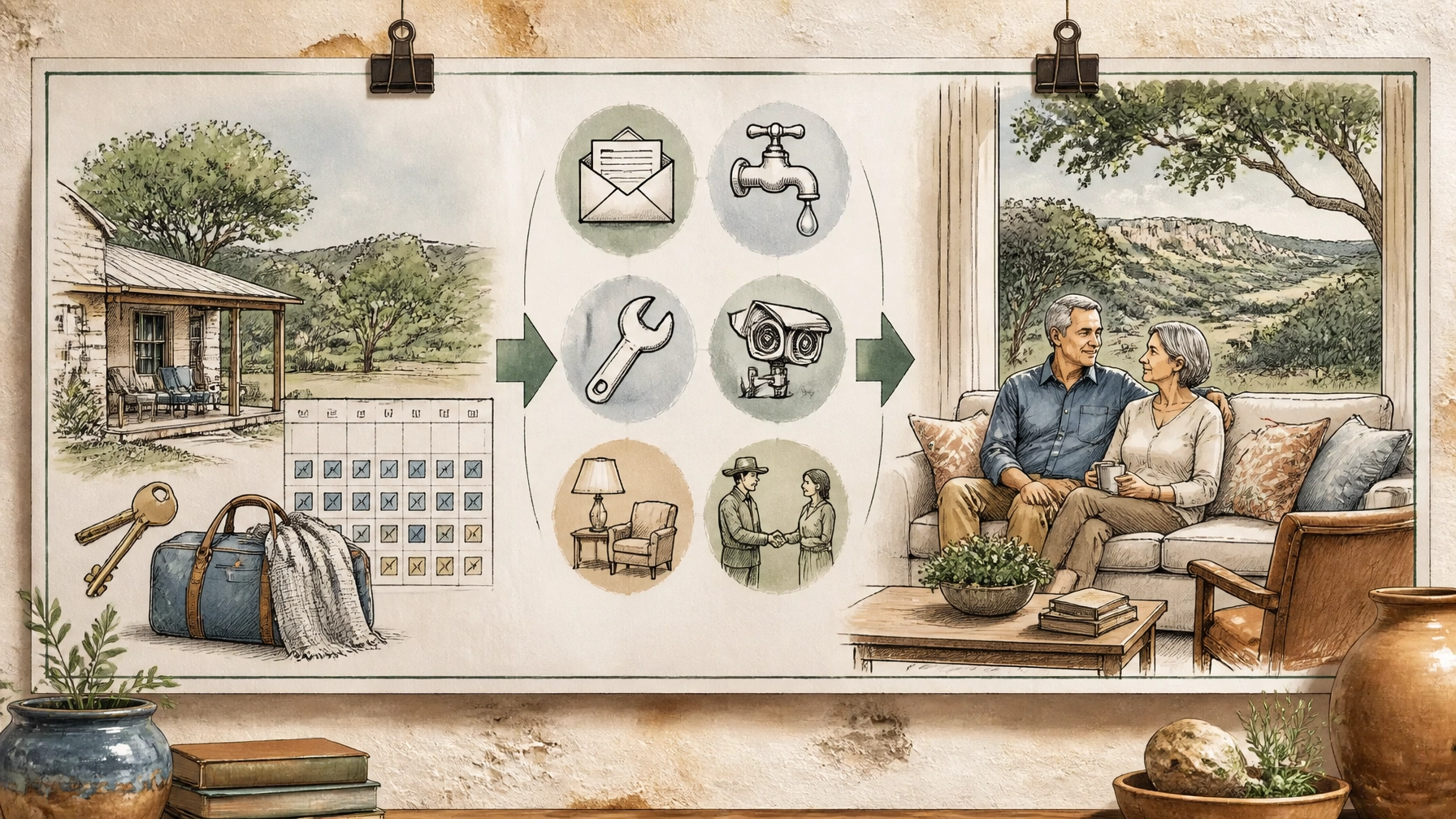
A second home can feel like your future before it becomes your everyday reality.
You may already know the best coffee shop nearby, have a favorite trail, and recognize the sound of rain on the porch roof. But using a Hill Country home for long weekends is different from relying on it as your primary base. The transition involves more than bringing additional clothes and extending your stay. It requires an operational handoff: turning occasional routines into dependable systems.
For affluent pre-retirees, the goal is not simply to “move in.” It is to make the home function smoothly when you are there for months at a time, travel away from it, welcome guests, and eventually use it as the center of your retirement lifestyle.
Think in Three Phases, Not One Big Move
The most effective handoffs usually happen gradually:
- Weekend retreat: The home is prepared for arrival and departure.
- Recurring routine: You begin spending longer periods there and learn what needs to be adjusted.
- Full-time base: Mail, care, maintenance, healthcare, security, and furnishings all support daily life.
This staged approach gives you time to identify gaps while the home is still familiar and manageable. You can test the internet during a longer stay, learn how quickly a service provider responds, and discover whether the nearest pharmacy or urgent care location is genuinely convenient.

Make Mail and Address Changes Deliberate
Mail is one of the clearest signs that a second home has become a real base. It also requires more than submitting one form.
When the timing is right, file a permanent USPS Change of Address. USPS generally forwards most First-Class Mail and Priority Mail for 12 months, which gives you time to update individual senders.
“Most First-Class Mail and Priority Mail is forwarded for 12 months.” : USPS
Use that forwarding period as a safety net rather than a permanent solution. Create a master address list covering:
- Banks, credit card companies, and investment accounts
- Home, auto, life, and health insurance providers
- Medical offices and prescription services
- Professional associations and licenses
- Charitable organizations and subscriptions
- Family offices, household staff, and recurring vendors
Then determine how mail and packages will work at the property. Some Hill Country homes use a roadside mailbox, while others rely on a neighborhood mailbox center or a post office box. Confirm whether private carriers can reach the property, whether a gate code is needed, and where deliveries should be left.
A small operational detail: such as a clearly visible address marker: can also make deliveries and emergency response easier, especially on acreage or a winding private road.
Rebuild the Utility Routine for Full-Time Living
A weekend home can tolerate occasional inconvenience. A retirement base should not.
During an extended stay, document how each system works and who to call when something fails:
- Electricity and backup power
- Water and wastewater
- Propane or natural gas
- Internet and cellular coverage
- Trash and recycling
- Irrigation and landscaping
- HVAC service
- Gate, alarm, and camera systems
If the property uses a private well, establish a relationship with a qualified well professional and ask when water testing is appropriate. If it uses septic, identify whether the system is conventional or aerobic and locate the service records.
The Texas Commission on Environmental Quality recommends pumping septic tanks approximately every three to five years, although household size, usage, and system design can affect the schedule. Aerobic systems may involve maintenance contracts and recurring inspections, and local permitting authorities can impose additional requirements. Keep the permit, service agreement, inspection reports, and pumping records together.
Full-time occupancy may also change your utility patterns. Water use, HVAC demand, internet needs, and propane consumption can all rise when the house is no longer occupied only a few days each month. A three- or four-week stay is a good time to observe those patterns before you commit to a permanent schedule.
Create a Local Maintenance Network
The handoff is complete when the property can be cared for without depending on you to solve every problem personally.
Build a local service map that includes:
- HVAC contractor
- Plumber familiar with the property’s water system
- Electrician
- Roofer and gutter service
- Pest-control provider
- Landscaper or land-management professional
- Septic or well specialist, where applicable
- General contractor for larger repairs
- Locksmith and gate technician
Ask each provider about response times, after-hours service, billing, and whether they maintain records. A trusted local relationship is particularly valuable when you are traveling or when a problem develops between visits.
Use a simple recurring calendar for filters, pest service, roof inspections, tree work, irrigation checks, and septic or well maintenance. The system does not need to be elaborate. A shared digital folder and a printed emergency sheet can be enough if both are kept current.
For acreage, add driveway and drainage inspections, brush management, erosion monitoring, and tree-risk reviews. Hill Country beauty often comes with limestone, slopes, exposed roots, and weather-related wear. Those details deserve a routine rather than a reaction.

Update Security for a Home That Is Occasionally Empty
A full-time home may still be empty when you travel. The security plan should support both realities.
Start with the basics:
- Confirm exterior lighting covers entrances, gates, and parking areas.
- Make sure house numbers are visible from the road.
- Test alarm and camera connectivity at the farthest points of the property.
- Keep gate instructions and emergency contacts accessible.
- Identify a nearby person who can check on the home when necessary.
- Review travel and vacancy requirements with your insurance agent.
The Texas Department of Insurance advises homeowners to understand what their policy covers and to review policy language carefully. Tell your insurer when the home’s occupancy or use changes. Primary and secondary residences can be underwritten differently, and the definitions of unoccupied or vacant may depend on the policy contract.
Security is not only about preventing theft. It is also about detecting water leaks, temperature changes, power interruptions, and equipment failures before a small issue becomes a major repair.
Furnish the House for Daily Life, Not Arrival Day
Second homes are often furnished around the arrival experience: attractive guest spaces, entertaining areas, and enough supplies for a long weekend.
A retirement base needs a different balance. Look for the places where daily friction appears:
- Is there a comfortable chair for reading every morning?
- Is the kitchen arranged for regular meals rather than occasional entertaining?
- Are frequently used items easy to reach?
- Is there a quiet area for calls, paperwork, or creative work?
- Is outdoor furniture comfortable enough for daily use?
- Can guests stay without disrupting your normal routine?
You do not need to redesign the entire home at once. Begin with the rooms you use most often. Add practical duplicates of important items so you are not constantly transporting chargers, medications, outdoor gear, or personal documents between homes.
The objective is continuity. When you arrive, the house should feel ready for life: not like a beautiful property that still needs to be unpacked.
Build Healthcare Around the Address
Healthcare planning should begin before the home becomes your primary base.
Identify:
- A primary care provider within a reasonable drive
- The nearest urgent care and emergency department
- Preferred hospitals for more complex services
- Pharmacies and prescription delivery options
- Dental, vision, and hearing providers
- Veterinary care if pets are part of the household
If you have Medicare, Care Compare can help you search for doctors and healthcare facilities by location. Call offices directly to confirm availability, accepted coverage, and whether they are accepting new patients.
Request medical-record transfers early when changing providers. Keep a current medication list and emergency information in a secure but accessible location. If your preferred specialists are in Austin, San Antonio, or another larger medical hub, test the drive during normal traffic and consider who would provide transportation if you could not drive yourself.
Our guide to Hill Country healthcare access offers additional lifestyle-planning considerations for comparing care access across the region.

Choose the Handoff Date by Readiness, Not Emotion
There may never be a perfect moment to make the transition. Instead, look for operational readiness.
Your Hill Country home may be ready to become your retirement base when:
- Mail and packages can be handled reliably.
- Utilities have been tested under normal occupancy.
- You have dependable local maintenance contacts.
- The insurance company understands the home’s use.
- Security and emergency procedures have been tested.
- Your healthcare relationships are in place.
- The furnishings support ordinary daily life.
- You can leave for several weeks without worrying about the property.
Before choosing a date, spend one extended season there. Live through a period of heat, heavy rain, or a holiday stretch. Learn how the house performs when you are not treating it like a getaway.
There may also be financial decisions to coordinate around the timing of your move, including household cash flow, investment withdrawals, and the cost of maintaining two properties during the overlap. Mau Sanchez Capital can help families evaluate those planning questions in the broader context of their retirement strategy. For guidance specific to your tax situation, filing requirements, or tax treatment related to a move, consult a qualified tax professional. This is separate from the lifestyle and operational guidance provided by Texas Hill Country Retirement.

A Better Way to Think About the Second Home
The most successful second-home handoff is not dramatic. It is a series of quiet improvements:
The mailbox works. The internet is dependable. The right person answers when the well pump stops. The local physician has your records. The guest room is ready, but the primary bedroom is designed for your everyday comfort. You can leave for a trip and know the house is cared for.
That is when a retreat becomes a retirement base: not because the address changed, but because the systems now support the life you want to live there.
Schedule a private meeting with a fiduciary financial advisor today by calling (512) 593-8380 or by visiting: https://calendly.com/portafoliocapital/15min
Portafolio Capital Management dba Mau Sanchez Capital is a Registered Investment Adviser. This content is for informational purposes only and does not constitute investment advice or a solicitation to buy or sell any security. Advisory services are provided only pursuant to a written advisory agreement.
This article may include stories, scenarios, and perspectives created or assisted by artificial intelligence. Although the individuals and circumstances described may be fictional, the topics are intended to reflect real financial, personal, and lifestyle issues that retirees and individuals commonly face.
The content is provided to encourage readers to consider different perspectives that may affect their retirement, regardless of whether they are currently planning, approaching retirement, or already retired. It is intended for general educational and informational purposes only and should not be interpreted as personalized investment, financial, tax, legal, medical, or retirement-planning advice.
Individual circumstances vary. Readers should independently verify any information presented and consult appropriately qualified professionals before making financial or personal decisions. No advisory, professional, or client relationship is created through the use of this website.
Leave a Reply