
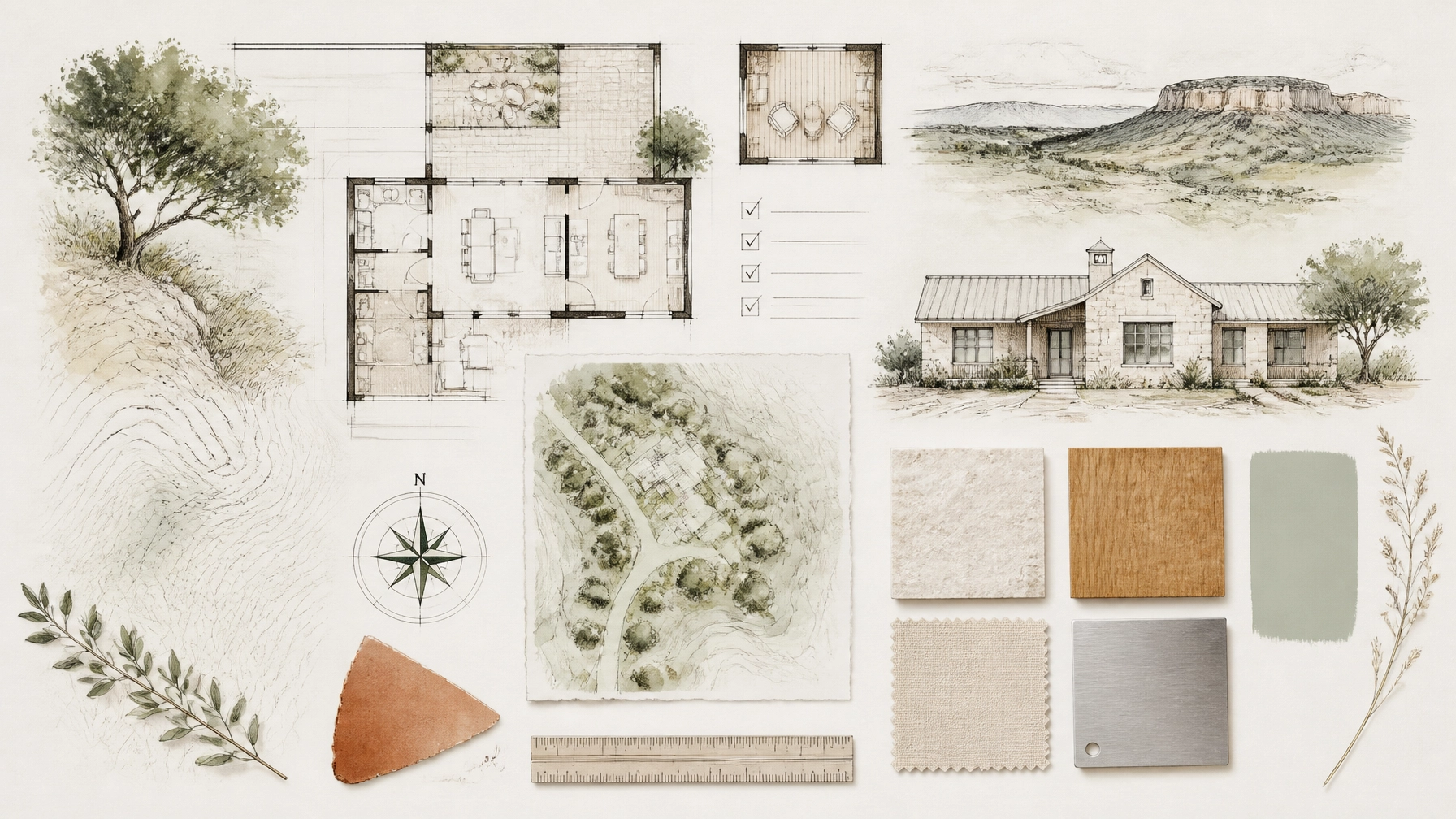
Buying a luxury home in the Texas Hill Country is rarely just a question of square footage, finishes, or the beauty of the view. For retirees and pre-retirees, the better question is:
How well will this property support the life you want to live five, ten, or fifteen years from now?
A dramatic homesite may be memorable at first showing. But privacy, road access, utilities, maintenance, guest space, and everyday convenience will shape your experience long after the novelty of the purchase has faded.
This home brief is designed as a decision framework: not a generic luxury-home checklist. Before you fall in love with a property, prioritize these 10 features and evaluate how they work together.
1. Privacy That Feels Peaceful, Not Isolated
Privacy is one of the great attractions of Hill Country living. Large lots, mature oak trees, limestone outcroppings, and thoughtful landscaping can create a sense of retreat without requiring total separation from the surrounding community.
Look beyond the distance between the home and its nearest neighbor. Consider:
- Whether the primary living spaces face neighboring homes or natural views
- The placement of driveways and guest parking
- Visibility from roads, gates, and elevated properties
- The density of cedar and other vegetation near the home
- Whether future construction could change the sightlines
The ideal property offers privacy while preserving access to neighbors, services, cultural events, restaurants, and outdoor recreation. A home that feels secluded but requires a difficult drive for every errand may not support the lifestyle you envision.
2. Access to Town, Healthcare, and Daily Essentials
A quiet homesite can be wonderful: until you need groceries, a specialist appointment, pharmacy access, or a reliable place to meet friends for lunch.
When comparing properties, map the real drive times to the places you expect to use regularly:
- Medical offices and hospitals
- Grocery stores and farmers markets
- Restaurants and coffee shops
- Golf, fitness, and recreation
- Airports and visiting family
- Arts venues, wineries, and community events
Texas Hill Country Retirement maintains resources on Hill Country healthcare access and active lifestyle opportunities that can help you think beyond the property itself.
The goal is not necessarily to live in the center of town. It is to choose a location where your preferred daily routines remain easy and enjoyable.

3. A Manageable Maintenance Profile
Luxury does not have to mean high maintenance. In retirement, a well-designed home should give you more time for travel, family, golf, wine country excursions, and community life: not create a second career managing the property.
During due diligence, ask:
- How much acreage requires regular mowing or trimming?
- Are there steep slopes that complicate landscaping?
- How often do gates, wells, pools, irrigation, and generators require service?
- Are the roof, exterior materials, and drainage systems approaching major repair cycles?
- Is there an established vendor network nearby?
Native landscaping, durable exterior materials, shaded outdoor areas, and automated systems can reduce the amount of hands-on upkeep. However, automation does not eliminate maintenance; it changes the type of maintenance required.
Request service records where available and build a realistic annual maintenance estimate before making an offer.
4. Reliable Water and Wastewater Systems
Utilities deserve the same attention as the kitchen and primary suite: particularly when a property is outside municipal service areas.
First, identify whether the home uses:
- Municipal water
- A private well
- A shared well
- Rainwater collection
- Septic or another on-site sewage facility
For a private well, review the available Texas Water Well Report resources, arrange an inspection by a qualified well professional, and obtain an independent water-quality test. Texas Well Owner Network guidance recommends regular testing for items such as nitrate, dissolved solids, and bacteria through an appropriately certified laboratory.
If the property uses septic, ask for the permit, site evaluation, system type, installation date, maintenance history, and current inspection results. TCEQ’s On-Site Sewage Facilities program provides the statewide regulatory framework, while local counties may handle permitting and inspections.
For buyers who enjoy entertaining, also confirm that water flow, storage, and wastewater capacity are appropriate for the home’s bedroom count and expected guest use.
5. Utility Resilience for Comfortable Living
A retirement home should function gracefully during the occasional outage, severe storm, or service interruption.
Review the property’s:
- Electric provider and outage history
- Generator or backup-power system
- Propane tank ownership and delivery arrangement
- Internet service and measured speeds
- Cellular coverage
- Water storage and pump backup
- Trash and recycling service
Do not rely solely on a listing description. Ask the current owners which providers they use and how the systems perform in real conditions.
If remote work, telehealth, video calls with family, or online financial management remain part of your routine, connectivity is a lifestyle feature: not a minor technical detail.
6. A Floor Plan That Works Beyond Today
A home can be beautiful and still become inconvenient if its layout depends on stairs, narrow passageways, distant laundry facilities, or a primary suite separated from the home’s everyday living areas.
Prioritize adaptable design elements such as:
- A main-level primary suite
- Wide, simple circulation paths
- Minimal thresholds
- A convenient laundry room
- Well-placed lighting and storage
- A flexible office, hobby room, or guest suite
- Space for occasional or future assistance without making the home feel institutional
Think in terms of options. The best floor plan may serve as a quiet retreat for two today, a gathering place for family next year, and a more accessible home later.
7. Entertaining Space That Matches Your Real Habits
Outdoor living is central to the Hill Country lifestyle, but not every covered patio is equally useful.
Evaluate whether the entertaining areas provide:
- Shade during the hottest parts of the day
- Comfortable access from the kitchen and main living spaces
- Protection from wind and weather
- Convenient outdoor storage
- Adequate lighting
- A logical path to the pool, garden, or fire feature
- Enough seating for the gatherings you actually host
A smaller, well-oriented courtyard may be more enjoyable than an oversized terrace exposed to afternoon sun. Walk the property at different times of day if possible. Notice where the shade falls, how the wind moves, and whether the outdoor spaces feel connected to the home.
8. Fire, Flood, and Terrain Awareness
The Hill Country’s beauty is shaped by the same terrain that can create ownership considerations. Before buying, evaluate slopes, drainage, creek beds, low-water crossings, and vegetation near structures.
For flood information, use FEMA’s Flood Map Service Center, which FEMA identifies as the official public source for its flood hazard maps. Also speak with the local floodplain administrator about drainage patterns, elevation requirements, and known problem areas.
For wildfire exposure, review the property through the Texas Wildfire Risk Assessment Portal. Texas guidance commonly uses home-ignition zones, including a noncombustible area immediately around the structure and progressively managed vegetation farther from the home. The practical principle is often summarized as “lean, clean, and green.”
A property does not need to be stripped of its natural character. It should, however, offer a realistic plan for maintaining defensible space and allowing emergency access.

9. Access Roads and Easements You Can Understand
A private road, gated entrance, steep driveway, or low-water crossing can change the ownership experience significantly.
Confirm:
- Whether the road is public or privately maintained
- Who pays for grading, drainage, and repairs
- Whether legal access is documented in the title records
- How emergency vehicles reach the property
- Whether gates have reliable power and backup access
- How the road performs after heavy rain
- Whether there are bridge or roadway weight limits
Ask for road-maintenance agreements, easements, and any homeowners’ association or property owners’ association documents. A visually impressive entrance is not a substitute for clear access rights and a practical maintenance arrangement.
10. Flexibility for Resale and Changing Household Needs
Even if you expect to remain in the home indefinitely, flexibility is valuable. Circumstances change. Adult children may visit more often, family members may need temporary accommodations, or you may eventually prefer a smaller footprint.
Look for features that broaden the property’s future usefulness:
- A private guest suite
- A flexible room with a nearby bathroom
- A separate office or studio
- A layout that can accommodate multigenerational visits
- Reasonable proximity to services
- Manageable acreage
- Improvements that are attractive without being overly personalized
Also consider the likely future buyer. A home with a distinctive design can be rewarding, but highly specialized improvements may narrow the resale audience. Strong proportions, quality materials, practical storage, and a flexible floor plan generally provide more enduring appeal than features designed around one particular hobby.

Turn the Brief Into a Property Scorecard
Before touring homes, rank these 10 features as essential, preferred, or optional. Then score each property consistently.
For example:
| Feature | Essential | Preferred | Optional |
|---|---|---|---|
| Privacy | |||
| Daily access | |||
| Maintenance profile | |||
| Water and wastewater | |||
| Utility resilience | |||
| Flexible floor plan | |||
| Entertaining space | |||
| Fire, flood, and terrain awareness | |||
| Road and access clarity | |||
| Future flexibility |
This approach helps separate emotional appeal from long-term fit. A home can still have charm, character, and a spectacular view: but the decision becomes grounded in how it will support your everyday life.
Housing is also one part of a broader retirement transition. If you are considering how a Hill Country purchase may interact with your long-term income needs, investment portfolio, liquidity, and overall lifestyle priorities, you can learn more about Portafolio Capital Management dba Mau Sanchez Capital or review the fiduciary questions worth asking. If tax topics arise in connection with a home purchase, sale, ownership structure, or relocation, readers should consult a qualified tax professional for guidance based on their individual circumstances. This article is intended for general educational purposes only.
The right Hill Country home should feel beautiful when you arrive: but dependable when you live there.
Prioritize the features that protect your time, preserve your options, simplify daily routines, and make it easier to enjoy the people and experiences that brought you to the Hill Country in the first place.
Schedule a private meeting with a fiduciary financial advisor today by calling (512) 593-8380 or by visiting: https://calendly.com/portafoliocapital/15min
Portafolio Capital Management dba Mau Sanchez Capital is a Registered Investment Adviser. This content is for informational purposes only and does not constitute investment advice or a solicitation to buy or sell any security. Advisory services are provided only pursuant to a written advisory agreement.
This article may include stories, scenarios, and perspectives created or assisted by artificial intelligence. Although the individuals and circumstances described may be fictional, the topics are intended to reflect real financial, personal, and lifestyle issues that retirees and individuals commonly face.
The content is provided to encourage readers to consider different perspectives that may affect their retirement, regardless of whether they are currently planning, approaching retirement, or already retired. It is intended for general educational and informational purposes only and should not be interpreted as personalized investment, financial, tax, legal, medical, or retirement-planning advice.
Individual circumstances vary. Readers should independently verify any information presented and consult appropriately qualified professionals before making financial or personal decisions. No advisory, professional, or client relationship is created through the use of this website.
Leave a Reply