
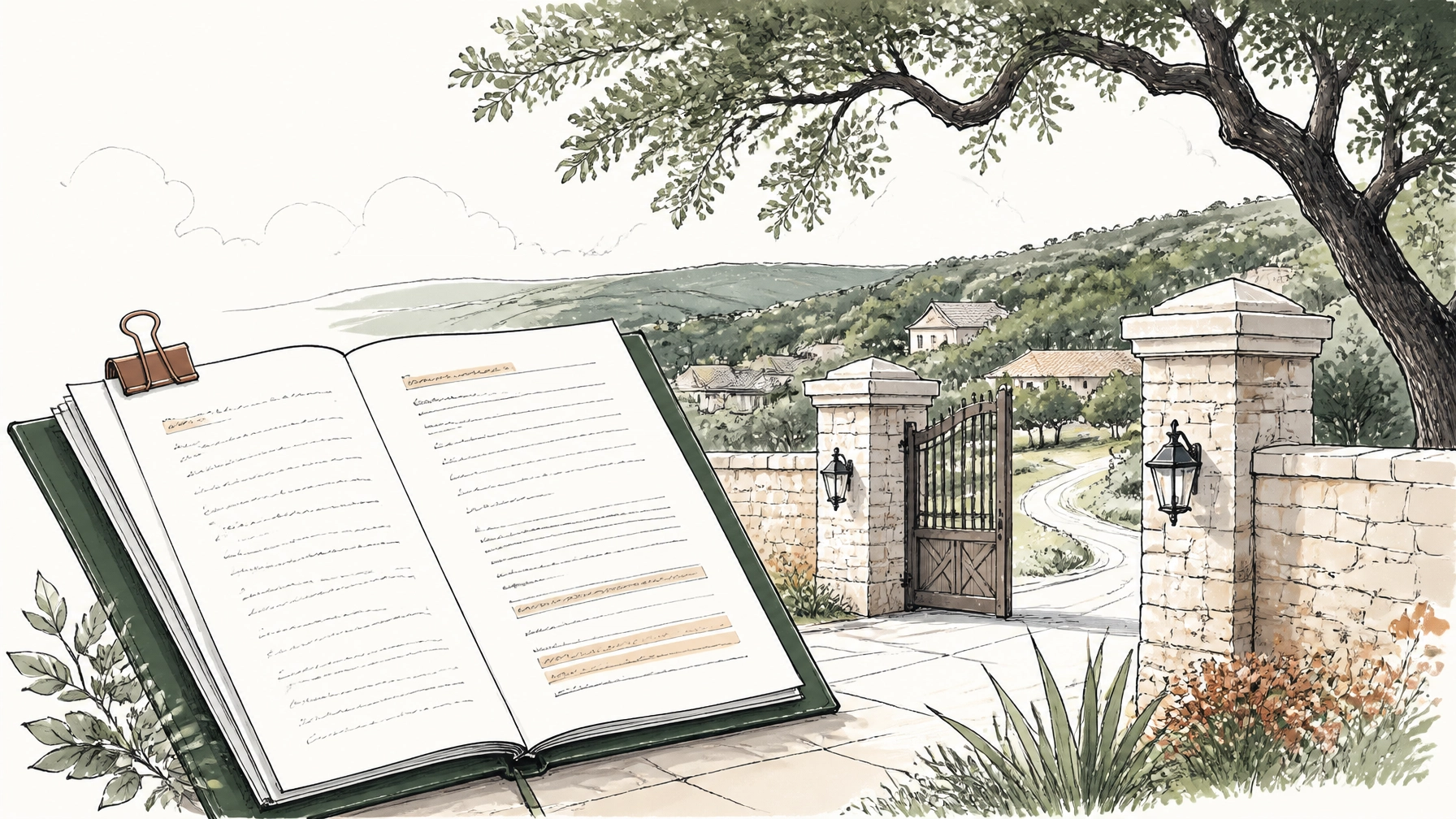
A thoughtfully managed community can make retirement in the Texas Hill Country more convenient, social, and enjoyable. Shared landscaping, maintained roads, inviting amenities, and consistent architectural standards may help preserve the character that attracted you in the first place.
But community living also means accepting rules that can affect how you use, improve, rent, maintain, and eventually sell your property.
Before purchasing a luxury home, ranch-style retreat, or retirement-friendly residence, read more than the marketing materials. Request the governing documents and study the sections that could influence your daily lifestyle and long-term flexibility.
Texas property owners’ associations are generally governed by recorded covenants, bylaws, rules, and related documents. The Texas State Law Library’s guide to property owners’ associations explains where these rules come from and how buyers can locate association information.
Here are nine areas worth reading closely.
1. Architectural controls and design approvals
Many Hill Country communities protect their visual character through an architectural review committee or architectural control committee. These controls may apply to far more than building a new home.
Look for approval requirements covering:
- Exterior paint colors and finishes
- Roofing materials
- Fences, gates, and walls
- Pools, spas, and outdoor kitchens
- Guest houses and detached structures
- Solar panels and standby generators
- Windows, doors, and exterior lighting
- Major landscaping changes
- Additions, renovations, and screened porches
A rule that sounds simple: such as “all exterior changes require approval”: can affect your timeline and budget. Ask how applications are submitted, whether there is a fee, how long decisions typically take, and what happens if the committee does not respond.
For associations with more than 40 lots, Texas law provides specific procedures for certain architectural review denials. Under Texas Property Code Section 209.00505, an owner may have a right to request a hearing before the board after receiving a written denial.
The practical question is not simply, “Can I make this improvement?” It is, “How much design freedom may a buyer have after purchasing the property?”

2. Rentals and short-term stays
Even if you do not plan to rent your home today, circumstances can change. You may spend part of the year elsewhere, help a family member, or want the option to lease the property before selling.
Read the rental provisions carefully. Important questions include:
- Are leases allowed?
- Is there a minimum lease term?
- Are short-term rentals prohibited?
- Is there a cap on the number of rental homes?
- Must owners register tenants with the association?
- Are lease addenda required?
- Do renters have access to amenities?
- Are owners responsible for tenant violations?
Texas Property Code Section 209.016 allows associations to establish restrictions related to occupancy and leasing, while limiting certain types of tenant approval and information requirements. The current statute may be helpful to review for general education, and readers should consult a qualified attorney for guidance on their specific situation if rental flexibility is an important consideration.
Do not rely on a sales representative’s verbal statement that “rentals are usually fine.” Ask for the current rule in writing, including any amendments or separate policies.
3. Landscaping and water-conscious design
Texas Hill Country landscaping can be beautiful, but it also requires thoughtful planning around heat, drought, rocky soil, irrigation, and seasonal conditions.
Community rules may address:
- Permitted turf and plant varieties
- Tree removal or trimming
- Irrigation systems
- Native and drought-resistant landscaping
- Rock, gravel, and decomposed granite
- Rain barrels and water-harvesting systems
- Landscape lighting
- Garden structures and composting
- Maintenance standards during periods of travel
Texas law protects certain water-conservation choices. For example, Texas Property Code Section 202.007 addresses drought-resistant landscaping, efficient irrigation, rainwater systems, and composting measures.
That does not mean every design choice is automatically permitted. Associations may still regulate placement, appearance, visibility, materials, and maintenance. Ask whether the community has a preferred plant palette and whether its standards are realistic for the property’s exposure and terrain.
A low-water landscape may be a lifestyle advantage: but only if the rules allow you to maintain it economically.
4. Guests, occupancy, and everyday use
Rules about guests may be hidden inside sections labeled “occupancy,” “residential use,” or “nuisance.” They can affect how you host family and friends, especially if your Hill Country home is intended to be a gathering place.
Review provisions addressing:
- Maximum occupancy
- Extended guests
- Caregivers or live-in assistance
- Guest parking
- Home-based businesses
- Events and private gatherings
- Noise and quiet hours
- Use of pools, trails, and clubhouses
- Moving trucks, contractors, and service providers
A community may welcome visitors while still limiting overnight parking, large gatherings, or use of common facilities by unaccompanied guests.
For retirees who expect frequent visits from children, grandchildren, or friends, confirm that the rules fit the way you actually plan to live: not just the way the home appears during a tour.
5. Assessments and special assessments
Monthly or annual dues are only the beginning. The governing documents and financial records should explain how assessments are calculated, when they may increase, and what projects may trigger additional charges.
Pay attention to:
- Regular assessment amounts
- Assessment increase procedures
- Reserve funding
- Special assessment authority
- Road and drainage projects
- Amenity renovations
- Insurance deductibles
- Late fees and collection costs
- Transfer and resale fees
A community with extensive amenities may offer a wonderful lifestyle, but it also has more infrastructure to maintain. A pool, fitness center, trail network, gate system, or clubhouse can create meaningful value while requiring substantial ongoing funding.
Ask for recent budgets, reserve information, meeting minutes, and notices of planned projects. The Texas State Law Library’s HOA buying guide explains that buyers may request governing documents and a resale certificate summarizing important financial information and amounts owed on the property. Questions about the tax treatment of property-related costs should be discussed with a qualified tax professional.

6. Roads, gates, easements, and maintenance responsibilities
A winding Hill Country road may be part of the charm: but determine who maintains it before you buy.
Find out whether roads are:
- Publicly maintained
- Privately maintained by the association
- Shared through an easement
- Maintained through a separate road association
- Subject to future dedication or repair plans
Also ask about drainage, culverts, bridges, streetlights, signage, gates, snow or ice procedures, and emergency access. In rural areas, private roads can require more attention after severe storms, flooding, construction traffic, or erosion.
Your title commitment, survey, declaration, and community maintenance agreements may each contain part of the answer. A real estate attorney or title professional can help explain how easements and maintenance obligations apply in a particular transaction.
7. Amenities and access rules
A clubhouse, trail system, pool, lake, fitness room, or event lawn can be a significant part of a Hill Country retirement lifestyle. But amenities are only valuable if you understand how they may be used.
Check:
- Who owns each amenity
- Whether use is included in regular dues
- Whether separate memberships are required
- Guest limitations
- Reservation procedures
- Seasonal hours
- Age restrictions
- Food, beverage, and event policies
- Future construction plans
- Whether amenities may be leased or closed
If outdoor recreation is important to your plans, you may also enjoy Texas Hill Country Retirement’s guide to pickleball, golf, and tennis clubs in the Hill Country.
Do not confuse an amenity shown in a brochure with an amenity guaranteed by your deed or association documents. Confirm exactly what you are buying into.
8. Pets, animals, and outdoor structures
Pet restrictions can be especially important in a community marketed around open space and outdoor living. Rules may cover the number, size, or type of animals allowed, as well as leashes, fencing, barking, and nuisance behavior.
If you are considering a larger property, also ask whether the community permits:
- Chickens or small livestock
- Horses
- Dog runs
- Kennels
- Invisible fencing
- Outdoor pet enclosures
- Wildlife feeding
- Beehives
- Agricultural or ranch uses
A dog-friendly community may still prohibit certain fencing designs or require architectural approval for an enclosure. Likewise, acreage does not necessarily mean the property can be used as a small ranch.
Read the rules with your current pets: and your likely future lifestyle: in mind.

9. Enforcement, resale, and the resale certificate
Finally, understand what happens when rules are violated and how the community’s policies may affect a future sale.
Ask for:
- The current enforcement policy
- Fine schedules
- Cure periods
- Hearing and appeal procedures
- Pending violations on the property
- Outstanding assessments
- Architectural violations
- Transfer fees
- Required resale disclosures
Texas law does not automatically give every association the power to impose fines. That authority generally must come from the governing documents. If fines are authorized, Texas Property Code Section 209.0061 requires an enforcement policy addressing categories of violations, fine schedules, and hearing information.
The State Law Library summarizes the issue plainly: “Most regulations are at the discretion of the POA.” Read the documents rather than assuming a rule is informal or unenforceable.
For resale, a violation that seems minor to you may become a negotiation issue for a future buyer. An unapproved fence, unresolved landscape notice, or rental restriction can delay a transaction or require correction before closing.
A practical pre-purchase document checklist
Before making an offer: or during your due diligence period: request:
- Declaration and restrictive covenants
- Bylaws
- Current rules and regulations
- Architectural guidelines
- Rental and occupancy policies
- Pet and landscaping rules
- Budget and reserve information
- Recent board meeting minutes
- Resale certificate
- Notices of violations, assessments, or planned projects
As the Texas State Law Library notes, restrictive covenants are typically filed in the county real property records, and a property owners’ association must file its dedicatory instruments for them to have effect under Texas Property Code Section 202.006.
The goal is not to find a community without rules. The goal is to find rules that support the way you want to live.
For affluent retirees, the right Hill Country community should provide comfort, beauty, and connection without creating surprises that interfere with long-term plans. Reviewing the fine print early can help readers make a more confident lifestyle decision and better understand how a property’s ongoing costs may fit within broader financial planning conversations. This article is intended for general educational purposes only. Readers with questions about tax treatment, filing, or their individual tax position should consult a qualified tax professional.
Schedule a private meeting with a fiduciary financial advisor today by calling (512) 593-8380 or by visiting: https://calendly.com/portafoliocapital/15min
Portafolio Capital Management dba Mau Sanchez Capital is a Registered Investment Adviser. This content is for informational purposes only and does not constitute investment advice or a solicitation to buy or sell any security. Advisory services are provided only pursuant to a written advisory agreement.
This article may include stories, scenarios, and perspectives created or assisted by artificial intelligence. Although the individuals and circumstances described may be fictional, the topics are intended to reflect real financial, personal, and lifestyle issues that retirees and individuals commonly face.
The content is provided to encourage readers to consider different perspectives that may affect their retirement, regardless of whether they are currently planning, approaching retirement, or already retired. It is intended for general educational and informational purposes only and should not be interpreted as personalized investment, financial, tax, legal, medical, or retirement-planning advice.
Individual circumstances vary. Readers should independently verify any information presented and consult appropriately qualified professionals before making financial or personal decisions. No advisory, professional, or client relationship is created through the use of this website.
Leave a Reply