
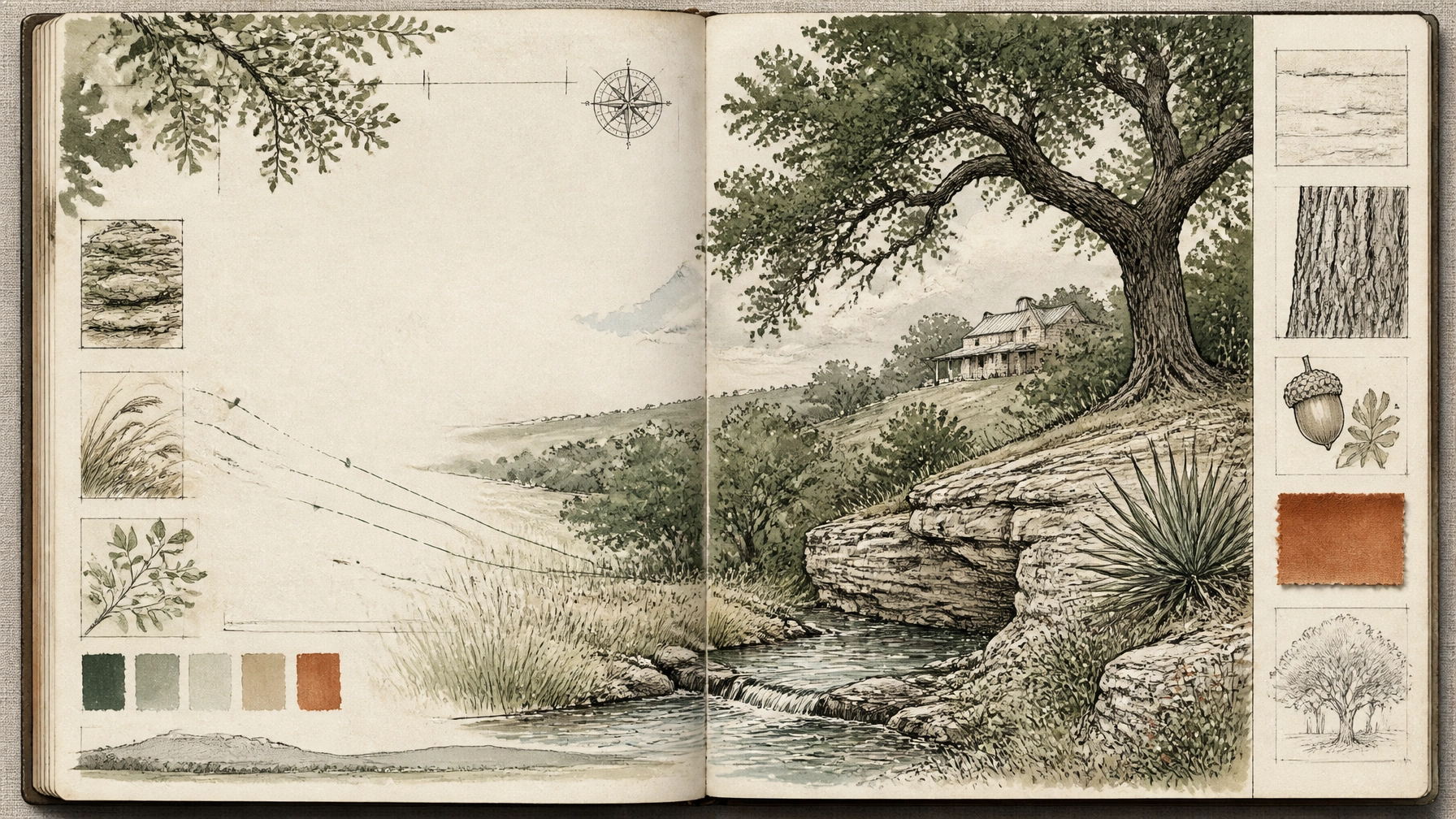
A luxury Hill Country home should look beautiful in photographs. But photographs cannot tell you how the property feels at 7:30 on a summer morning, how water travels after a hard rain, or whether the outdoor living spaces are comfortable when the wind changes.
For retirees and pre-retirees evaluating a home in the Texas Hill Country, the senses offer another way to read the land. Wind, water, limestone, tree canopy, light, and seasonal change reveal qualities that may not appear in a listing description.
This is not a substitute for a professional inspection, survey, engineering review, or other due diligence. It is a field-journal approach to deciding whether a property feels right: and what questions deserve closer attention.
“It is a land of many springs, stony hills, and steep canyons.” : Texas Parks and Wildlife Department
Begin With a Quiet Arrival
Before touring the rooms, pause at the edge of the property.
Turn off the car. Put away the listing brochure. Give yourself several minutes to notice what is present without trying to interpret it too quickly.
Can you hear a road, an air-conditioning unit, a nearby pool pump, or activity from neighboring properties? Is the arrival court calm, or does sound collect near the driveway? Does the approach feel welcoming for guests, service providers, and future mobility needs?
For an affluent retirement buyer, this first impression is about more than romance. It helps you understand how the property may support ordinary routines: morning coffee, evening conversation, visiting grandchildren, or a quiet afternoon outdoors.
Make a simple note in your field journal:
- What do I hear?
- What do I feel on my skin?
- Where does my attention naturally settle?
- Which outdoor areas invite me to stay?
- Which spaces feel exposed, damp, hot, or difficult to reach?
The goal is not to find a perfect property. It is to understand the property’s personality.
Read Water as Movement, Not Just a Feature
A creek, pond, spring, or water view can add beauty and recreational value. But water should also be evaluated as a moving system.
The Texas Hill Country sits across rolling terrain shaped by limestone, springs, canyons, and aquifer systems. Texas Parks and Wildlife Department describes the region as part of the Edwards Plateau, with many springs and underground water pathways through limestone.

When visiting a property, ask where water goes during three different conditions:
During a storm
Look for natural channels, swales, gravel deposits, exposed roots, and debris caught in vegetation. These clues can show where water concentrates and how forcefully it may move.
Listen for the difference between:
- A gentle drip from a roof edge
- Water moving through a shallow drainage path
- Rushing water cutting across a slope
- Water pooling near a patio, retaining wall, driveway, or foundation
A property that feels peaceful in dry weather may behave very differently after a significant rain. If possible, revisit after a storm or ask for information about drainage, flood exposure, culverts, and past water events.
During a dry period
Notice what remains green and what becomes stressed. A dense band of vegetation may follow a shallow drainage line or a naturally moister area. Exposed rock and thin grass may indicate shallow soil and limited water-holding capacity.
Neither condition is automatically a problem. It simply tells you where the land is naturally generous and where it may require more thoughtful maintenance.
Around the home
Walk the perimeter of the house slowly. Look for soil pulled away from hardscape, cracks in patios or walkways, erosion near downspouts, and grading that appears to direct water toward the structure.
These observations do not diagnose a foundation or drainage issue. They do help you create a more useful list of questions for an inspector, engineer, builder, or landscape professional.
“Water has always attracted people, and the Hill Country is no exception.” : City of Wimberley Parks and Recreation
Let Wind Map Comfort
Wind is often treated as background atmosphere. At a Hill Country property, it can help you understand exposure, shade, privacy, and the usability of outdoor spaces.
Stand in several locations:
- On the highest point of the property
- Beneath the largest tree canopy
- On the main terrace or veranda
- Near the pool, outdoor kitchen, or fire feature
- Along walking paths and arrival areas

On a ridge, wind may feel refreshing and expansive. In a hollow or courtyard, it may become softer and more protected. Neither experience is universally better. The question is which one suits the way you expect to live.
Listen to how wind interacts with the property:
- Does it move gently through oak leaves?
- Does it whistle around architectural corners?
- Does it carry traffic or distant mechanical noise?
- Does it make a covered porch comfortable or uncomfortable?
- Are there sheltered areas for reading, dining, or conversation?
For retirees, outdoor comfort can make a major difference in how often a beautiful property is actually used. A large terrace that is too exposed may be less valuable in daily life than a smaller, well-protected courtyard.
Feel the Stone Beneath the Design
Limestone is one of the defining materials of the Hill Country, both geologically and architecturally. It appears in walls, terraces, retaining features, fireplaces, pathways, and natural outcrops.
But stone is not only a visual choice. It influences how a property feels underfoot, how heat is reflected, and how the land transitions from house to landscape.

Walk from the house toward the natural landscape and notice:
- Where does the ground become uneven?
- How quickly do you encounter exposed rock?
- Are pathways easy to navigate?
- Are retaining walls integrated gracefully into the terrain?
- Do stairs, slopes, or loose gravel create challenges?
- Is there enough level ground for future outdoor routines?
A rugged site may be ideal for someone who wants a private ranch atmosphere. Another buyer may prefer a more manageable setting with level paths, close parking, and minimal elevation changes.
This is where lifestyle goals matter. A property should support the retirement you imagine: not only the view you admire.
Because Hill Country geology can include fractured limestone and karst features, property-specific due diligence is important before purchasing or changing the land. The U.S. Geological Survey explains that karst aquifers can include fractures, sinkholes, caves, and springs that influence how groundwater moves.
Study the Canopy and the Light
Tree canopy creates one of the most valuable sensory experiences on a Hill Country property: changing light.
Observe the home at different times of day if possible. Morning light may enter a breakfast room or bedroom. Midday shade may determine whether a veranda is usable. Late-afternoon glare may affect a west-facing living room or patio.
Look for the relationship between:
- Existing oak and juniper canopy
- Windows and interior comfort
- Covered outdoor living areas
- Walkways between the home and amenities
- Seasonal changes in shade and privacy
Mature trees can give a property a settled, established character. They can also influence maintenance, access, storm planning, and future construction. Ask how the landscape has been managed and whether any trees require an arborist’s review.
For a retirement home, the best landscape is not necessarily the densest one. It is the one that gives you a comfortable balance of openness, shade, privacy, and connection to the surrounding land.
Visit in More Than One Season
A Hill Country property should be experienced as a year-round setting rather than a single perfect afternoon.

Ask how the property changes:
- Spring: Do wildflowers, new leaves, and wet-season growth make the grounds feel especially alive?
- Summer: Are there shaded paths and comfortable outdoor rooms, or does heat limit the property’s use?
- Autumn: Do grasses, leaves, and lower-angle light change the mood of the home?
- Winter: Does the landscape remain inviting when foliage is thinner and outdoor activity slows?
The Texas Hill Country has meaningful variation in rainfall, elevation, vegetation, and terrain. Texas Parks and Wildlife Department lists average rainfall across the region at approximately 15 to 34 inches per year and elevations ranging from roughly 500 to 2,250 feet.
That range helps explain why two properties only a short drive apart can feel remarkably different.
Turn Impressions Into Better Questions
After the sensory visit, convert observations into practical follow-up questions.
If you heard water, ask about drainage paths, flood maps, and maintenance history.
If you felt strong exposure, ask how outdoor spaces are used during windy weather.
If you found shallow soil and extensive rock, ask about landscaping, irrigation, septic considerations where applicable, and future construction limitations.
If the home’s best spaces depend on shade, ask how the property feels during the hottest months.
If accessibility matters, evaluate the distance between parking, bedrooms, living areas, gardens, and gathering spaces.
You can also review Texas Hill Country healthcare and community considerations through this guide to hospitals, specialists, and concierge medicine. For relocation logistics, the Texas residency checklist can help organize the broader move. If your relocation raises tax questions tied to residency, property ownership, or filing status, consult a qualified tax professional for individualized guidance.
Finally, consider how the home fits into your full retirement picture. Mau Sanchez Capital specializes in helping families think through retirement income, portfolio construction, and wealth management alongside major lifestyle decisions. You can learn more about Portafolio Capital Management dba Mau Sanchez Capital or call (512) 593-8380.
A Home Should Feel Right in Ordinary Moments
The most memorable Hill Country property may not be the one with the most dramatic architecture or the largest acreage. It may be the one whose natural rhythms fit your life.
A good home can make morning coffee feel unhurried, invite guests to linger, offer shade when the day is warm, and remain comfortable when the weather changes. It can connect you to stone, trees, water, and open land without making daily living unnecessarily complicated.
Look beyond the photograph. Listen carefully. Walk slowly. Feel the ground. Return at another hour, and if possible, another season.
The right property will reveal itself not only in what you see, but in how naturally you can imagine living there.
Schedule a private meeting with a fiduciary financial advisor today by calling (512) 593-8380 or by visiting: https://calendly.com/portafoliocapital/15min
Portafolio Capital Management dba Mau Sanchez Capital is a Registered Investment Adviser. This content is for informational purposes only and does not constitute investment advice or a solicitation to buy or sell any security. Advisory services are provided only pursuant to a written advisory agreement.
This article may include stories, scenarios, and perspectives created or assisted by artificial intelligence. Although the individuals and circumstances described may be fictional, the topics are intended to reflect real financial, personal, and lifestyle issues that retirees and individuals commonly face.
The content is provided to encourage readers to consider different perspectives that may affect their retirement, regardless of whether they are currently planning, approaching retirement, or already retired. It is intended for general educational and informational purposes only and should not be interpreted as personalized investment, financial, tax, legal, medical, or retirement-planning advice.
Individual circumstances vary. Readers should independently verify any information presented and consult appropriately qualified professionals before making financial or personal decisions. No advisory, professional, or client relationship is created through the use of this website.
Leave a Reply